
Loading, please wait...
_900x900.jpg "Greek Terracotta Figure of Eros, the God of Love")
_200x200.jpg "Greek Terracotta Figure of Eros, the God of Love")
.jpg "Greek Terracotta Figure of Eros, the God of Love")
LOT 0065
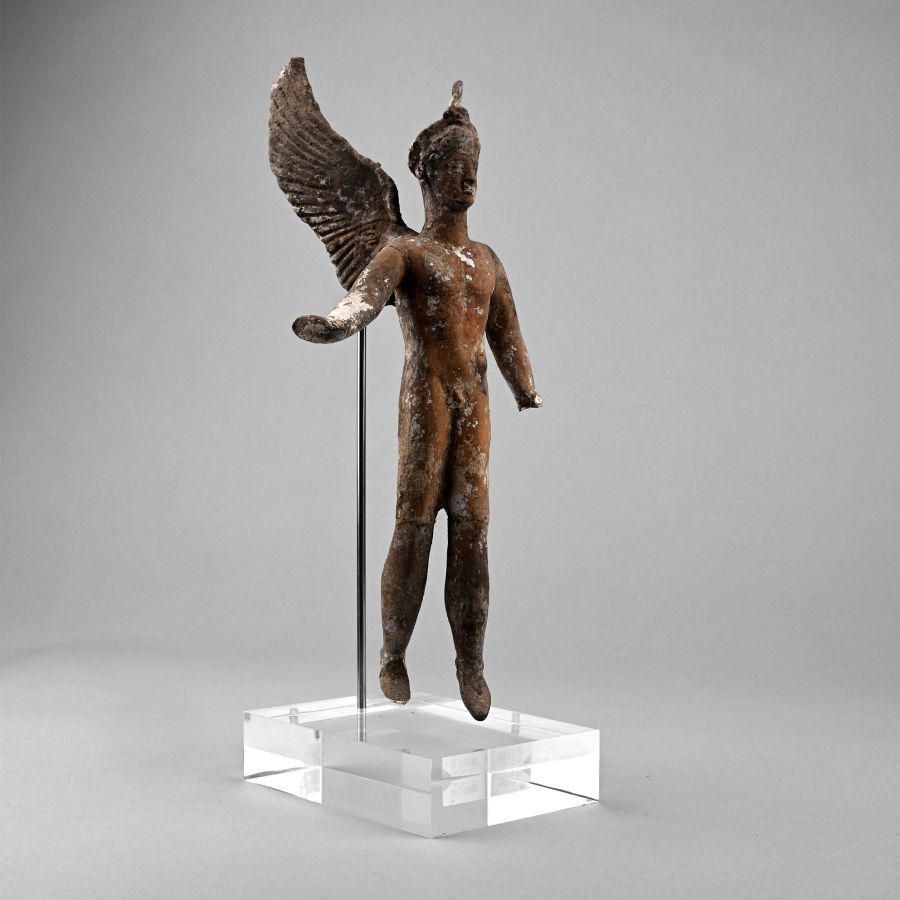
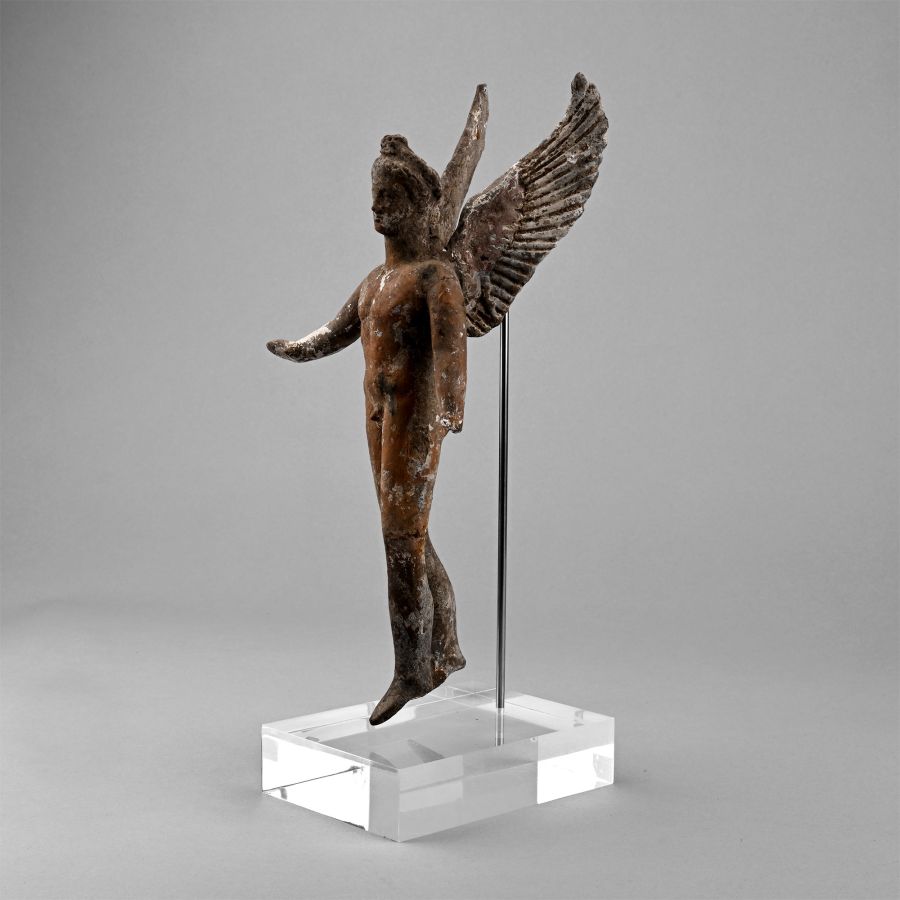
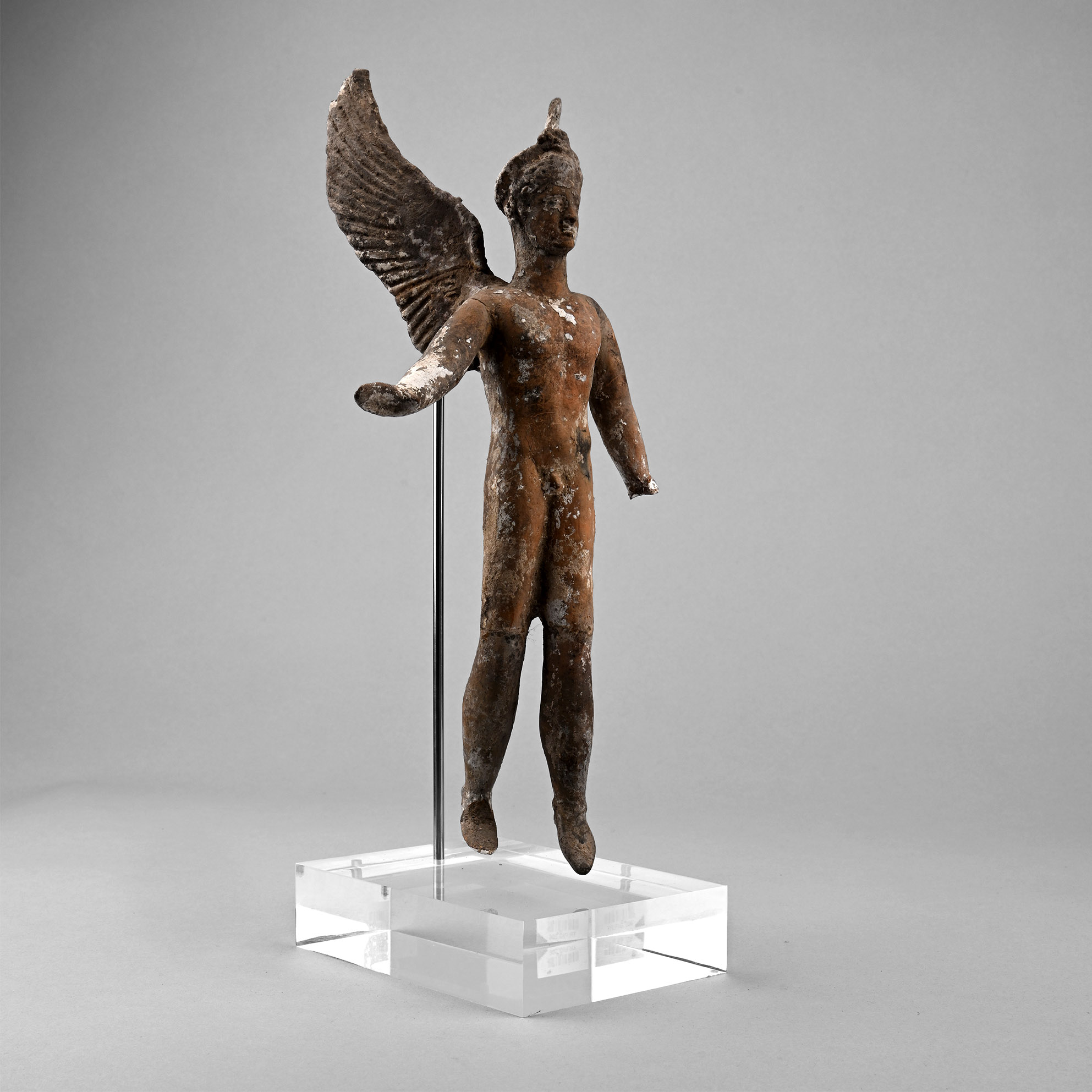
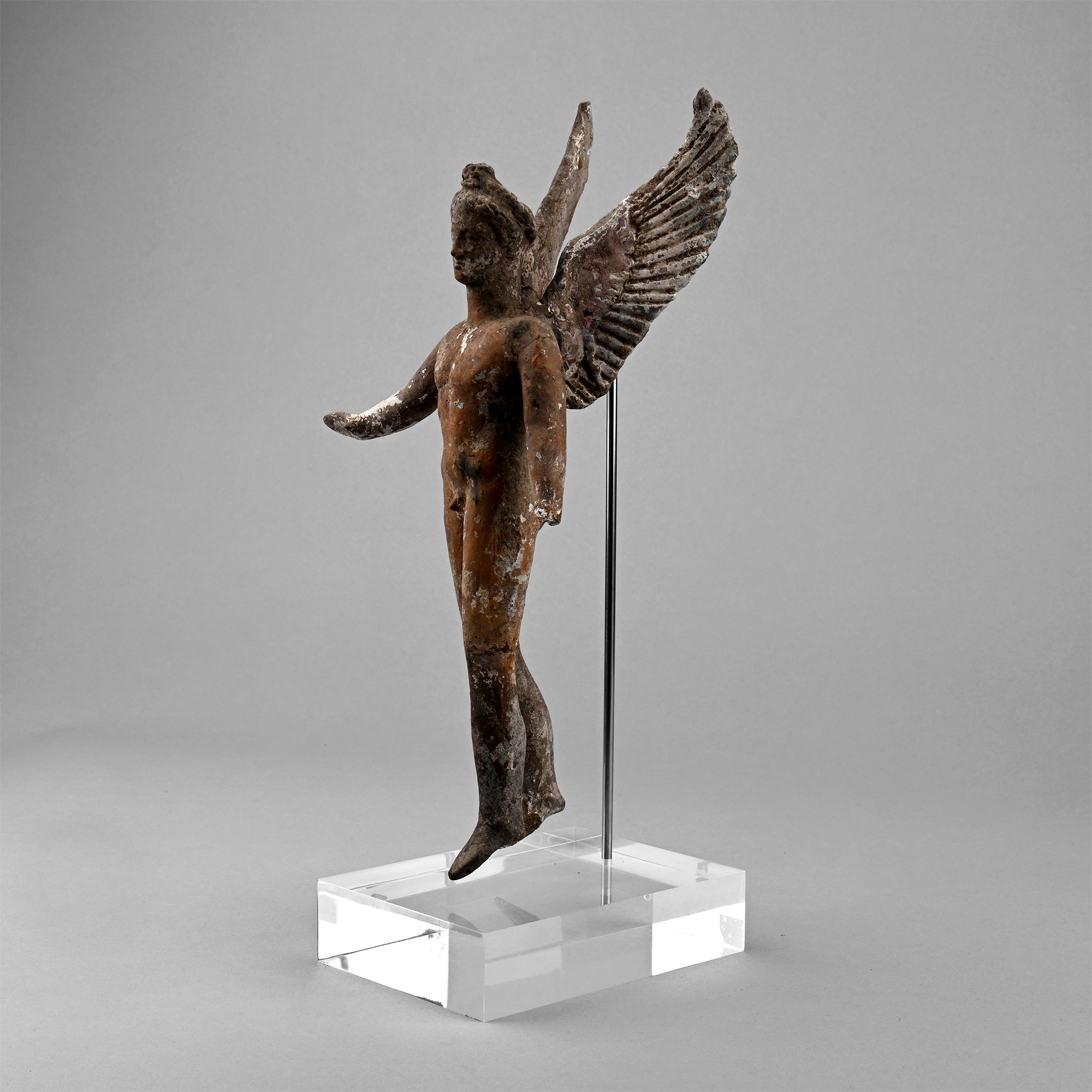
Greek Terracotta Figure of Eros, the God of Love
HELLENISTIC, 3RD-1ST CENTURY B.C.
12 1/4 in. (808 grams total, 31 cm including stand).
Modelled nude in a dynamic pose with his wings spread open, the left leg slightly advanced, and the right arm extended with open palm, a diadem or a fillet on his head; circular socket between the wings; accompanied by a display stand.
ProvenanceLouis-Gabriel Bellon (1819-1899) collection, France.
European private collection, 2009.
Accompanied by an academic report by Dr Raffaele D’Amato.
This lot has been checked against the Interpol Database of stolen works of art and is accompanied by search certificate number no. 13014-246790.
Cf. Mollard-Besques, S., Catalogue Raisonné des Figurines et Reliefs en Terre-Cuite Grecs et Romains. II: Myrina. 2 Bände Paris, 1963, pls.39-48, for similar terracotta flying erotes; cf. flying Eros with a mirror, in the Louvre Museum, accession no. Myr 95; a winged Eros with a diadem similar to our statuette, from Myrina, in Louvre, accession number Myr67; handmade statuette of winged dancing Eros with the same diadem in Mentesidou, E., The Terracotta figurines of Amisos, Thessaloniki, 2011, fig.60 (dancing winged Eros with similar diadem); for a general analysis of the Eros figure and character see Mattei, M. (ed.), La Favola di Amore e Psyche, Roma, 2012.
FootnotesIn classical times, Eros was usually depicted as a handsome adolescent, with only his wings distinguishing him from other kaloi and young athletes. Sometimes he was depicted younger and with less masculine features: Lysippos, in the famous statue of Eros of Thespiae, depicted him as a youth.
CONDITIONTimeLine Auctions follows a vetting process to ensure the authenticity and legality of all items, reinforcing our commitment to integrity and responsible trading. Each antiquity, antique, and coin lot undergoes thorough examination by a vetting committee of at least ten external specialists, professional trade association members, scientists, and archaeologists: Our Vetting Process
AUCTIONS:
TimeLine is a leading auction house specialising in antiquities, ancient art, collectables, natural history, coins, medals, and books. Our auctions offer museums, collectors, historians, and enthusiasts the opportunity to acquire unique and historically significant pieces.
LOT 0065
Greek Terracotta Figure of Eros, the God of Love
Estimate £8,000 - 10,000€9,280 - 11,600 (for guidance only)$10,800 - 13,500 (for guidance only)
-
.jpg)
Greek Carnelian Bead with Gold End Caps
Hellenistic, 1st century B.C.-1st century A.D.Sold for (Inc. bp): £780
Columnar bead with sheet-gold cap to each end, each with beaded circlets and applied granule clusters, domed end with loop; possibly assembled. 17.44 grams, 60 mm
Acquired in the mid 1980s-1990s. Private collection, Switzerland, thence by descent. Private collection, since the late 1990s.
The very elaborate versions of earrings with large domes and pendants composed of clusters of hollow spheres and granulation are most typically Romano-Syrian, but they begin to be produced in the Late Hellenistic Age. They were diffused in the Levant, Egypt and on the frontier area between the Roman and the Arsacid Empire. -
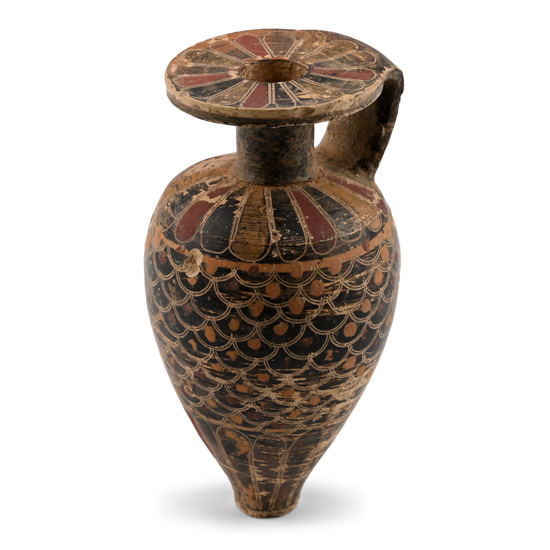
Proto-Corinthian Painted Terracotta Aryballos
7th century B.C.Sold for (Inc. bp): £2,080
Comprising a piriform body and a tubular neck with a wide rim, a strap handle to the rear, the rim with painted polychrome petals, the pattern repeating beneath the neck and on the base of the vessel; the body decorated with fishscale decoration. 79 grams, 10.5 cm
Swiss private collection, assembled in the 1960s and 1970s. Acquired by the present owner in 2004. Accompanied by an academic report by Dr Raffaele D’Amato. This lot has been checked against the Interpol Database of stolen works of art and is accompanied by search certificate number no.30017-246794.
The aryballoi were used to hold perfumed oil, an essential item for the wealthy middle classes of the time. Similar piriform vases are fairly common in Corinthian contexts. There is utmost precision in both the potting and the execution of the incised scale pattern of the present example. The fish-scale decoration was realised with the incision technique, by executing the scales neatly with their ends meeting. -
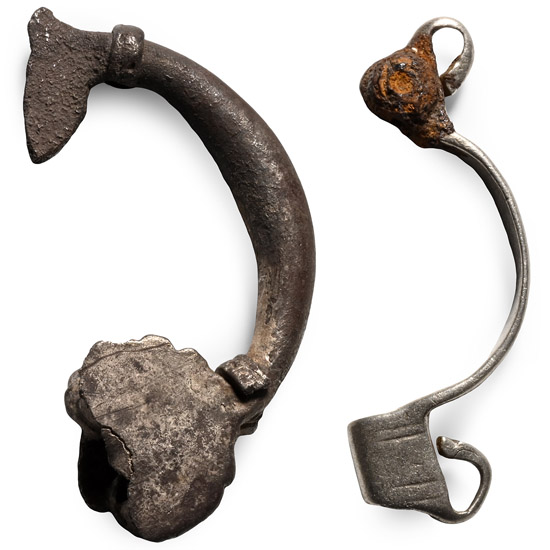
Greek Silver Bow Brooch Group
5th-3rd century B.C.Sold for (Inc. bp): £26
Comprising two bow brooches, one with recurved finials, both lacking a pin. 12.64 grams total, 40-43 mm
Ex German art market, 2000s. Acquired from an EU collector living in London. From the collection of a Surrey, UK, gentleman.
