
Loading, please wait...
LOT 0650
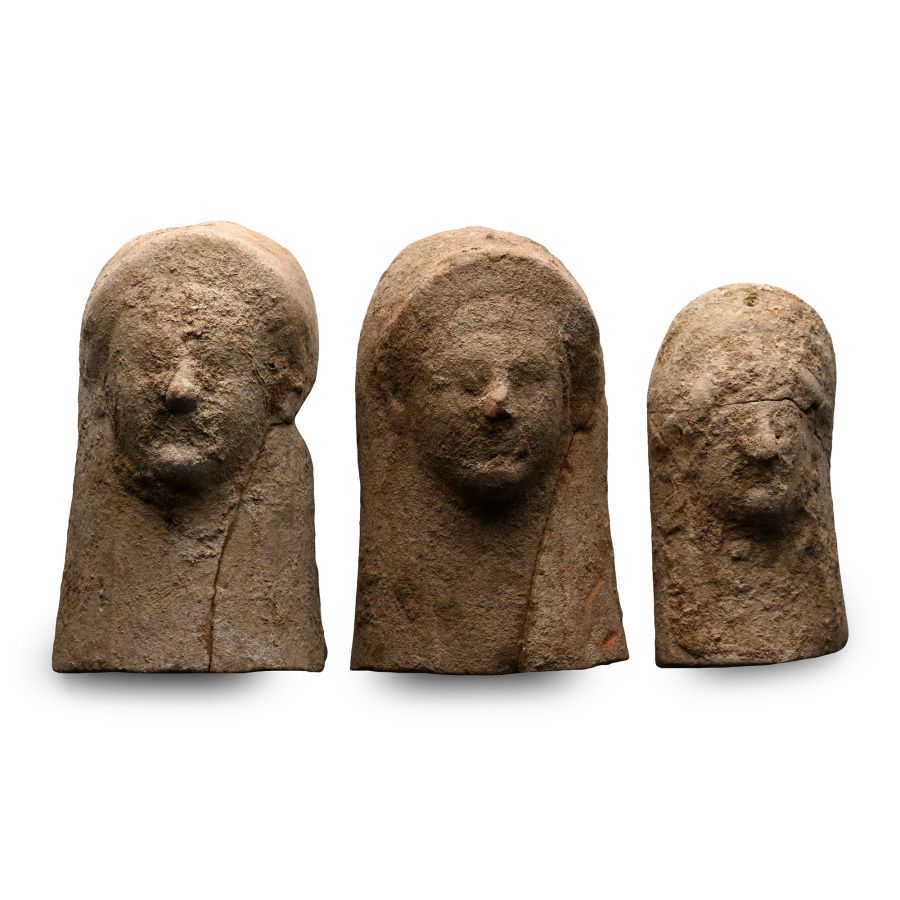
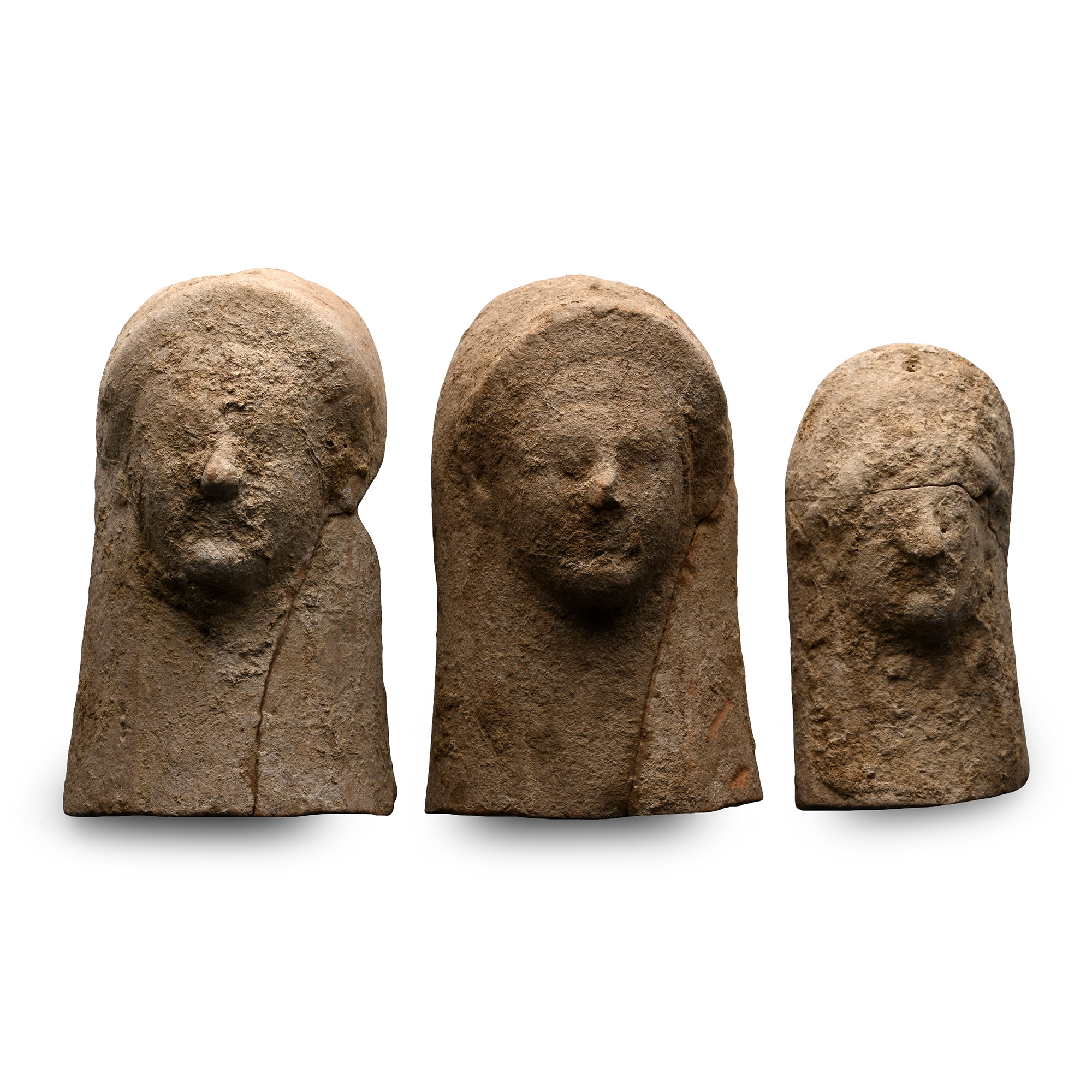
Greek Terracotta Female Protome Group
EARLY 5TH CENTURY B.C.
3 3/4 - 4 1/2 in. (350 grams total, 9.5-11.4 cm).
Each tongue-shaped in plan and hollow to the reverse, female bust in high-relief with palla head-covering. [3, No Reserve]
Provenancewith H.A.C., Basel, prior 1999.
This lot is accompanied by an illustrated lot declaration signed by the Head of the Antiquities Department, Dr Raffaele D'Amato.
Cf. Van Rooijen, G., Goddesses of Akragas, a study of terracotta votive figurines from Sicily, Leiden, 2021, no.163, for similar.
CONDITIONTimeLine Auctions follows a vetting process to ensure the authenticity and legality of all items, reinforcing our commitment to integrity and responsible trading. Each antiquity, antique, and coin lot undergoes thorough examination by a vetting committee of at least ten external specialists, professional trade association members, scientists, and archaeologists: Our Vetting Process
AUCTIONS:
TimeLine is a leading auction house specialising in antiquities, ancient art, collectables, natural history, coins, medals, and books. Our auctions offer museums, collectors, historians, and enthusiasts the opportunity to acquire unique and historically significant pieces.
-
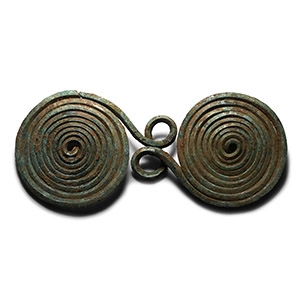
Large Greek Geometric Bronze Spiral Fibula
7th-6th century B.C.Estimate: £450 - 550 (‡+bp*)
Opening Bid: £225
Formed from a single square-section filament rolled into two 'spectacle' discs; one of the spirals terminating in a long pin, the other in a hook serving as the catchplate; openwork figure-of-eight at the centre; pin present broken, coils separated. 159 grams, 17 cm
Acquired in the mid 1980s-1990s. Private collection, Switzerland, thence by descent. Private collection, since the late 1990s. This lot is accompanied by an illustrated lot declaration signed by the Head of the Antiquities Department, Dr Raffaele D’Amato. -
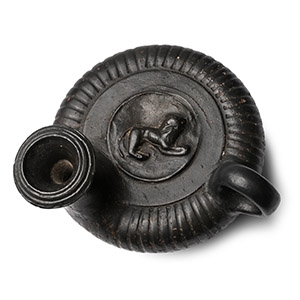
Greek Black-Glazed Guttos with Lion
South Italic, circa 4th century B.C.Sold for (Inc. bp): £286
High-angled spout and loop handle to the shoulder, the body decorated with vertical ribs around the perimeter, central image of a crouching lion in profile. 210 grams, 11.3 cm
From the private collection of a Canadian gentleman living in Essex, UK, formed since the 1920s-circa 1990. Property of an Essex lady until the late 1990s; thence by descent. From the private collection of an Essex gentleman since the late 1990s. This lot is accompanied by an illustrated lot declaration signed by the Head of the Antiquities Department, Dr Raffaele D'Amato. -
.jpg)
Greek Bronze Ring with Standing Hermes
4th-3rd century B.C.Sold for (Inc. bp): £1,690
Ellipsoid plaque with intaglio Hermes standing on a baseline with petasos, marsupium and caduceus; supplied with a museum-quality impression. 11.41 grams, 25.26 mm overall, 20.87 mm internal diameter (approximate size British P, USA 7 1/2, Europe 16.23, Japan 15)
European private collection, 1980s. Private collection, acquired on the German art market in 2001. This lot has been cleared against the Art Loss Register database, and is accompanied by an illustrated lot declaration signed by the Head of the Antiquities Department, Dr Raffaele D'Amato.
