Loading, please wait...

Use mousewheel to zoom in and out, click to enlarge

Details

LOT 0634

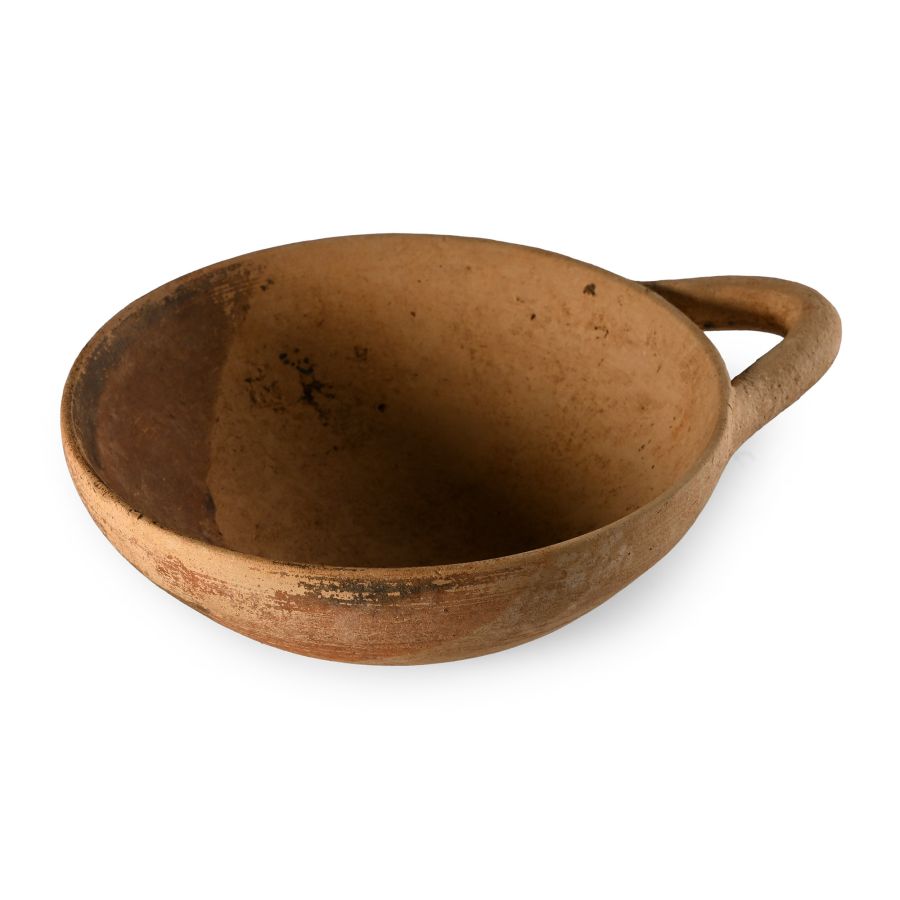
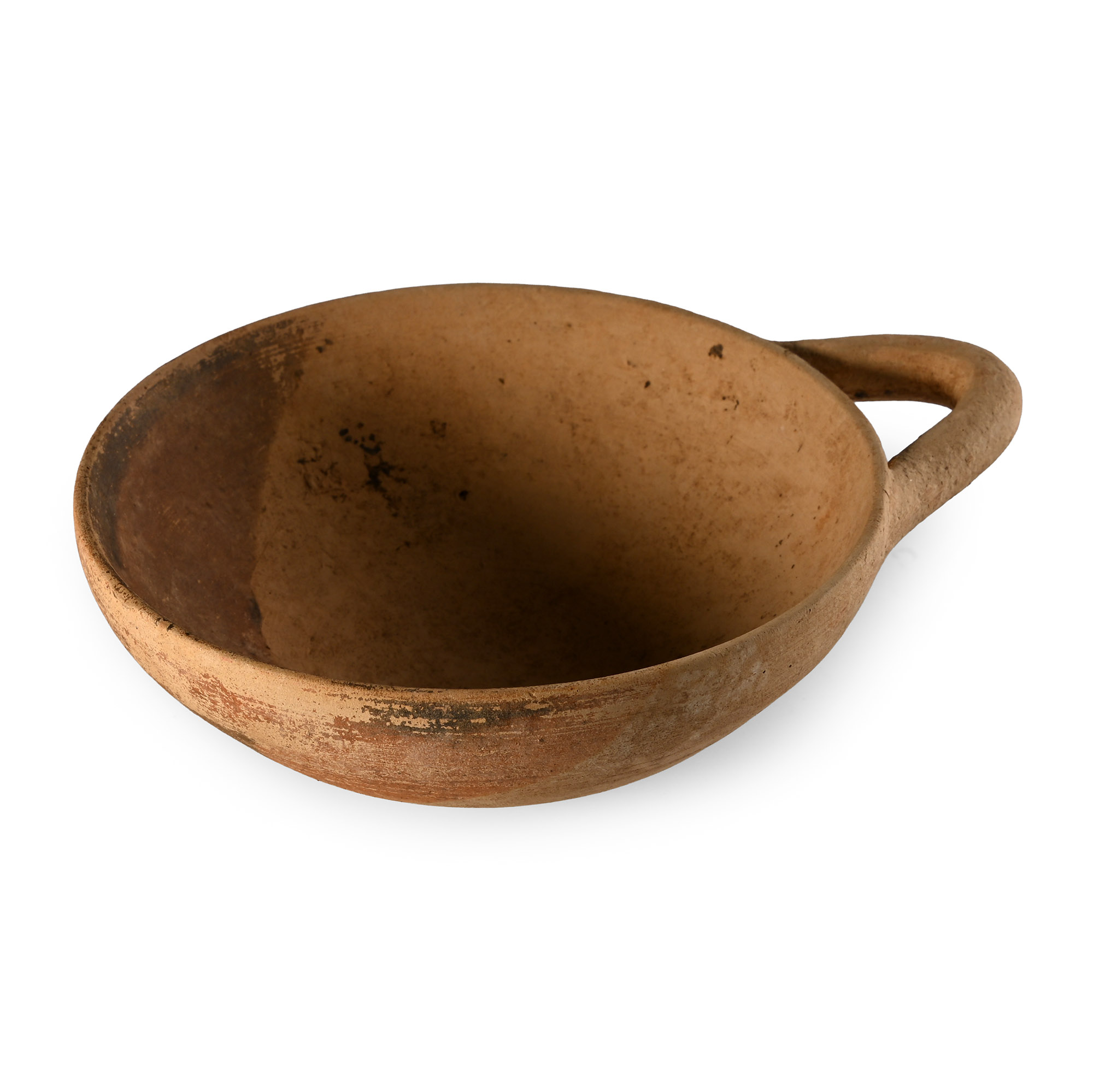
Greek Terracotta Dipper Cup

APULIAN, CIRCA 4TH CENTURY B.C.

5 1/8 in. (117 grams, 13.1 cm).

With a hemispherical body, narrow foot and a round-section loop handle. [No Reserve]

Provenance

Acquired on the UK art market during the late 20th century.
From the private collection of David King (1940-2024), Hoddesdon, Hertfordshire, UK.
This lot is accompanied by an illustrated lot declaration signed by the Head of the Antiquities Department, Dr Raffaele D'Amato.

CONDITION

VETTING:

TimeLine Auctions follows a vetting process to ensure the authenticity and legality of all items, reinforcing our commitment to integrity and responsible trading. Each antiquity, antique, and coin lot undergoes thorough examination by a vetting committee of at least ten external specialists, professional trade association members, scientists, and archaeologists: Our Vetting Process


AUCTIONS:

TimeLine is a leading auction house specialising in antiquities, ancient art, collectables, natural history, coins, medals, and books. Our auctions offer museums, collectors, historians, and enthusiasts the opportunity to acquire unique and historically significant pieces.

LOT 0634

Greek Terracotta Dipper Cup

Sold for (Inc. bp): £104

Print page

RELATED LOTS

  • Greek Black-Glazed Terracotta Bowl with Stamped Decoration
    Greek Black-Glazed Terracotta Bowl with Stamped Decoration
    Circa 330 B.C.

    Sold for (Inc. bp): £182

    Flat bowl on a ring-base, convex rim decorated with a flat-profiled tongue-leaf frieze and fine groove beneath. 183 grams, 12.2 cm


    with Galerie Gilgamesh, prior 2003. Accompanied by a copy of an Art Loss Register certificate no.S00035402. This lot is accompanied by an illustrated lot declaration signed by the Head of the Antiquities Department, Dr Raffaele D’Amato. This lot is accompanied by an illustrated lot declaration signed by the Head of the Antiquities Department, Dr Raffaele D'Amato.

    Lot Details

  • Greek Silver Rhyton with Mythological Scenes and Glass Inlays
    Extremely Rare Museum Quality Example
    Greek Silver Rhyton with Mythological Scenes and Glass Inlays
    North-eastern Pontic area, 1st-2nd century A.D.

    Sold for (Inc. bp): £24,700

    Comprising a conical body, a flat out-turned rim and a tubular spout with a ball-shaped terminal, made in two halves hammered over a relief matrix and then soldered together; the body divided into four horizontal registers separated by narrow bands in high-relief, the uppermost band formed as a stylised garland and the lower two ornamented with oblique notches; the upper register decorated with a bound garland of ivy weaving between applied cells filled with inlays of blue and red glass; the register below bearing a figural frieze with (from left to right, starting from the join): a tree with short branches and large leaves, a rider to the right, another tree, Athena moving to the left, wearing a Corinthian helmet, with an aegis on her breast and carrying a round shield and a spear, another tree, a rider moving to the left with the right hand stretched forward and upwards; the central lower register also decorated with a figural frieze: a swathed female figure standing with a sceptre in the right hand, a male figure turned to the left wearing a Corinthian helmet and carrying a spear, a bearded male figure wearing a chiton and himation with a phiale in the right hand, leaning on a vertical staff; the lower register decorated with elongated triangular leaves alternating with stemmed buds in relief, stamped with heart-shaped petals; the spout decorated with two zones of elongated lozenges stamped with ring-and-dot motifs and separated by an undecorated band; the ball terminal made in two halves with a soldered join disguised with a band of punched rings and dots; housed in a custom-made velvet-lined box. 157 grams, 26.5 cm


    North European private collection, 1980s. Private collection, acquired in 2005. This lot has been checked against the Interpol Database of stolen works of art and is accompanied by search certificate number no.12763-237138. This lot has been cleared against the Art Loss Register database, and is accompanied by an illustrated lot declaration signed by the Head of the Antiquities Department, Dr Raffaele D'Amato.

    Bronze matrices for such horns were found at the turn of the century in the vicinity of Tuapse on the eastern coast of the Black Sea; these are now kept in the Hermitage. While the style of the decoration suggests that the craftsman who made the matrices had a distant knowledge of the type of late Hellenistic ornament figured on objects of Parthian manufacture, its provincial presentation suggests that the matrices cannot have been made earlier than the 1st century A.D. The decoration of the tube finds a parallel on the tube of a silver-gilt rhyton of a similar construction with four decorative friezes on the horn, including the motifs, wide-spread in the art of the Roman Empire, such as amours carrying garlands, which was exhibited at the Christie’s in New York in 2003. A defining feature of this rhyton is the glass inlays in the upper two registers which are placed randomly, primarily in the upper field below the rim. Such inlaid cells were widely used on jewellery and vessels made of precious metals in the late Hellenistic period, as for example on the mounts and belt tabs from Zubov barrow no. 1 in the Kuban area. They were also employed in the 1st to 2nd centuries A.D. in the North Pontic area, and it seems possible that the matrices and the rhyton date to this period and were executed in a workshop located on the fringe of the Roman world. This is likely to have been one of the local workshops, whose products catered to the tastes of the populations of the foothills of the north-western Caucasus. The images of the deities represented on the rhyton are of considerable importance for understanding the culture and religious beliefs of the populations of this area.

    Lot Details

  • Greek Terracotta Female Protome Group
    Greek Terracotta Female Protome Group
    Early 5th century B.C.

    Sold for (Inc. bp): £338

    Each tongue-shaped in plan and hollow to the reverse, female bust in high-relief with palla head-covering. 157 grams total, 79-87 mm


    with H.A.C., Basel, prior 1999. This lot is accompanied by an illustrated lot declaration signed by the Head of the Antiquities Department, Dr Raffaele D'Amato.

    Lot Details

Stay up-to-date with the latest from TimeLine Auctions by joining our mailing list