
Loading, please wait...



LOT 0046
Greek Terracotta Black-Glazed Kantharos
BOEOTIA, 5TH CENTURY B.C.
7 3/4 in. (360 grams, 19.5 cm wide).
With a tall flared foot, tapering body and two lateral high strap handles, the sidewall set off from the foot by a carination; reassembled from fragments.
ProvenanceEx Mr Bohler, Bern, Switzerland, prior 2001.
Accompanied by a copy of an Art Loss Register certificate no.S00074898.
This lot is accompanied by an illustrated lot declaration signed by the Head of the Antiquities Department, Dr Raffaele D'Amato.
Cf. similar in University of Colorado, Boulder, under accession no.2006.21.T.
CONDITIONTimeLine Auctions follows a vetting process to ensure the authenticity and legality of all items, reinforcing our commitment to integrity and responsible trading. Each antiquity, antique, and coin lot undergoes thorough examination by a vetting committee of at least ten external specialists, professional trade association members, scientists, and archaeologists: Our Vetting Process
AUCTIONS:
TimeLine is a leading auction house specialising in antiquities, ancient art, collectables, natural history, coins, medals, and books. Our auctions offer museums, collectors, historians, and enthusiasts the opportunity to acquire unique and historically significant pieces.
-
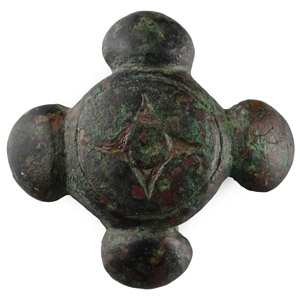
Greek Geometric Bronze Strap Distributor
8th-7th century B.C.Sold for (Inc. bp): £117
Discoid in plan and hollow to the underside with four radiating lugs to the rim, cruciform band to the reverse; to the upper face an incised ring and central quatrefoil. 30.1 grams, 40 mm
Ex private collection. with Gorny & Mosch, Munich, 17 June 2004, no.[TBC]. Private collection, Europe. This lot is accompanied by an illustrated lot declaration signed by the Head of the Antiquities Department, Dr Raffaele D'Amato. -
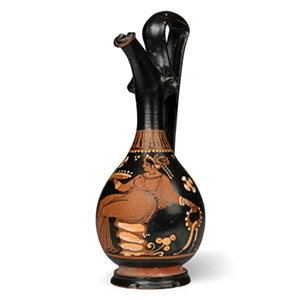
Greek Red-Figure Epichysis
4th-2nd century B.C.Sold for (Inc. bp): £1,690
With pedestal foot, bulbous body, flared neck, pinched rim with lateral lugs and extended pouring lip, ribbed strap handle to the reverse; radiating white pellets and vertical red strokes to the neck, palmette to the reverse and profile seated figure of a lady of fashion with stephane and necklace, holding a wreath in one hand and a platter in the other; objects in the field; old collector's references to underside. 175 grams, 19.1 cm
From the estate of a deceased American, acquired between 1970-1989. with Bonham's, London, Knightsbridge, 28 October 2009, no.23 [part]. This lot has been cleared against the Art Loss Register database, and is accompanied by an illustrated lot declaration signed by the Head of the Antiquities Department, Dr Raffaele D'Amato. -
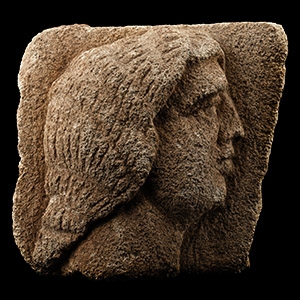
Cypriot Limestone Relief
3rd-2nd century B.C. or laterSold for (Inc. bp): £572
Frieze fragment with high-relief profile female bust, wavy hair, exaggerated eye and narrow chin. 1.67 kg, 16 cm
Acquired in the 1992. Private collection, Switzerland, thence by descent. Private collection, since the late 1990s. This lot is accompanied by an illustrated lot declaration signed by the Head of the Antiquities Department, Dr Raffaele D'Amato.
