
Loading, please wait...
LOT 0594
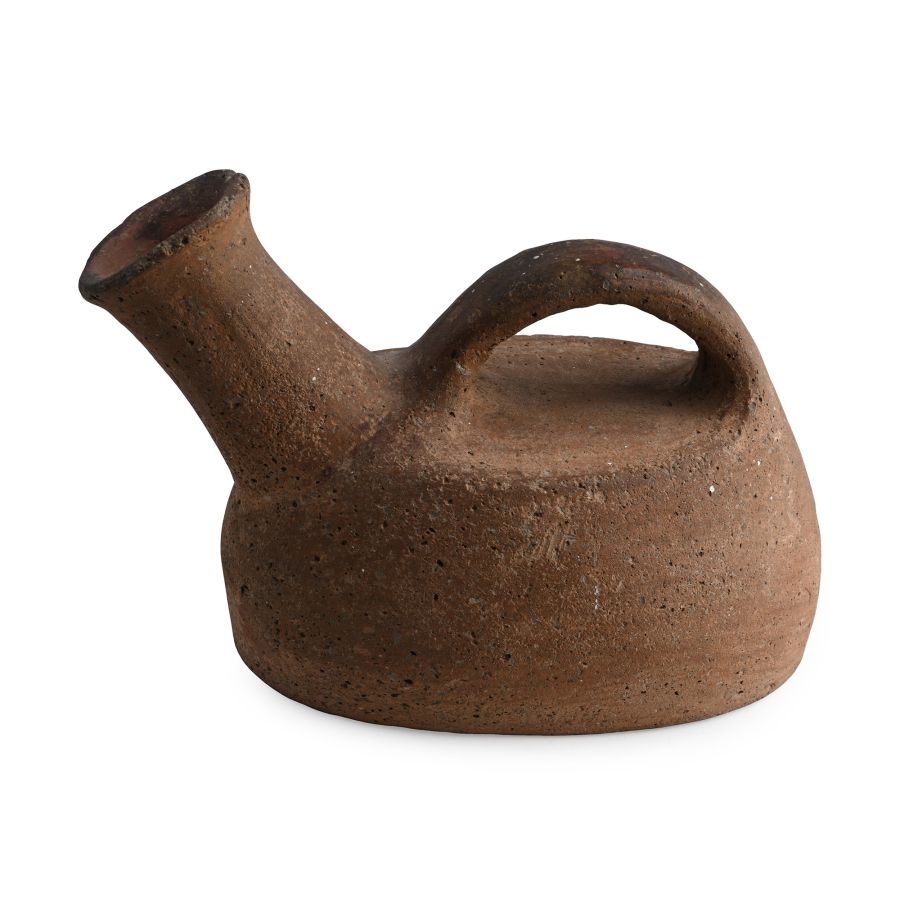
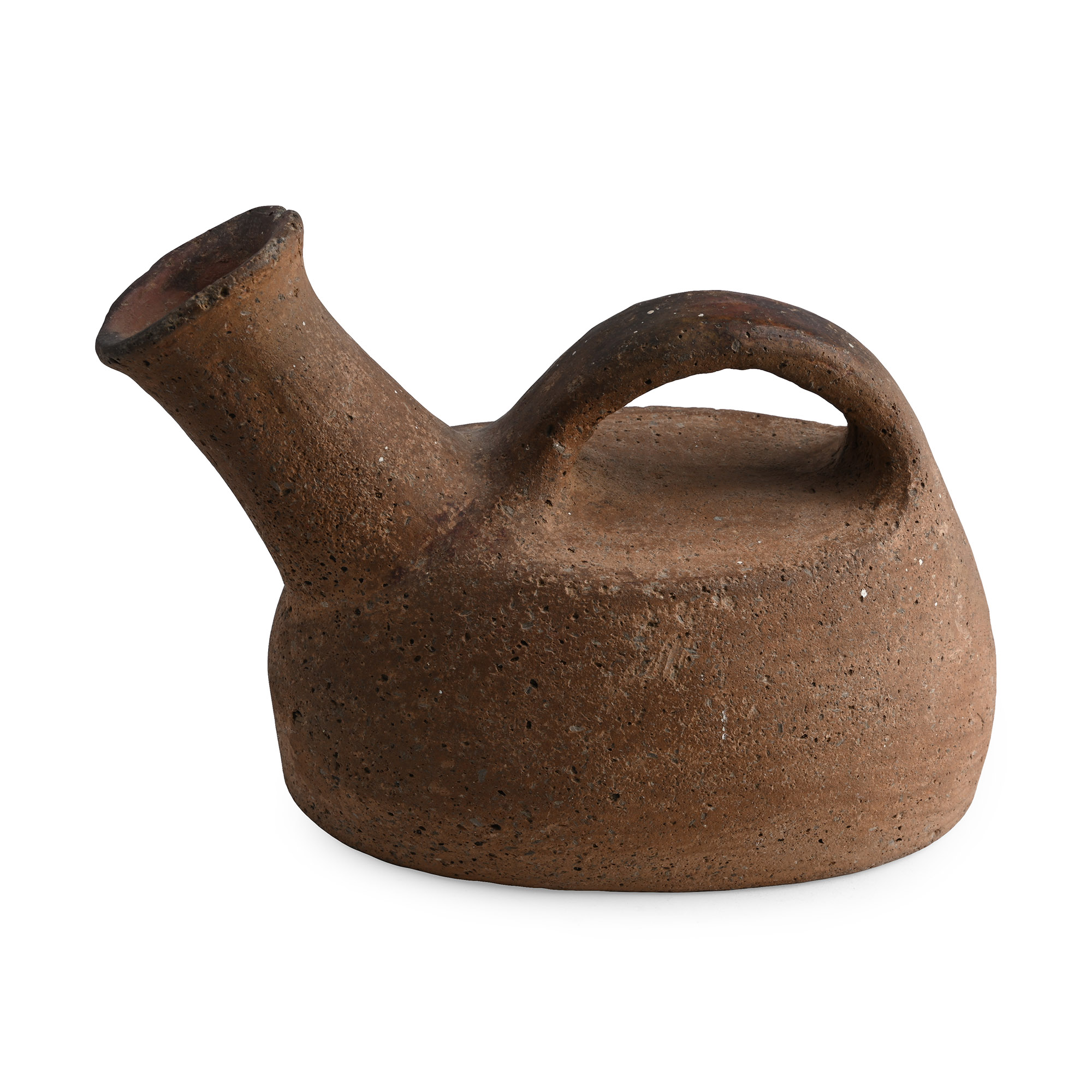
Greek Terracotta Askos
CIRCA 5TH-3RD CENTURY B.C.
6 1/4 in. (400 grams, 16 cm wide).
With an arching strap handle and a wide spout with everted rim; ellipsoid in plan with a long flat base.
ProvenanceFrom a late Hampshire gentleman's collection, formed from the 1960s.
LiteratureCf. for an askos of similar shape Mayer-Emmerling, S., Vedder, U., Corpus Vasorum Antiquorum, Deutschland Band 4, Frankfurt, 1994, pl.57 no.5 (inv.2668).
FootnotesThe askos was an ancient Greek vessel used for pouring small quantities of oily liquids, used as an ointment container or to fill oil lamps. The modern name for this vessel is conventional; it was originally used for animal-skin wine bottles, as often seen on Dionysian-themed vase paintings, and is used in modern times to designate this vessel shape based on some morphological similarity.
CONDITIONTimeLine Auctions follows a vetting process to ensure the authenticity and legality of all items, reinforcing our commitment to integrity and responsible trading. Each antiquity, antique, and coin lot undergoes thorough examination by a vetting committee of at least ten external specialists, professional trade association members, scientists, and archaeologists: Our Vetting Process
AUCTIONS:
TimeLine is a leading auction house specialising in antiquities, ancient art, collectables, natural history, coins, medals, and books. Our auctions offer museums, collectors, historians, and enthusiasts the opportunity to acquire unique and historically significant pieces.
-
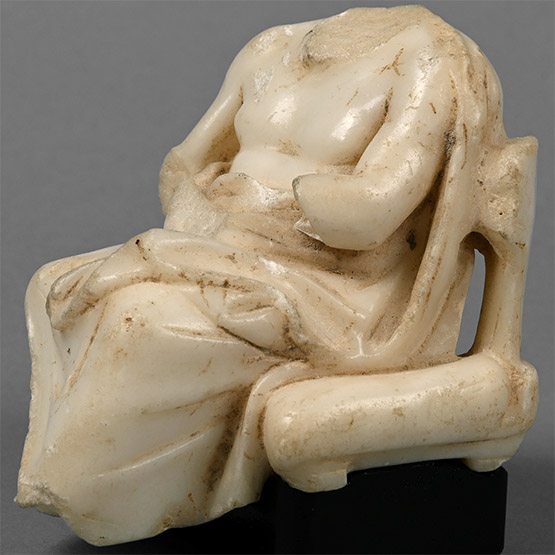
Greek Marble Figure of a Seated God or Philosopher
Hellenistic, 3rd-1st century B.C.Estimate: £15,000 - 20,000 (‡+bp*)
Opening Bid: £7,500
Carved in the round male figure in a seated pose wearing a loosely draped pallium on the shoulders and lower body, legs crossed at the knees; openwork frame to the chair with deep undercuts; mounted on a custom-made stand. 563 grams total, 86 mm high including stand
Formerly in a private collection, London. European private collection, acquired in 2002. Accompanied by a copy of an Art Loss Register certificate, 8 June 2004. This lot has been checked against the Interpol Database of stolen works of art and is accompanied by search certificate number no.13210-249309.
The statuette could represent Zeus or Chronos, based on similarities with two statues in the Vatican Museums and two statues in the Thebes Museum. The god is depicted seated, with his torso exposed, and his left hand, which normally holds the sceptre in statues of seated Zeus, is instead stretched out across his legs. -
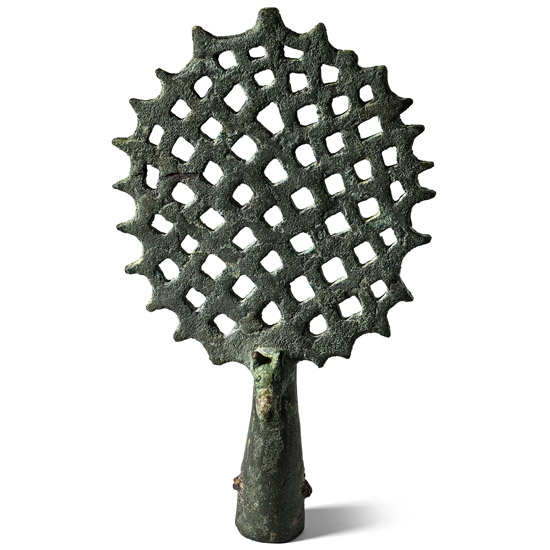
Scythian Bronze Finial with Animal Head
5th-4th century B.C.Estimate: £2,000 - 3,000 (+bp*)
Opening Bid: £1,000
Comprising an ellipsoid panel mounted on a conical socket; openwork lattice design with lozenge voids; socket with horse-head to one face, lateral lugs above the mouth. 570 grams, 24.6 cm
Private European collection, 1990s. Private collection, London, UK. Accompanied by an academic report by Dr Raffaele D'Amato. This lot has been checked against the Interpol Database of stolen works of art and is accompanied by search certificate number no.13278-254311.
Bronze pole tops, together with mirrors and horse trappings, were characteristic of Scythian art. Usually, Scythian warrior burials were accompanied by horses, the number of which corresponded to the status of the deceased (Galanina, 1997, p.54, fig.16). In the famous Chrertomlyk barrow, together with a deposit of 250 bridles, several openwork pole-tops were found, with figures of animals and birds, which could have been mounts for the harness or top of standards. However, they could also have been the upper part of staff poles decorating funeral wagons. Pole tops are one of the most significant objects used by the Scythians, and formed part of the ritual furnishings. -
.jpg)
Greek Terracotta Gnathian-Ware Alabastron
Apulian, circa 3rd century B.C.Sold for (Inc. bp): £1,235
Piriform in profile with a carinated rim to the mouth, a low basal ring; horizontal bands and a hatched panel, concentric rings. 255 grams, 14.5 cm
Louis-Gabriel Bellon (1819-1899) collection, France. European private collection, 2009.
Among the shapes of pottery that are also mostly represented in the Gnathian style are lekanides, bombilyoi and alabastra. They were containers for ointments and perfumes, used in funerary contexts during the first phase of the ritual, when the body needed to be treated and prepared for the burial.
