
Loading, please wait...
_900x900.jpg "Greek Solid Gold Earring Pair")
_200x200.jpg "Greek Solid Gold Earring Pair")
_900x900.jpg "Greek Solid Gold Earring Pair")
_200x200.jpg "Greek Solid Gold Earring Pair")
.jpg "Greek Solid Gold Earring Pair")
.jpg "Greek Solid Gold Earring Pair")
LOT 0125
Greek Solid Gold Earring Pair
4TH-2ND CENTURY B.C.
1 in. (18.43 grams total, 27 mm each).
Each a thick braided hoop with a collar of twisted filigree and a lion's mask finial. [2]
ProvenancePrivate London collection, 1980s.
Private collection, acquired on the British art market in 1993.
This lot has been checked against the Interpol Database of stolen works of art and is accompanied by search certificate number no.13185-249263.
Cf. Davidson, P.F., Oliver, A.J., Ancient Greek and Roman Jewelry in the Brooklyn Museum, New York, 1984, pp.40ss., for the type and especially 41-44.
FootnotesThe earrings belong to the hoop-type earrings, in which animal and human heads form the terminal as small miniature sculptures modelled in the round. The heads were attached to collars made from a single piece of gold. The group is characterised by lion heads.
CONDITIONTimeLine Auctions follows a vetting process to ensure the authenticity and legality of all items, reinforcing our commitment to integrity and responsible trading. Each antiquity, antique, and coin lot undergoes thorough examination by a vetting committee of at least ten external specialists, professional trade association members, scientists, and archaeologists: Our Vetting Process
AUCTIONS:
TimeLine is a leading auction house specialising in antiquities, ancient art, collectables, natural history, coins, medals, and books. Our auctions offer museums, collectors, historians, and enthusiasts the opportunity to acquire unique and historically significant pieces.
LOT 0125
Greek Solid Gold Earring Pair
Estimate £3,000 - 4,000€3,480 - 4,640 (for guidance only)$4,050 - 5,400 (for guidance only)
-
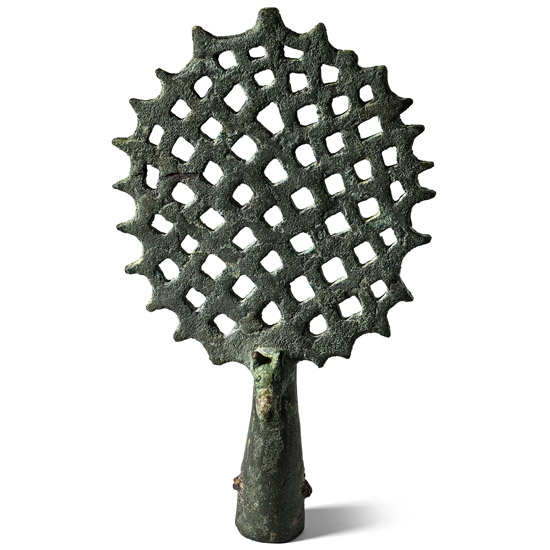
Scythian Bronze Finial with Animal Head
5th-4th century B.C.Estimate: £2,000 - 3,000 (+bp*)
Opening Bid: £1,000
Comprising an ellipsoid panel mounted on a conical socket; openwork lattice design with lozenge voids; socket with horse-head to one face, lateral lugs above the mouth. 570 grams, 24.6 cm
Private European collection, 1990s. Private collection, London, UK. Accompanied by an academic report by Dr Raffaele D'Amato. This lot has been checked against the Interpol Database of stolen works of art and is accompanied by search certificate number no.13278-254311.
Bronze pole tops, together with mirrors and horse trappings, were characteristic of Scythian art. Usually, Scythian warrior burials were accompanied by horses, the number of which corresponded to the status of the deceased (Galanina, 1997, p.54, fig.16). In the famous Chrertomlyk barrow, together with a deposit of 250 bridles, several openwork pole-tops were found, with figures of animals and birds, which could have been mounts for the harness or top of standards. However, they could also have been the upper part of staff poles decorating funeral wagons. Pole tops are one of the most significant objects used by the Scythians, and formed part of the ritual furnishings. -
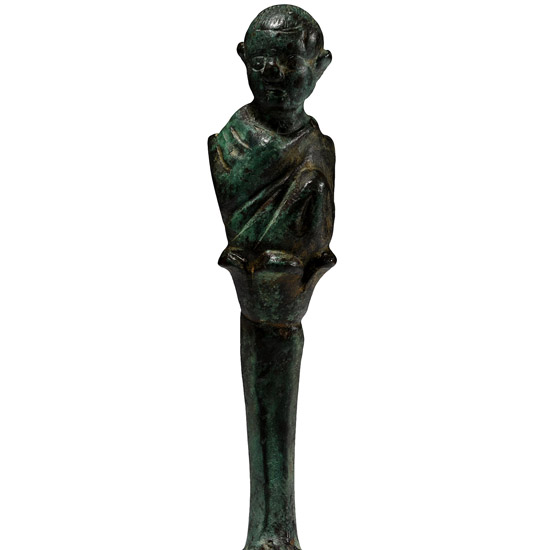
Greek Bronze Furniture Mount with Mime Actor
Hellenistic, Alexandria, 1st century B.C.Sold for (Inc. bp): £442
Modelled with large prominent ears and neatly cut short hair, rounded facial detailing with large eyes and flattened nose, the upper body and hands wrapped inside a pleated cloak, hollow to the reverse; the bust emerging from a lotus flower resting atop a lion's claw foot with a mounting spike on the reverse; mounted on a display stand. 130 grams total, 11.9 cm including stand
Collection of Ambassador G.P., nr.126, before 1965. with Galerie Rhéa, Zurich, Switzerland. -
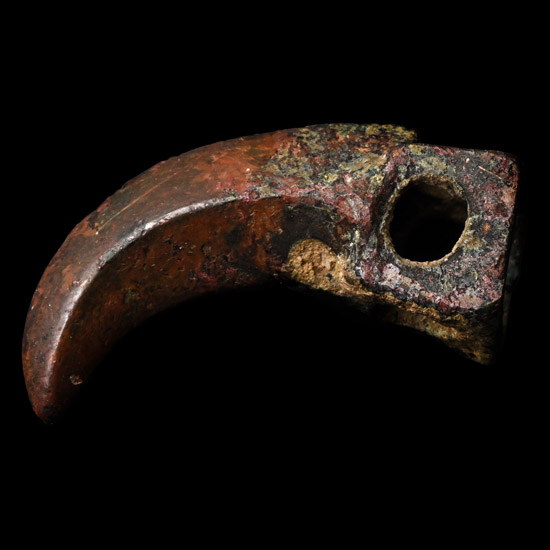
Scythian Bronze Eagle's Talon Pendant
Circa 6th century B.C.Sold for (Inc. bp): £156
Curved square-section hook with cuboid finial pierced on all four sides and to the top. 12.45 grams, 36.19 mm
From the private collection of a European gentleman (1942-2024), formed since the 1970s.
