
Loading, please wait...
LOT 0094
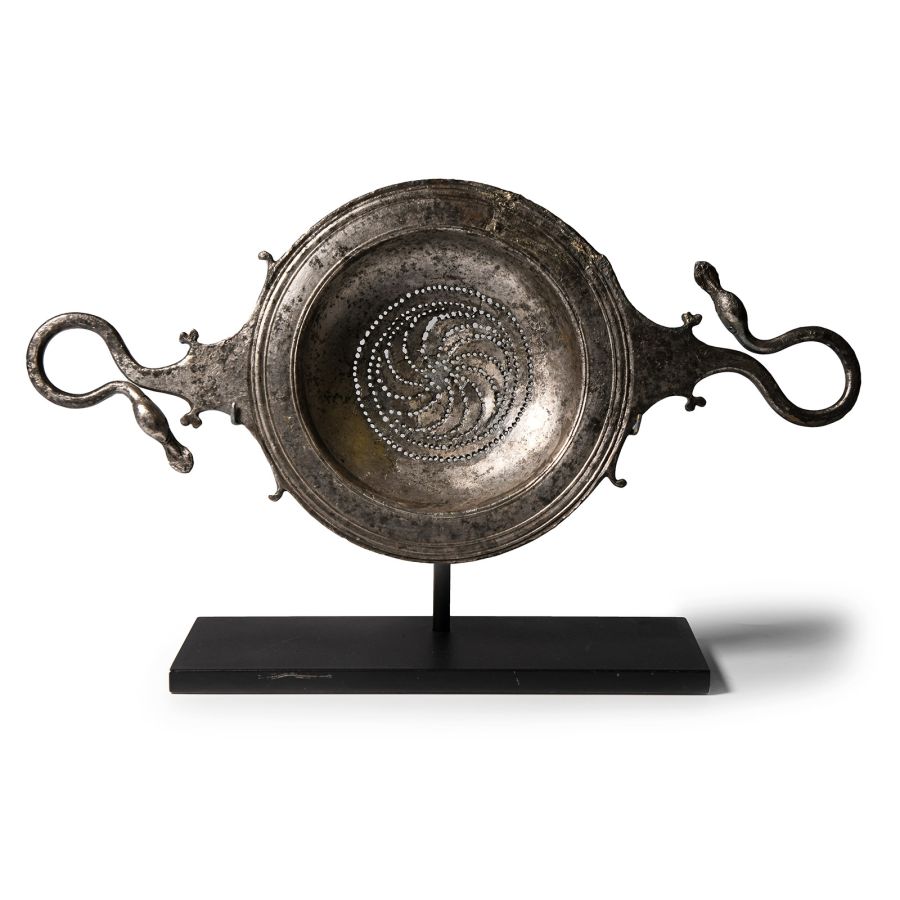
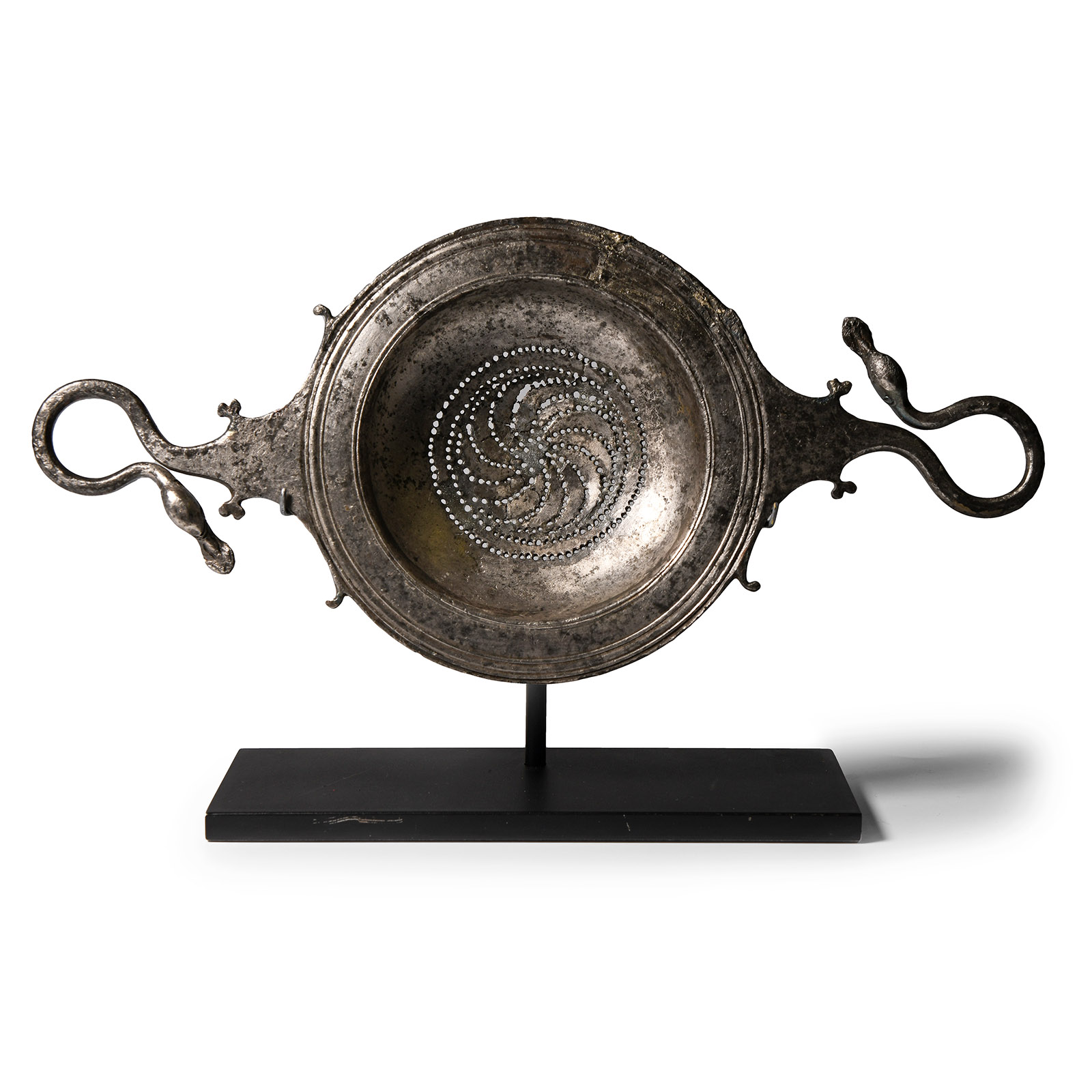
Greek Silver Wine Strainer
4TH-3RD CENTURY B.C.
8 3/4 in. (160 grams, 22.2 cm wide (526 grams total including stand)).
Composed of a shallow bowl and broad flange rim, two integral scalloped handles with scrolled flourishes, tapering to a loop handle with swan head terminals each with incised eye and beak detailing; perforated whirl within roundel to interior base; accompanied by a custom-made display stand.
ProvenanceEx private South German collection, 1980s.
with Christie's, New York, 8 June 2012, lot 86.
Accompanied by an academic report by Dr Raffaele D’Amato.
Accompanied by copies of the relevant Christie's pages.
This lot has been checked against the Interpol Database of stolen works of art and is accompanied by search certificate number no.11578-198980.
Cf. Reeder, Ellen D., Hellenistic Art in the Walters Art Gallery, Baltimore, 1988, p.125, no.130, for similar examples and a general discussion of type; A Passion for Antiquities, Ancient Art from the collection of Barbera and Lawrence Fleischman, The J. Paul Getty Museum, Malibu, 1994, pp.77-78, no.31D; and The Search for Alexander, exhibition catalogue, 1980, p.167, no.130; the Metropolitan Museum of Art, accession number 1972.118.88, for a group containing a silver strainer with similar looped handle and bird-head terminal; a similar specimen in the Walters Art Museum, accession number 57.910; a similar example in shape and quality can be seen in the ‘Tomb of the Prince’, in Pella, cf. Touratsoglou, I., Macedonia, History, Monuments, Museums, Athens, 1996, p.240, fig.312.
FootnotesElaborate silver strainers, such as this present example, were used at symposia and festive occasions for the purpose of preventing the dregs of wine from entering the wine cup. This and other related silver utensils became popular in the later 4th and 3rd century B.C. These highly decorated wine strainers were fitted with dual handles forming loops in the shape of twisting animals, here a swan. Usually they took the form of a shallow dish complete with four rings of perforations in the centre in order to drain the wine. Strainers of this type were used to separate out sediments which could be found in the thick Greek wine. Examples similar to this one have been found in royal tombs in northern Greece, as well as the tomb of a monarch in Sudan.
CONDITIONTimeLine Auctions follows a vetting process to ensure the authenticity and legality of all items, reinforcing our commitment to integrity and responsible trading. Each antiquity, antique, and coin lot undergoes thorough examination by a vetting committee of at least ten external specialists, professional trade association members, scientists, and archaeologists: Our Vetting Process
AUCTIONS:
TimeLine is a leading auction house specialising in antiquities, ancient art, collectables, natural history, coins, medals, and books. Our auctions offer museums, collectors, historians, and enthusiasts the opportunity to acquire unique and historically significant pieces.
-
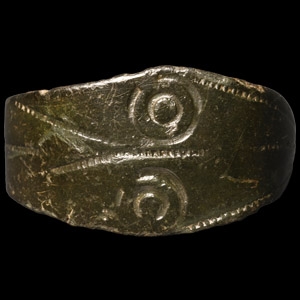
Greek Bronze Ring with Face
Circa 3rd-2nd century B.C.Sold for (Inc. bp): £117
With broad plaque, pointillé bands and roundels imitating a human mask. 7.47 grams, 27.25 mm overall, 23.27 mm internal diameter (approximate size British Y 1/2, USA 12 1/4, Europe 28.2, Japan 27)
From the collection of a High Wycombe, Buckinghamshire, UK, gentleman, circa 2000. -
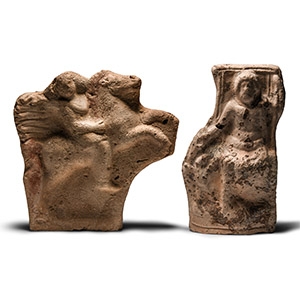
Parthian Terracotta Statuette Group
3rd century B.C.Sold for (Inc. bp): £351
Hollow-formed, comprising: a rider on a rearing horse with chlamys extended in the wind, and wearing wide Persian trousers (saravara), red pigment in the field; Zeus enthroned, facing with an eagle at his feet, hole to the reverse. 598 grams total, 15.5 cm each
Ex private European collection. with Genève Enchères, 14 December 2017, lot 863.
The costume of Parthian nobles consisted of a tunic or wrapped jacket, trousers and boots/footwear, generally typical of a riding dress. Interestingly, the right side of the tunic was knee-length (such as those seen om early Sassanian noblemen depicted in the Persepolis graffiti) but the left side of the tunic, for many Parthian cavalrymen, appeared shorter and only reached to the upper thigh. -
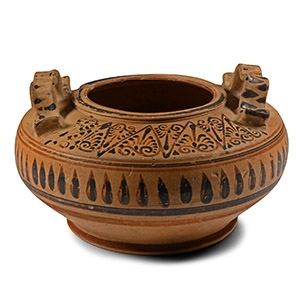
Greek Corinthian Decorated Pyxis
5th century B.C.Sold for (Inc. bp): £1,170
Squat profile, broad body with low sidewall, black and red coloured bands and teardrops; applied strap handles to shoulder amid painted palmettes and scrolls; raised rim. 514 grams, 19 cm wide
Acquired from Charles Ede, London, 1986. with Christie's London, 27 October 2004, lot 451. with Christie ́s London, 20 April 2005, lot 314. Accompanied by a copy of an Art Loss Register certificate number S00085809, dated 27 March 2014. Accompanied by copies of the relevant Christie's catalogue pages.
