
Loading, please wait...
LOT 0116
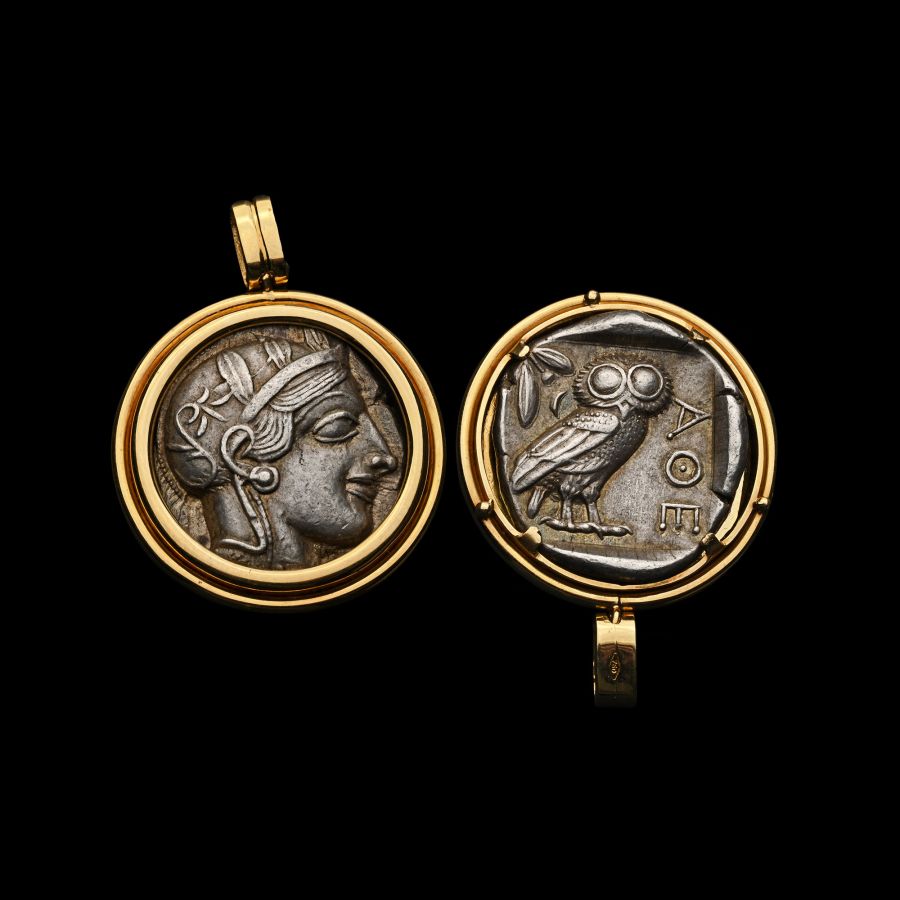
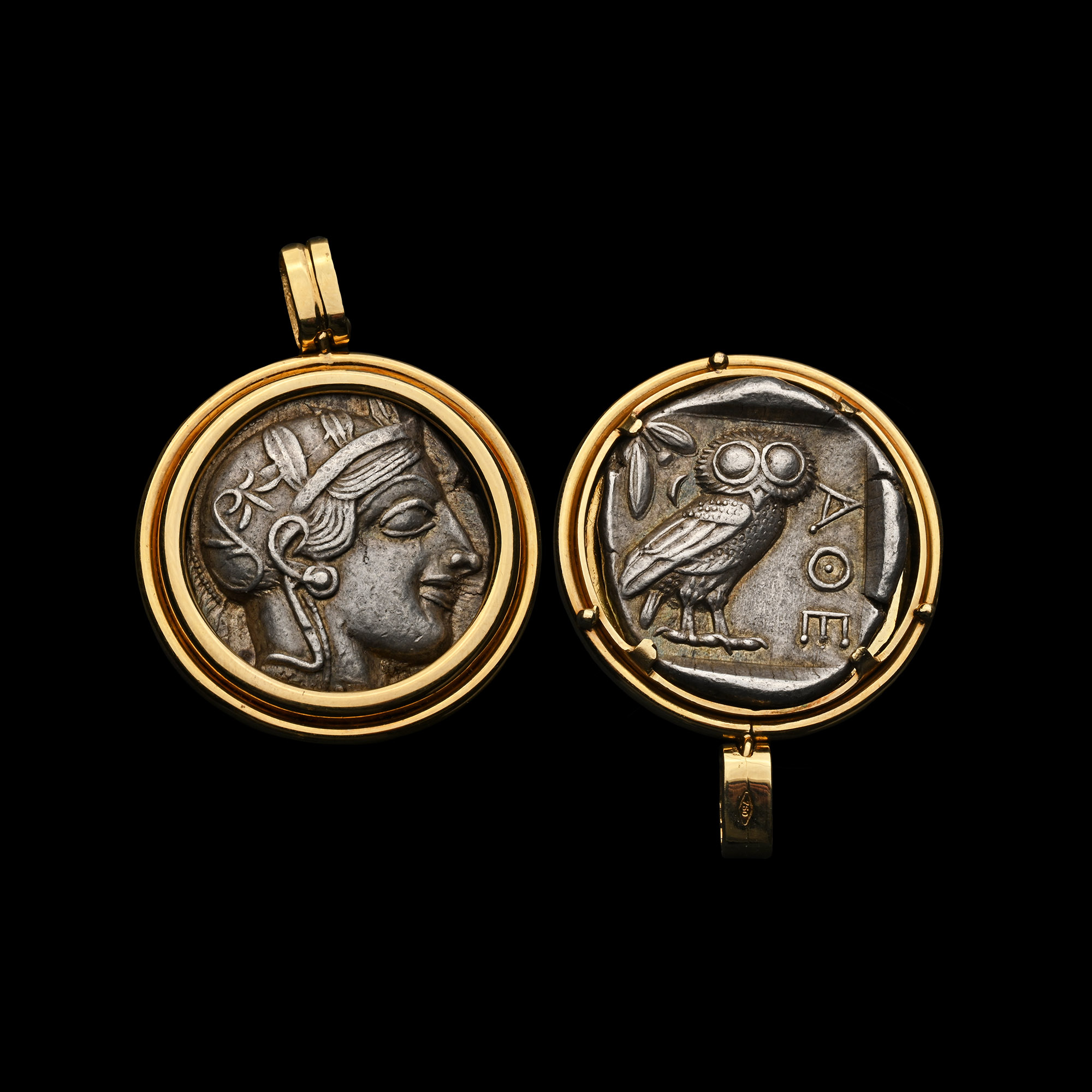
Greek Silver Tetradrachm of Athens in Gold Pendant
CIRCA 454-404 B.C.
1 3/8 in. (24.36 grams, 37 mm).
Obv: head of Athena with profile eye to right, wearing disc earring, pearl necklace and a crested Attic helmet adorned with three olive leaves and a pi-style palmette. Rev: ΑΘΕ, owl standing to right, head facing the viewer, olive sprig with berry and crescent moon in upper left field, all within incuse square. Kroll 8; Dewing 1591-8; SNG Copenhagen 31; HGC 4, 1597; the coin enclosed inside a modern gold medallion pendant stamped '750' with double border.
ProvenanceRoma Numismatics, E-LIVE Auction 4, 29 November 2018, no.155.
Private collection of Mr K.A., France.
with Kallos Gallery, London.
This lot has been checked against the Interpol Database of stolen works of art and is accompanied by search certificate number no. 13024-246751.
Cf. Kroll, J.H., ‘Athenian Tetradrachm Coinage of the First Half of the Fourth Century BC’ in RBN clvii, (2011), pp.3-26 pls.Iff.
FootnotesThe Athenian components of several of the hoards in which these tetradrachms were found, together with other published and unpublished tetradrachms, make it clear that this coinage of c.400/390 to 353 was not only substantial, but was one of the most prolific Greek coinages of the period.
CONDITIONTimeLine Auctions follows a vetting process to ensure the authenticity and legality of all items, reinforcing our commitment to integrity and responsible trading. Each antiquity, antique, and coin lot undergoes thorough examination by a vetting committee of at least ten external specialists, professional trade association members, scientists, and archaeologists: Our Vetting Process
AUCTIONS:
TimeLine is a leading auction house specialising in antiquities, ancient art, collectables, natural history, coins, medals, and books. Our auctions offer museums, collectors, historians, and enthusiasts the opportunity to acquire unique and historically significant pieces.
-
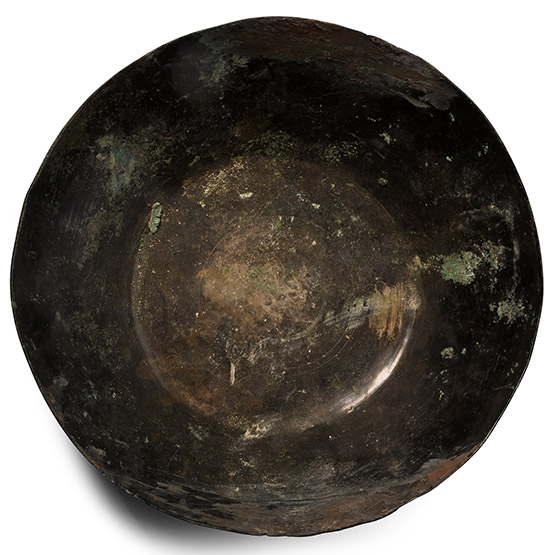
Parthian Bronze Bowl
2nd century B.C.-1st century A.D.Sold for (Inc. bp): £78
Broad and squat with flared sidewall. 153 grams, 17.5 cm
Ex 1990s collection and with a central London gallery. -
.jpg)
Etruscan Carnelian Scarab of a Fletcher in Gold Ring
4th-3rd century B.C.Estimate: £1,200 - 1,700 (+bp*)
Opening Bid: £600
With carapace detailing and intaglio of a crouching male carving an arrow; set into a later gold swivel ring. 4.24 grams, 27.12 mm overall, 18.38 x 18.49 mm internal diameter (approximate size British P 1/2, USA 7 3/4, Europe 16.86, Japan 16)
Private collection, Europe. Acquired on the English art market. -
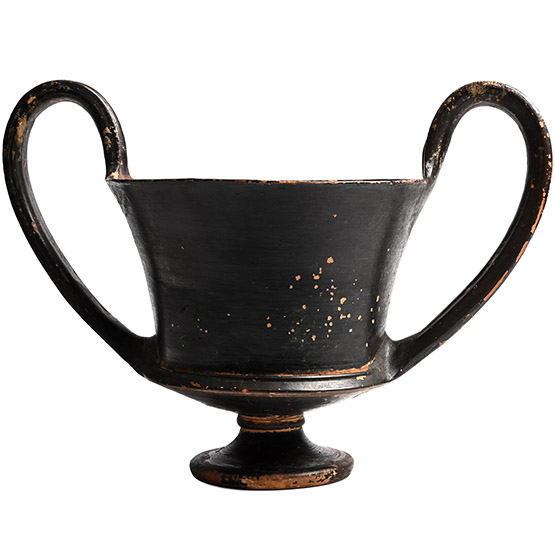
Greek Blackware Short-Stemmed Kantharos
Circa 5th-4th century B.C.Sold for (Inc. bp): £546
With a flared foot, tapering body and two lateral high strap handles with ribs to the outer edges, the sidewall set off from the foot by a carination. 354 grams, 23 cm wide
Ex Norri collection, Milton Keynes, Bedfordshire, UK, 1980s-1990s.
