
Loading, please wait...
_900x900.jpg "Greek Silver Medical Implement with Snake Handle")
_200x200.jpg "Greek Silver Medical Implement with Snake Handle")
.jpg "Greek Silver Medical Implement with Snake Handle")
LOT 0533
Greek Silver Medical Implement with Snake Handle
4TH-3RD CENTURY B.C.
10 in. (68 grams, 25 cm long).
A silver and copper-alloy medical instrument, oval in shape, the handle formed as a snake with shallow hatched pattern on the body representing scales, stylised rendering of the snake's head.
ProvenanceAcquired mid 1980s to early 1990s.
Private family collection formed in London, UK.
Accompanied by a metal test assessment number 182971/HM1456 from an Oxford specialist.
Cf. Milne, J.S., Surgical Instruments in Greek and Roman times, Oxford, 1907, pl.XI,4, for a spatula with a similar snake handle.
FootnotesThe use of this spatula (probe) for medical assessment can be confirmed by its snake-shaped handle, evidently a reference to the god Asklepios, whose symbol was a staff with a serpent wrapped around it. Such implements, called 'ἀπυρομήλη', were used in the Graeco-Persian world. The survival of the handle in this example makes it a rare find.
CONDITIONTimeLine Auctions follows a vetting process to ensure the authenticity and legality of all items, reinforcing our commitment to integrity and responsible trading. Each antiquity, antique, and coin lot undergoes thorough examination by a vetting committee of at least ten external specialists, professional trade association members, scientists, and archaeologists: Our Vetting Process
AUCTIONS:
TimeLine is a leading auction house specialising in antiquities, ancient art, collectables, natural history, coins, medals, and books. Our auctions offer museums, collectors, historians, and enthusiasts the opportunity to acquire unique and historically significant pieces.
LOT 0533
Greek Silver Medical Implement with Snake Handle
Estimate £450 - 650€520 - 750 (for guidance only)$610 - 880 (for guidance only)
-
.jpg)
Campanian Red-Figure Bail Amphora from a Cumae Workshop
330-300 B.C.Sold for (Inc. bp): £4,680
A ceramic red-figure bail amphora with round-section strap handle and pierced lug at the apex, tall waisted neck with vertical rib detailing, rounded shoulder with running wave pattern ornament, tapering body with figural designs of standing females wearing a himation and a stephane in red and white on black ground, one figure holding a thyrsus and the other an ear of corn, with accessories in the field; flared base; from a workshop in Cumae. 862 grams, 37 cm high
Ex collection H.& P. Payot, Clarens, by descent. Accompanied by an academic report by Dr Raffaele D’Amato. This lot has been checked against the Interpol Database of stolen works of art and is accompanied by search certificate number no.11577-199027. Accompanied by an original thermoluminescence analysis report no.QED2223/SG0-0105 from QED Laboratoire.
The bail amphora, named for the tall handle arching over the mouth, was a shape made primarily in Campania, where red-figure vases were produced at both Capua and Cumae in the 4th century B.C. The decoration offered a remarkable range of subjects associated not only with mythological images, but with representations of the local life, costumes and customs. The simple, single figure compositions decorating each side of this vase are also characteristic of the style, which tended to avoid complex mythological scenes often found on much larger vessels like volute craters, favouring representation of the daily life of south Italic people. -
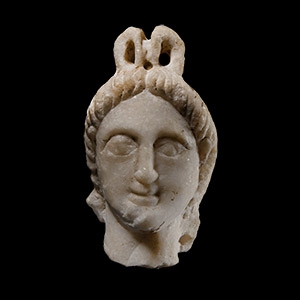
Graeco-Parthian Marble Head of a Divinity
2nd century B.C.-1st century A.D.Estimate: £2,000 - 3,000 (‡+bp*)
Opening Bid: £1,000
An alabaster bust of a goddess with elongated face and large almond-shaped eyes; braided hair with openwork topknot and socket to accept an inset stud, gathered at the rear in a chignon. 639 grams, 11.6 cm
Acquired early 1990s. Ex private American collection; thence by descent. Private Swiss collection since 1998. This lot has been checked against the Interpol Database of stolen works of art and is accompanied by search certificate no.11611-199026.
Several female figures, found in the Parthian graves of Babylonia, are represented in loose attire exhibiting strange headdresses, which give us some notion of the costume of the period. Some of them show a headgear rising into two tall conical peaks, from which a veil is suspended. Nude female figures, probably representing Assyrian Mylitta or Venus, were extremely common during the Parthian period, having been handed down from antiquity. Similar figures are universal throughout the east before the Christian era. -
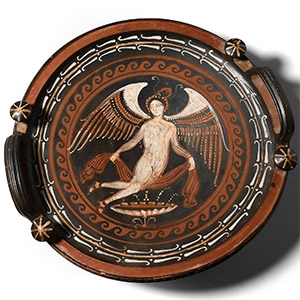
Large Greek Apulian Platter with Eros
4th century B.C.Estimate: £5,000 - 7,000 (+bp*)
Opening Bid: £2,500
A broad ceramic patera with raised rim and stepped foot, two strap handles to the rim each flanked by two domed studs; rim with reserved wave pattern band, studs with starburst motif; painted central scene with outer foliate bands and reserved wave pattern framing the tondo displaying Eros in flight with wings spread, holding a red cloth over an inverted shield; some repainting. 2.76 kg, 41 cm wide
Fine condition.
French collection, 1990s-early 2000s. Formerly in Patrick Declerck Auction, Douai, France, 2014, lot 72. From an important Paris gallery, France. Ex private Parisian collection. Accompanied by an original thermoluminescence analysis report no.N122j42 from Oxford Authentication. This lot has been checked against the Interpol Database of stolen works of art and is accompanied by search certificate no.11616-196567.
