
Loading, please wait...
LOT 0106
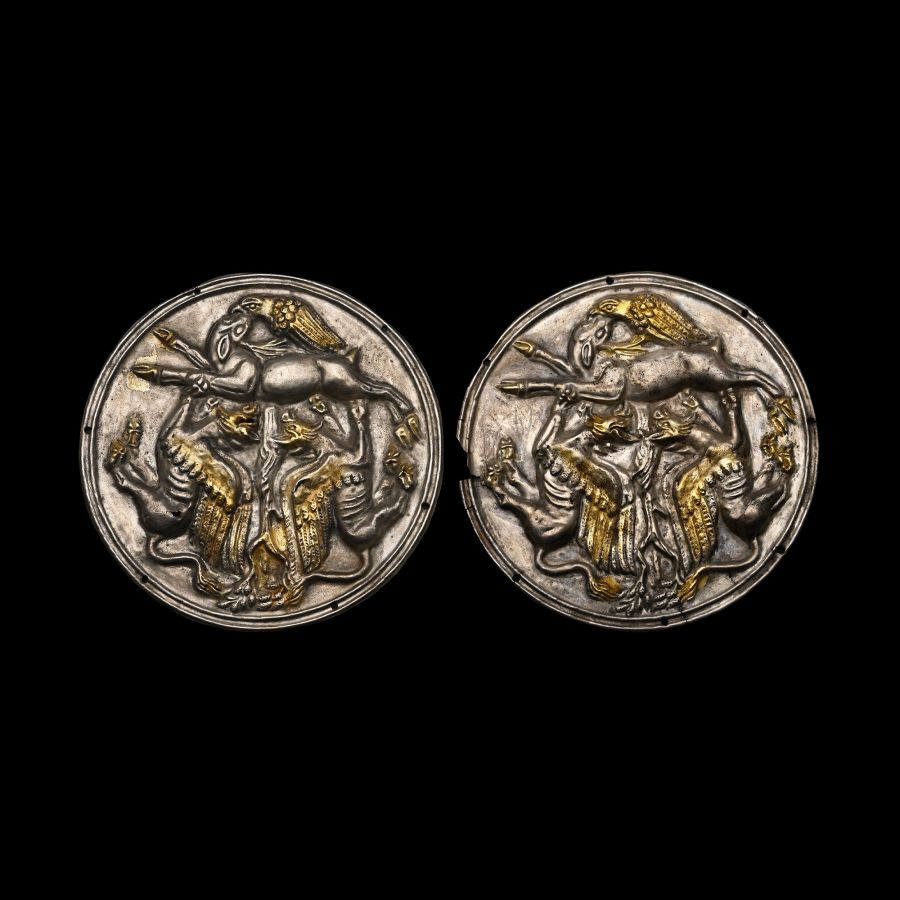
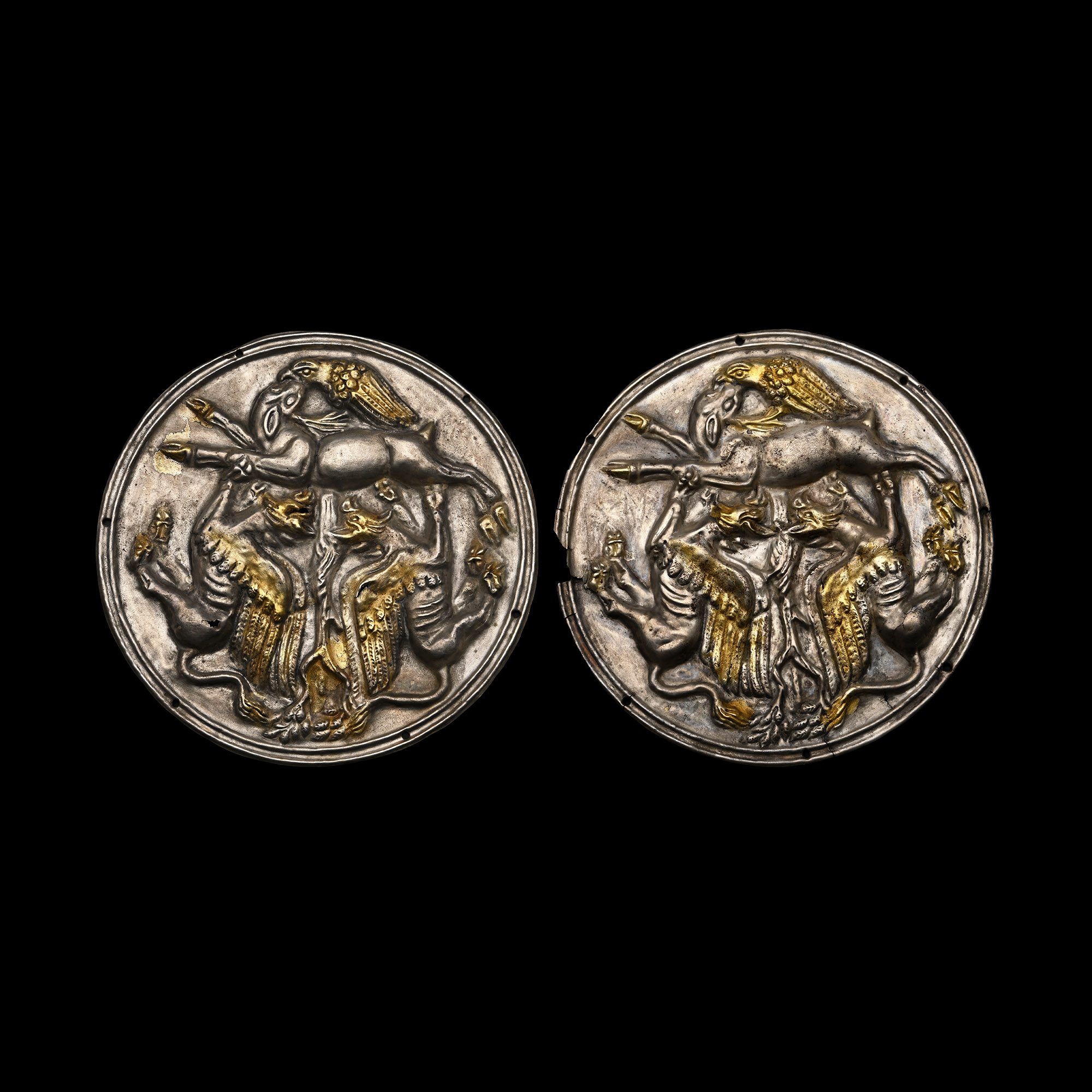
Greek Silver-Gilt Phalerae Depicting a Fight Between Gryphons, an Eagle and a Deer
HELLENISTIC, 1ST CENTURY B.C.-1ST CENTURY A.D.
5 1/4 in. (62 grams total, 13.2 cm).
A pair of circular horse trappings hammered from sheet-silver, each with a decoration of two gryphons and an eagle slaughtering a deer, the gryphons attacking the deer from below, and the eagle attacking its muzzle, a tree in the background; accompanied by a custom-made display case. [2]
ProvenancePrivate German collection, 1980s.
Accompanied by an expertise from Striptwist Ltd, a London-based company run by historical precious metal specialist Dr Jack Ogden.
Accompanied by an academic report by Dr Raffaele D’Amato.
This lot has been checked against the Interpol Database of stolen works of art and is accompanied by a search certificate number no.13038-248044.
Cf. Pfrommer, M., Metalwork from the Hellenized East, catalogue of the Collections in the Paul Getty Museum, Malibu, 1993, figs.2-5, figs. p.155ff.; Nikonorov, V.P., The armies of Bactria 700BC-450 AD, Stockport, 1997; Симоненко А. В., 'Шлемы сарматского времени из Восточной Европы' (Sarmatian Age Helmets from Eastern Europe), in Stratum Plus, no.4, 2014, pp.249-284; D'Amato R. and Negin, A., Roman Heavy Cavalry (1), Cataphractarii and Clibanarii, 1st century BC-5th century AD, Oxford, 2018.
FootnotesThis phalera comes from the Hellenised East, and was likely used as decoration of the higher part of a horse harness, like the phalerae visible on the armoured and unarmoured horses of the famous graffiti of Dura Europos representing Parthian, Palmyrene or Roman clibanarii (D’Amato-Negin, 2018, pp.11,16-17,26).
CONDITIONTimeLine Auctions follows a vetting process to ensure the authenticity and legality of all items, reinforcing our commitment to integrity and responsible trading. Each antiquity, antique, and coin lot undergoes thorough examination by a vetting committee of at least ten external specialists, professional trade association members, scientists, and archaeologists: Our Vetting Process
AUCTIONS:
TimeLine is a leading auction house specialising in antiquities, ancient art, collectables, natural history, coins, medals, and books. Our auctions offer museums, collectors, historians, and enthusiasts the opportunity to acquire unique and historically significant pieces.
LOT 0106
Greek Silver-Gilt Phalerae Depicting a Fight Between Gryphons, an Eagle and a Deer
Sold for (Inc. bp): £31,200
-
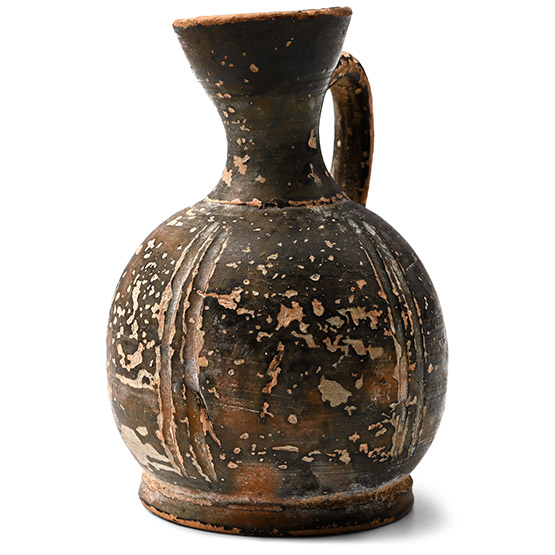
Greek Terracotta Handled Lekythos
4th-3rd century B.C.Sold for (Inc. bp): £124
Ovoid in profile with trumpet-shaped spout and strap handle, incised vertical bands to the bulbous body. 44.3 grams, 64 mm
From a Scottish gentleman’s collection, Glasgow, formed from the early 2000s. -
.jpg)
Greek Red-Figure Kantharos with Lady of Fashion
Apulian, 3rd-2nd century B.C.Sold for (Inc. bp): £1,040
High-handled cup with flared body and a tall offset foot with a collar, coiled lateral handles; profile 'ladies of fashion' busts with white and cream detailing to the hair, diadem and earrings. 415 grams, 18.6 cm
Acquired on the art market between the late 1990s and mid-2000s. Estate of the late Barry Paul Buxton (1944–2024), Oakham, Rutland. Acquired on the UK art market, 2025. -
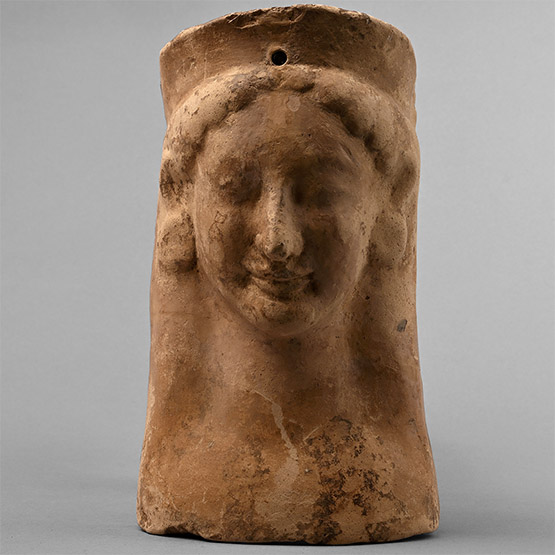
Greek Terracotta Female Protome
Early 5th century B.C.Estimate: £1,500 - 2,000 (‡+bp*)
Opening Bid: £750
Mould-made female protome with oval face, graceful nose and typical "archaic" smile; forehead framed by snail-shell curls descending to shoulder-height; with a low polos with a central perforation and large disc earrings. 606 grams, 19.5 cm
Ex Herbert A. Cahn, Kunst der Antike, Basel, 1997. with Paul and Vreny Vosseler-Studer, Riehen. Accompanied by a copy of an Art Loss Register certificate no.S00057826. This lot has been checked against the Interpol Database of stolen works of art and is accompanied by search certificate number no.12474-228714.
