
Loading, please wait...
LOT 0512
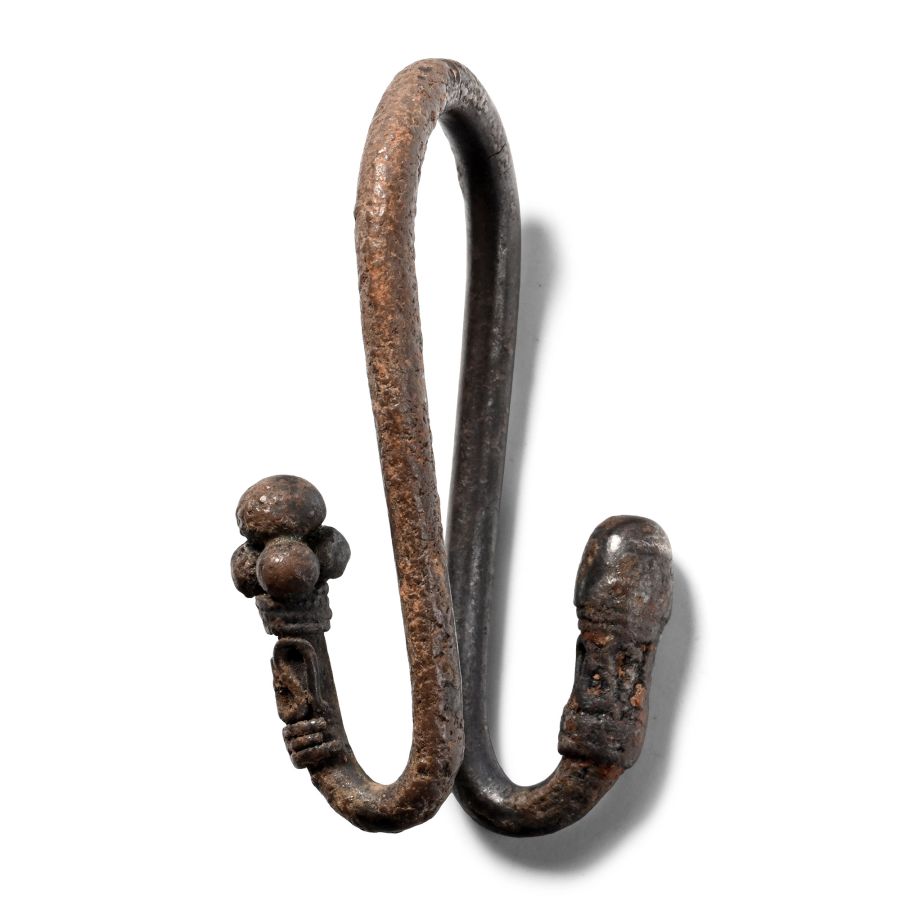
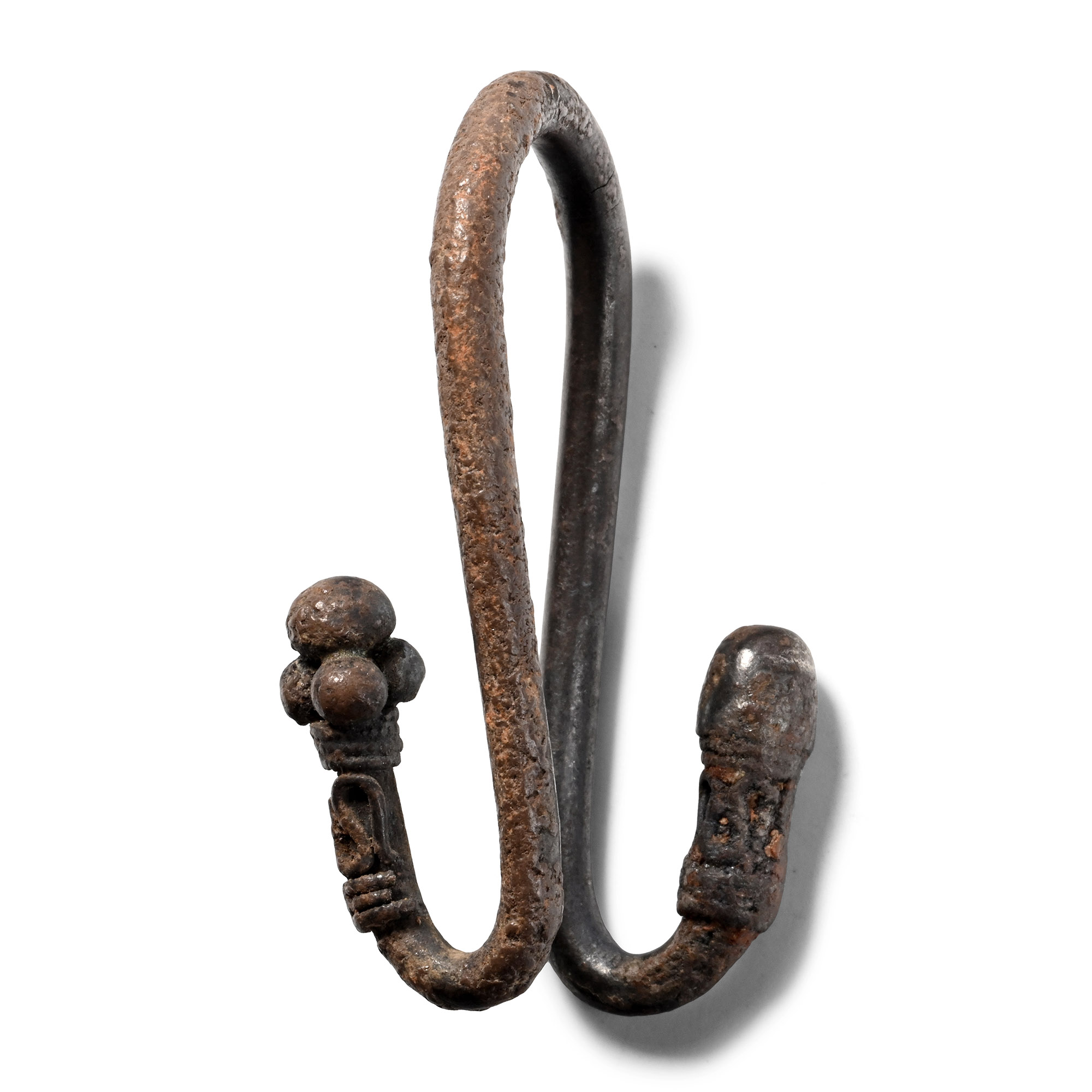
Greek Silver Belt Hanger with Decorated Terminals
5TH-3RD CENTURY B.C.
2 in. (17 grams, 50 mm).
U-shaped body with hooked terminals with filigree decoration. [No Reserve]
ProvenanceAcquired on UK art market.
Property of a Middlesex gentleman.
TimeLine Auctions follows a vetting process to ensure the authenticity and legality of all items, reinforcing our commitment to integrity and responsible trading. Each antiquity, antique, and coin lot undergoes thorough examination by a vetting committee of at least ten external specialists, professional trade association members, scientists, and archaeologists: Our Vetting Process
AUCTIONS:
TimeLine is a leading auction house specialising in antiquities, ancient art, collectables, natural history, coins, medals, and books. Our auctions offer museums, collectors, historians, and enthusiasts the opportunity to acquire unique and historically significant pieces.
-
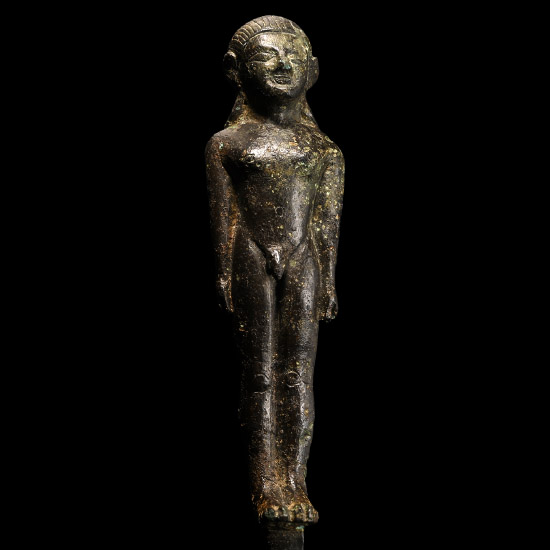
Etruscan Bronze Figure of a Kouros
Late 6th century B.C.Estimate: £2,000 - 3,000 (+bp*)
Current Winning Bid: £1,200
Depicting a youthful nude kouros standing frontally, with a long, slender body, broad shoulders, a narrow waist, and arms hanging close to the sides; the head, slightly oversized, characterised by an oval face, large almond-shaped eyes, an Archaic smile, and finely modelled ears, the hair arranged in beaded locks framing the forehead and falling onto the shoulders, reflecting the influence of contemporary Greek Archaic sculpture; standing on an integral rectangular base provided with a long tang for attachment. 118 grams, 11.2 cm
Acquired on the European art market between 1960s and 1980s. English private collection, property of a gentleman. Bertolami Fine Art, London, Auction 54, 9 November 2018, no.88. This lot has been checked against the Interpol Database of stolen works of art and is accompanied by search certificate number no.13320-258214.
The elegant proportions and linear modelling place the statuette within the widespread production of Etruscan votive bronzes of the Late Archaic period, probably intended as a sanctuary dedication. -
.jpg)
Greek Gold Bead Collection
4th-3rd century B.C.Estimate: £1,200 - 1,700 (‡+bp*)
Opening Bid: £600
A collection of necklace pendants and dress appliques comprising: a hollow bead with a truncated conical shape, featuring appliques for precious stone inserts; three studs with a hemispherical dome; a pair of appliques decorated with rosette and mask-shaped elements; a pendant in the form of a myrtle berry, and another fragment. 11.19 grams total, 10-31 mm
Acquired by a Swiss family in the mid-1980s to late 1990s, thence by descent. Private collection, Switzerland, since the late 1990s. This lot has been checked against the Interpol Database of stolen works of art and is accompanied by a search certificate number no.13023-246772.
The iconography of Hellenistic jewellery often incorporates vegetal motifs, reflecting the Greek value of fertility. With its heavy incorporation of plant motifs, including tendrils, blossoms, and a bursting pomegranate, the diadem design symbolises a woman’s reproductive potential and alludes to the female wearer’s social responsibility to produce offspring. -
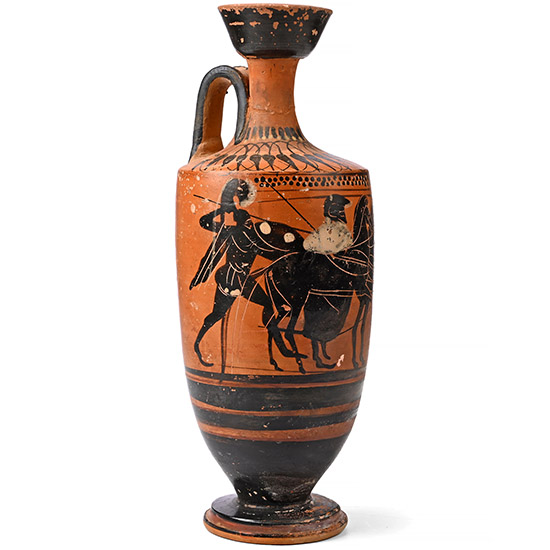
Greek Black-Figure Lekythos with Horses and Fighting Warriors
Athens, 550-500 B.C.Sold for (Inc. bp): £3,900
Cylindrical with echinus mouth and stepped torus foot, on the body a dynamic scene consisting of four rearing horses, side-by-side and wearing harnesses, nestled between the horses a standing warrior wearing a crested helmet, behind the horses an advancing warrior wearing a plumed helmet, holding a long spear in his raised hand a round shield in the other; before the horses a fleeing opponent in a running pose, facing back and holding a spear in one hand while protecting himself with a shield held in the other; long tongue motifs on the shoulder; restored. 472 grams, 23.5 cm
Ex Bonhams, Knightsbridge, London, 1990s. Private collection, Suffolk.
The scene depicts a battle between hoplites, possibly an episode from the Iliad. Originally, one or two of the combatants were positioned on a chariot; four horses from it remain visible. The scene may represent the wounding of Ares, the god of war, as he is pursued by Diomedes and accompanied by the goddess Pallas, whose helmet is emerging from behind the horses.
