
Loading, please wait...


LOT 0034
Greek Red-Figure Skyphos with Owl
ATTIC, 5TH-4TH CENTURY B.C.
5 1/2 in. (115 grams, 14.1 cm wide).
Mammiform body with flared pedestal base and two loop handles to the rim; each side with a facing image of an owl between laurel fronds; concentric circles to the base, Attic workmanship.
ProvenanceBonhams, Knightsbridge, London, 20 1994, no.39.
Private collection, Suffolk.
Cf. The Metropolitan Museum of Art, New York, object no.2001.761.5; see also Johnson, F. B., ‘An Owl Skyphos’, in Mylonas, G., Studies Presented to David Moore Robinson on His Seventieth Birthday, vol. 2, St. Louis, 1953, pp.96-105.
CONDITIONTimeLine Auctions follows a vetting process to ensure the authenticity and legality of all items, reinforcing our commitment to integrity and responsible trading. Each antiquity, antique, and coin lot undergoes thorough examination by a vetting committee of at least ten external specialists, professional trade association members, scientists, and archaeologists: Our Vetting Process
AUCTIONS:
TimeLine is a leading auction house specialising in antiquities, ancient art, collectables, natural history, coins, medals, and books. Our auctions offer museums, collectors, historians, and enthusiasts the opportunity to acquire unique and historically significant pieces.
-
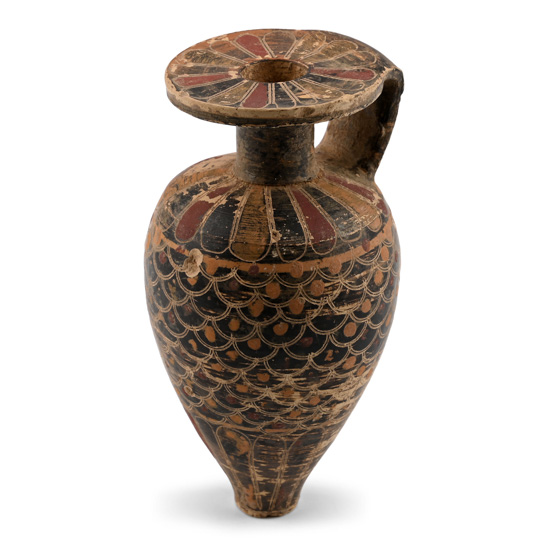
Proto-Corinthian Painted Terracotta Aryballos
7th century B.C.Sold for (Inc. bp): £2,080
Comprising a piriform body and a tubular neck with a wide rim, a strap handle to the rear, the rim with painted polychrome petals, the pattern repeating beneath the neck and on the base of the vessel; the body decorated with fishscale decoration. 79 grams, 10.5 cm
Swiss private collection, assembled in the 1960s and 1970s. Acquired by the present owner in 2004. Accompanied by an academic report by Dr Raffaele D’Amato. This lot has been checked against the Interpol Database of stolen works of art and is accompanied by search certificate number no.30017-246794.
The aryballoi were used to hold perfumed oil, an essential item for the wealthy middle classes of the time. Similar piriform vases are fairly common in Corinthian contexts. There is utmost precision in both the potting and the execution of the incised scale pattern of the present example. The fish-scale decoration was realised with the incision technique, by executing the scales neatly with their ends meeting. -

Greek Red-Figure Bell Krater with Eros
Apulia, 4th century B.C.Sold for (Inc. bp): £5,460
With flared and carinated foot, broad stem, ovoid body, carinated shoulder, everted rim with lip, D-shaped antefixes and lateral pendant loop handles; band of ivy to the neck and meander to the lower edge, frieze with figural scenes: Side A - seated female with thyrsos pointing towards Eros with head turned regarding her, wings spread; Side B - seated female in tiered robe pointing towards standing Eros with wreath, objects in the field; by the Ascoli Satriano Painter; restored. 1.81 kg, 33.5 cm
Ex private collection, previously with Bonhams, Bond Street, London, UK. This lot has been checked against the Interpol Database of stolen works of art and is accompanied by search certificate number no.13353-259030.
Female heads and Eros figures are common features on the vases attributed to the Ascoli Satriano Painter. His real name is unknown, and he has been named after a northern Apulian town, where many of his vases have been found. -
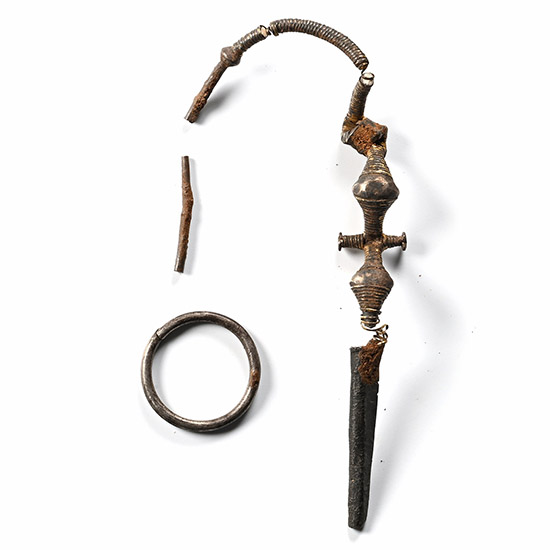
Italic Silver Wire Fibula
Circa 700-600 B.C.Estimate: £200 - 300 (‡+bp*)
Opening Bid: £100
With a coiled spring and lateral lugs; tapering shank, and separate ring. 9.11 grams total, 1.8-12.4 cm
Private collection, Switzerland, 1992. Thence by descent. Private collection, since the late 1990s.
