
Loading, please wait...
LOT 0067
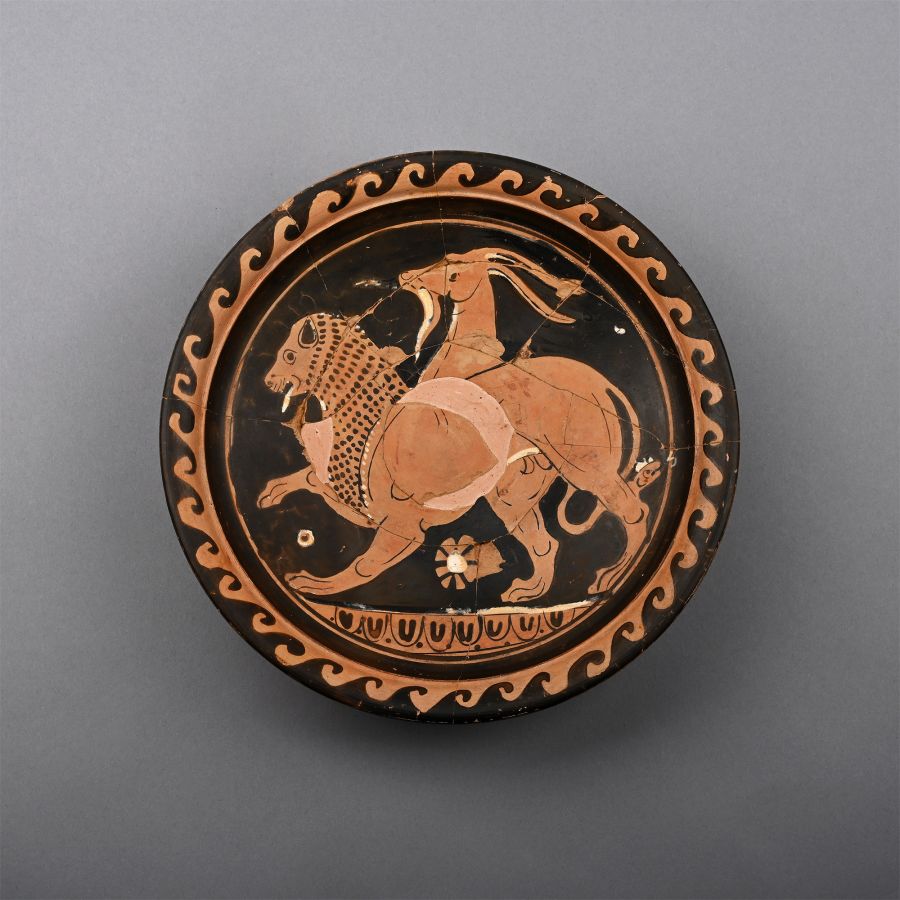
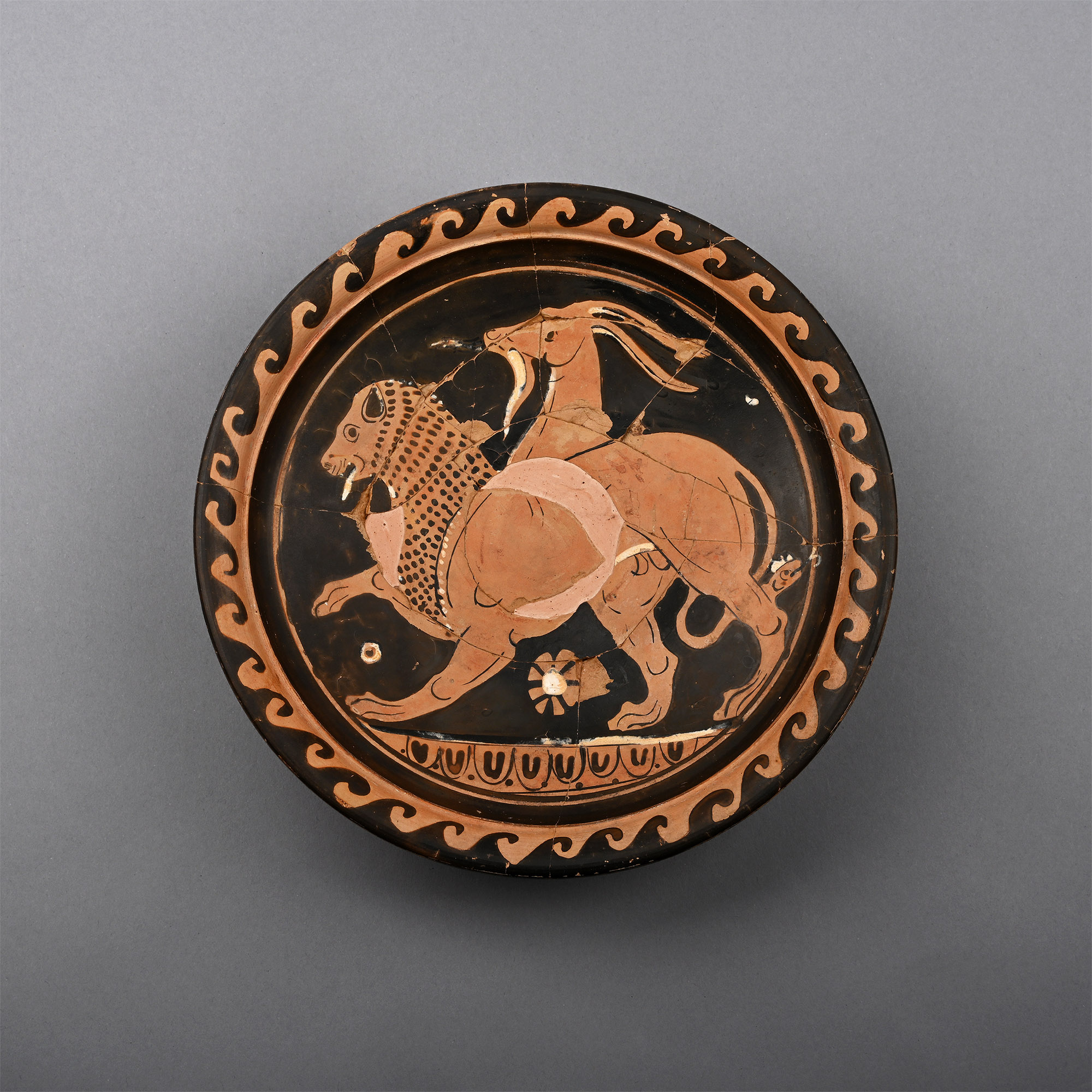
Greek Red-Figure Patera with Chimera
APULIAN, 4TH CENTURY B.C.
8 in. (342 grams, 20.5 cm wide).
With curved rim, carinated profile and low foot; rim with reserved wave pattern, tondo with reserved ring enclosing a chimera in profile advancing on an egg-and-dart baseline; repaired and partly restored.
ProvenanceEx private North American collection.
Acquired in the United States, 2010.
Accompanied by an academic report by Dr Raffaele D'Amato.
Accompanied by a thermoluminescence analysis report no.N126a12 from Oxford Authentication.
This lot has been checked against the Interpol Database of stolen works of art and is accompanied by search certificate number no.13028-246781.
Cf. a red-figure Apulian plate with the same iconography, in Musée du Louvre, c.350-340 B.C., inventory no. Cp1358, K362, in Morin, J., Le dessin des animaux en Grèce d'après les vases peints: essais sur les procédés des dessinateurs industriels dans l'antiquité, Paris, 1911, p. 247, 248, n° 11, no. 12; Schauenburg, K., ‘Neue Darstellungen aus der Bellerophonsage’, in Archäologischer Anzeiger, 1958, p. 25, fig. 26; Veron, G. (ed.), Félins. Petit dictionnaire illustré, cat. exp. (Paris, Grande Galerie de l'évolution, 2023), Paris, Muséum national d'histoire naturelle, 2023, p.55; Jacquemin, A., ‘Chimaira’ in Lexicon Iconographicum Mythologiae Classicae, III, 1986, p. 252, pl. 202, no. 60; see also Wisseman, S.U., Corpus Vasorum Antiquorum, Mainz, 1989, p.41, pl.52,3, for type.
FootnotesThe legend of Bellerophon and the chimaera was a subject highly appreciated by the Greek ceramists. Red-figure Apulian plates depicting the chimaera were realised in South Italian workshops dating back to around 350-340 BC. The most famous example and possible prototype is the one held at the Musée du Louvre in Paris, created using the red-figure technique.
CONDITIONTimeLine Auctions follows a vetting process to ensure the authenticity and legality of all items, reinforcing our commitment to integrity and responsible trading. Each antiquity, antique, and coin lot undergoes thorough examination by a vetting committee of at least ten external specialists, professional trade association members, scientists, and archaeologists: Our Vetting Process
AUCTIONS:
TimeLine is a leading auction house specialising in antiquities, ancient art, collectables, natural history, coins, medals, and books. Our auctions offer museums, collectors, historians, and enthusiasts the opportunity to acquire unique and historically significant pieces.
-
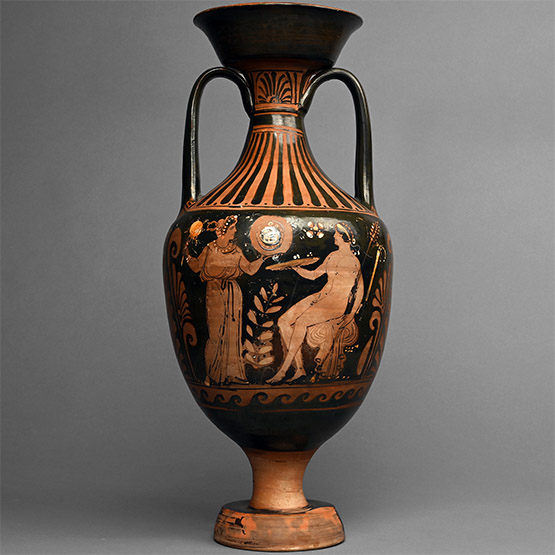
Large Greek Red-Figure Amphora with Dionysian Scenery
Apulian, 3rd-2nd century B.C.Sold for (Inc. bp): £3,640
The piriform body with broad, stepped rim and two lentoid-section handles; painted palemete beneath each handle and on the neck below the mouth; Side A: red-figure frieze depicting a standing woman wearing a himation and stephane, her hands raised supporting objects, a laurel frond before her and a seated nude male with thyrsus and other items; Side B: two opposed figures standing supported by staves, each wearing a loosely draped floor-length garment; objects in the field. 1.88 kg, 43 cm
Acquired on the art market between the late 1990s and mid-2000s. Estate of the late Barry Paul Buxton (1944-2024), Oakham, Rutland. Acquired on the UK art market, 2025. Accompanied by a thermoluminescence analysis report no.N126a18 from Oxford Authentication. This lot has been checked against the Interpol Database of stolen works of art and is accompanied by search certificate no.13075-248951.
The subject is standard, often representing the draped youths completely enveloped in their himatia. -
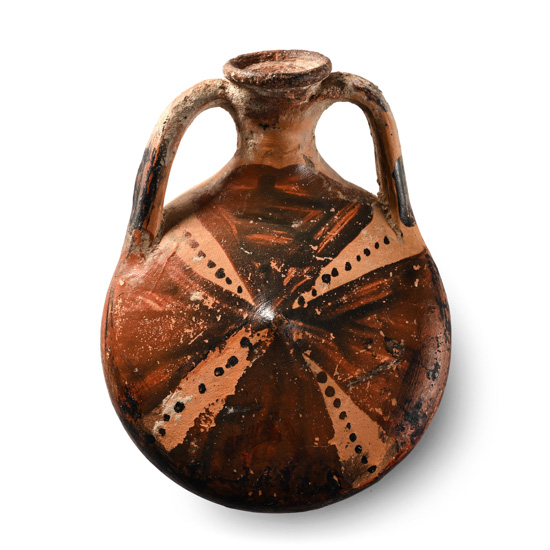
Mycenaean Painted Pottery Flask
14th-13th century B.C.Estimate: £1,500 - 2,000 (‡+bp*)
Opening Bid: £750
Comprising a circular body with a rounded base and two strap handles, a short neck with an everted rim; the body with a painted expanding cross motif with the arms separated by a band of pellets. 132 grams, 11.1 cm
Private collection, Switzerland, acquired in the 1994. Private family collection since the late 1990s. Accompanied by an academic report by Dr Raffaele D'Amato. This lot has been checked against the Interpol Database of stolen works of art and is accompanied by search certificate number no.13018-246795.
Mycenaean ceramics were influenced by Minoan shapes and decorative styles from the late Middle Helladic period. This close relationship – likely accompanied by the development of shared cultural practices and etiquette – creates the hypothesis that pilgrim flasks were introduced to Greece via Crete. Pilgrim flasks were produced in Mycenaean contexts from the Late Helladic IIA:1 period (1420-1390 B.C.). -
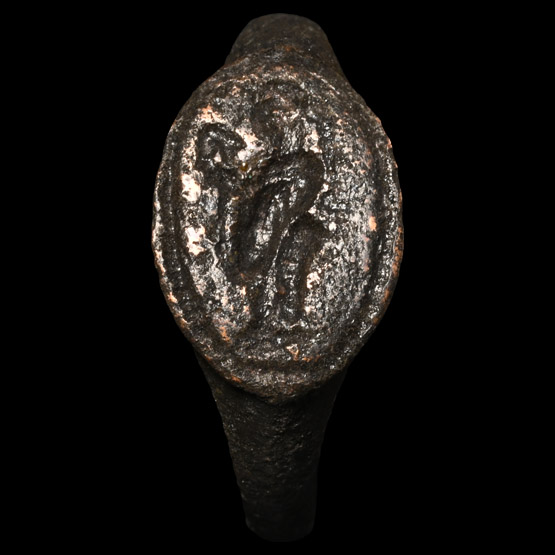
Graeco-Parthian Bronze Ring with Courtesan Holding a Flower
2nd-1st century B.C.Sold for (Inc. bp): £39
Comprising a slender hoop and an oval bezel with a standing female figure holding a flower. 4.91 grams, 24.51 mm overall, 19.94 mm internal diameter (approximate size British T 1/2, USA 9 3/4, Europe 21.89, Japan 21)
London, UK, art market, 1980s. Private collection, London, UK.
