
Loading, please wait...
LOT 0065
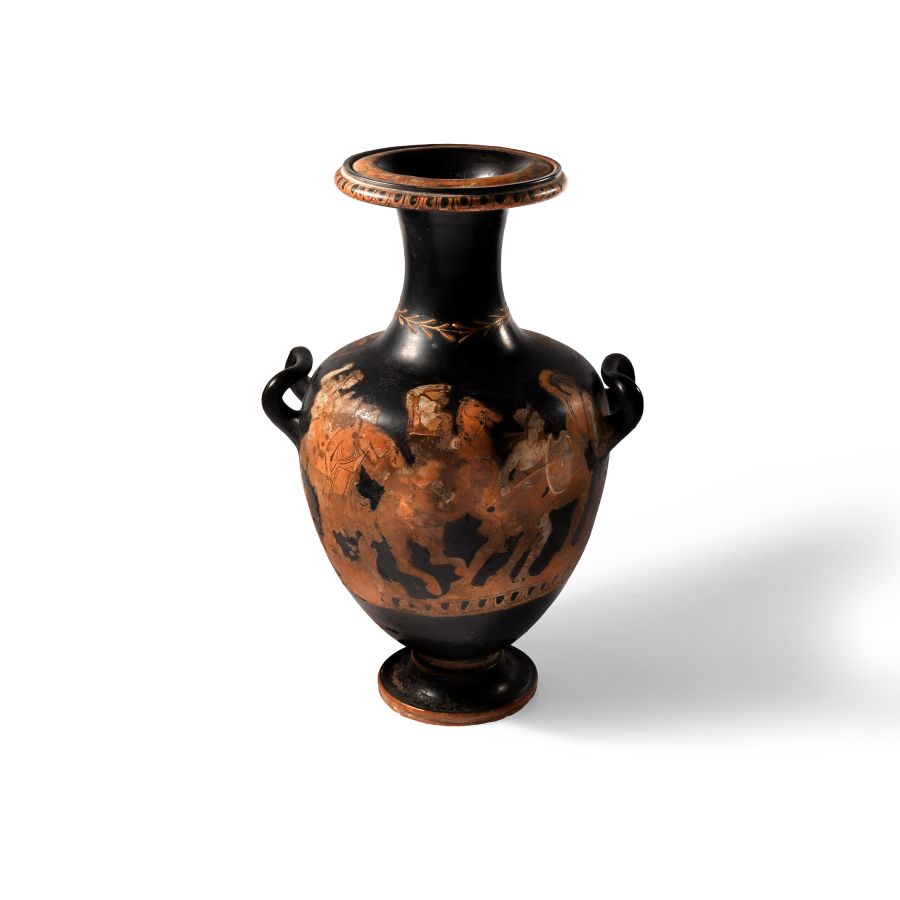
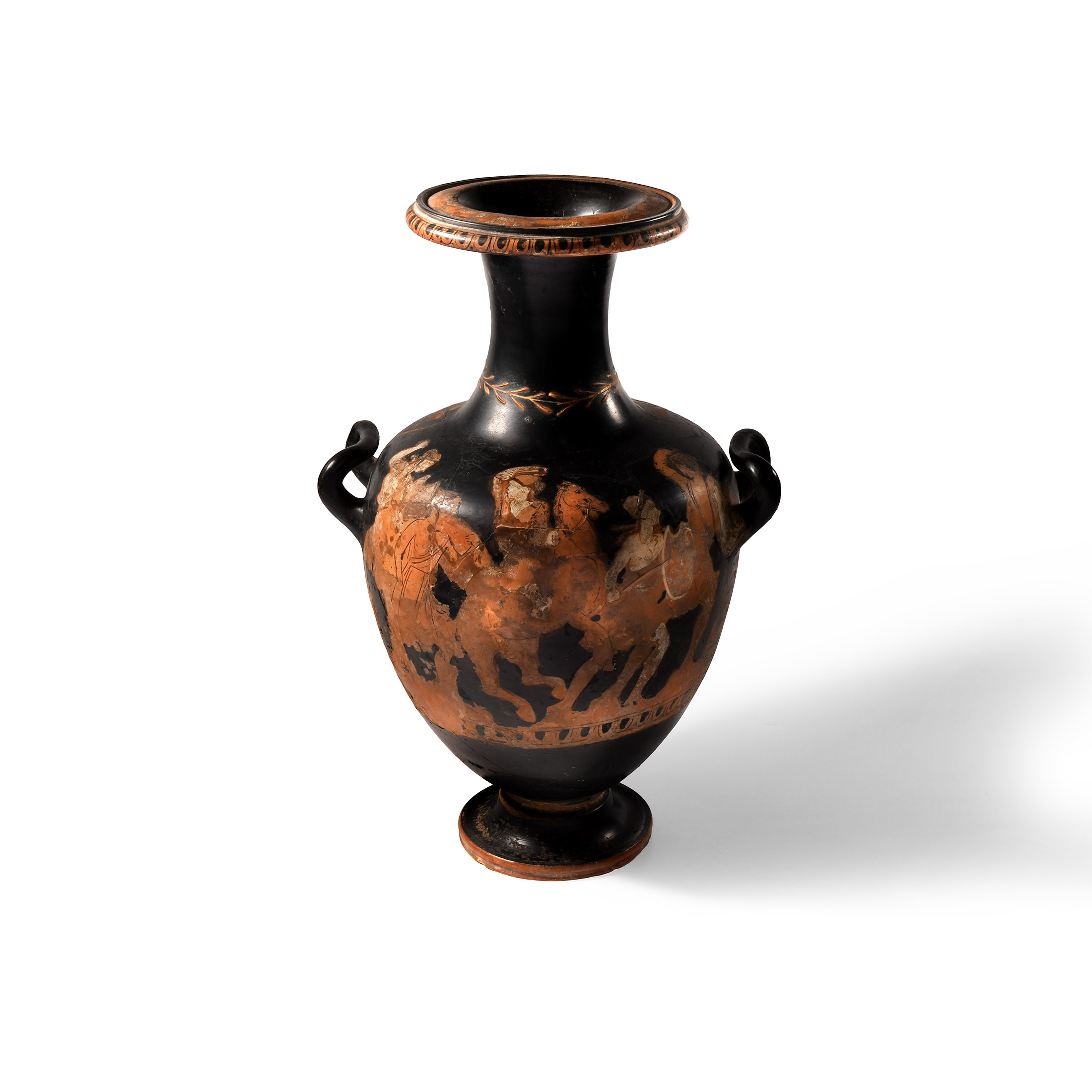
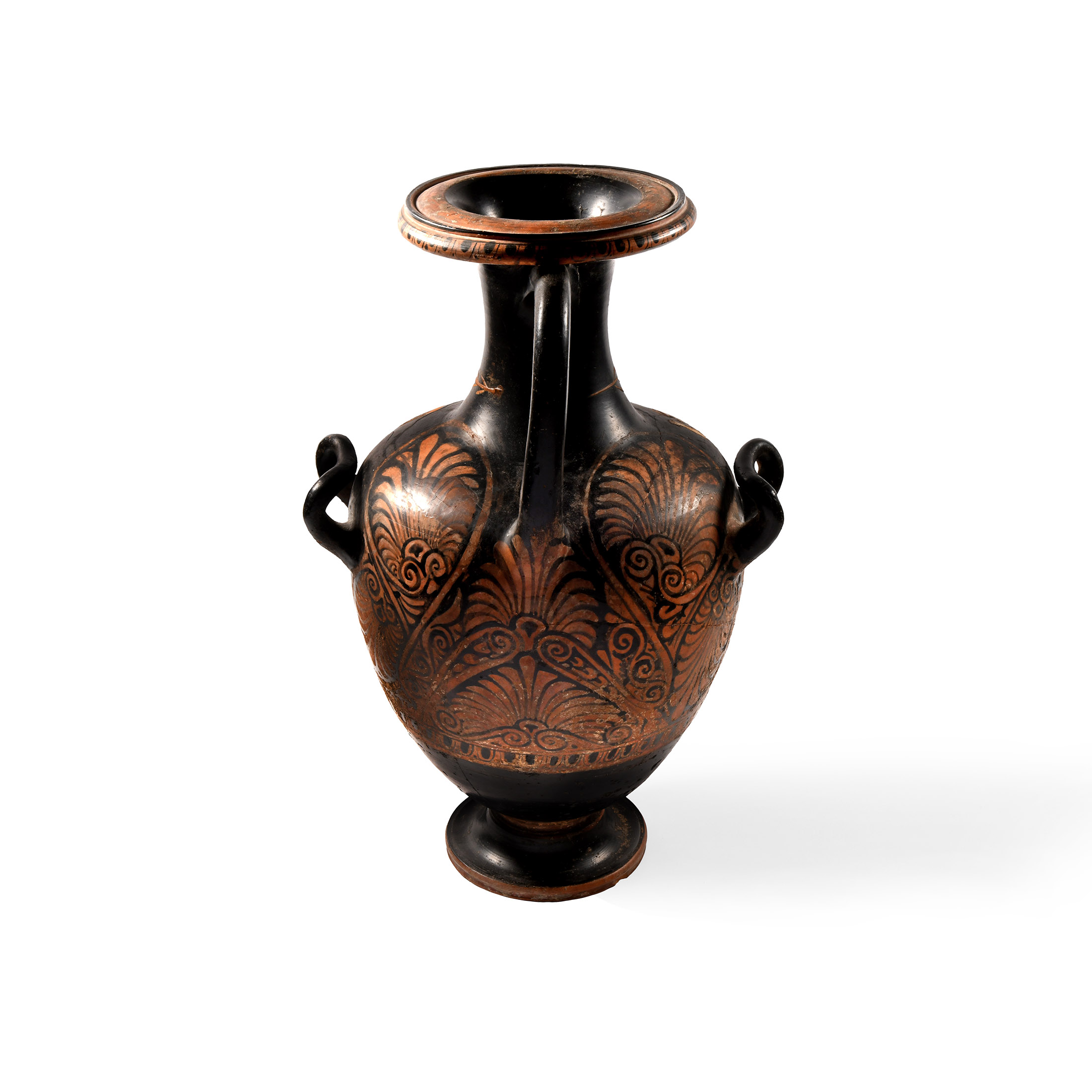
Greek Red-Figure Hydria with Fighting Between Amazons and Greek or Trojan Heroes
4TH CENTURY B.C.
18 1/8 in. (3 kg, 46 cm high).
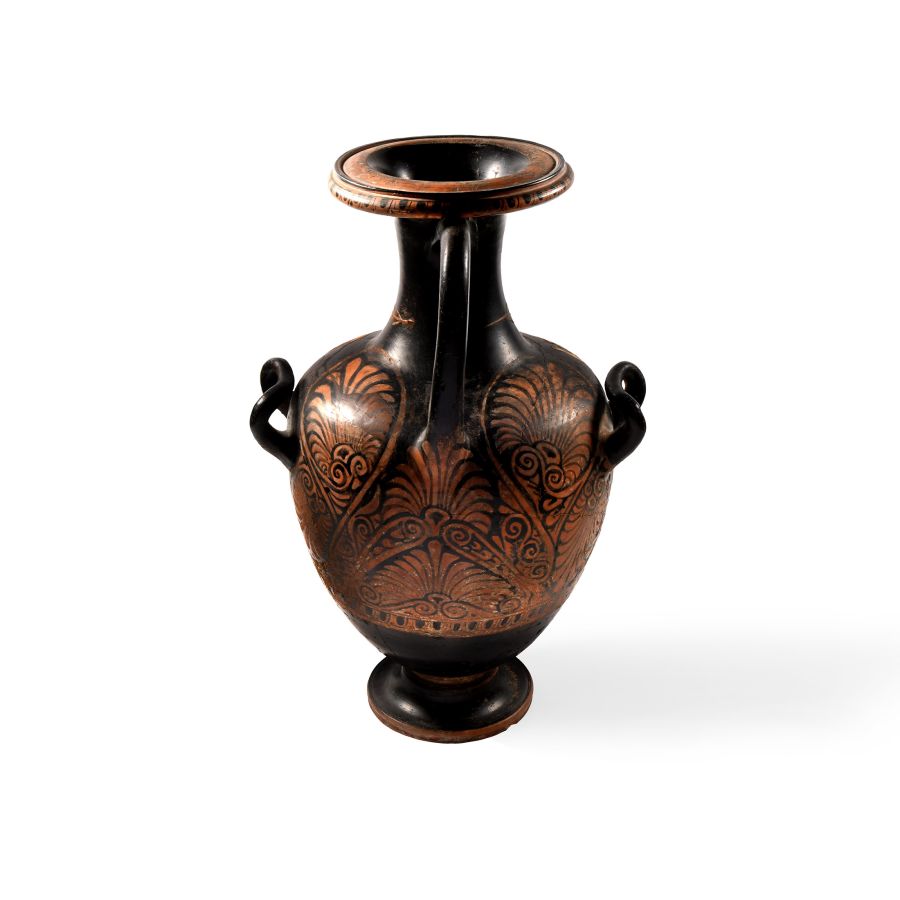
A red-figure terracotta hydria with mythological scene, the vessel with integral round-section upward facing handles, a third, round-section handle placed vertically between shoulder and upper neck to rear; laurel sprigs to the neck with traces of gilding; combat scene with Amazons (and Trojans?) below, armed with short swords and crescent shields, most wearing an exomis leaving the shoulder and one breast uncovered; volute palmettes below both side handles, a panel of tiered and swirling volutes to the rear, all on a band of egg-moulding, repeated around the rim; possibly Apulian or Campanian; restored.
ProvenanceEx collection Woodyat, Rome, Italy, 1912.
with Vente Genève, 24 & 25 June 1960.
Private European collection.
Accompanied by an academic report by Dr Raffaele D’Amato.
This lot has been checked against the Interpol Database of stolen works of art and is accompanied by search certificate number no.11581-199028.
Cf. The British Museum, museum number 1867,0508.1339 'Pottery: red-figured hydria (water jar)', for a similar type of vessel with a comparable volute panel to the rear, in Smith, A.N., Pryce, F.N., CVA British Museum 2 / Corpus Vasorum Antiquorum: Great Britain 2, British Museum 2, London, 1926, pl.8, 15; cf. The Metropolitan Museum, New York, accession number 07.128.1, for a similar vessel type, in Von Bothmer, D., Guide to the Collections: Greek and Roman Art, New York, 1964, p.24, fig.32; Trendall, A.D. & Cambitoglou, A., The Red-Figured Vases of Apulia, vol.1, Oxford, 1978, pl.XXX; Robinson, E.G.D., Carpenter, T., Lynch K.M., The Italic People of Ancient Apulia: New Evidence from Pottery for Workshops, Markets, and Customs, Cambridge, 2014, figs.4.5; for the represented topic see Patten, A.E., Addressing the Other: The Amazon in Greek Art, University Honors Theses, Portland, Paper 24, 2013, fig.2, folio VIII.
FootnotesThe mythological topic of this hydria is fascinating, representing the fight between Amazons and Greek or Trojan heroes (suggested by the central cavalryman wearing a Phrygian cap). During this period, Amazons were no longer represented as Persian or Scythian warriors, as in Attic red-figure ceramics, but depicted as athletic parthenoi and wearing chitons. Rather than the oriental costume and armour, the Amazons wear a short exomis with a bare shoulder and breast (Patten, 2013, PI.VI, I, VI,2, 2 and 3).
CONDITIONTimeLine Auctions follows a vetting process to ensure the authenticity and legality of all items, reinforcing our commitment to integrity and responsible trading. Each antiquity, antique, and coin lot undergoes thorough examination by a vetting committee of at least ten external specialists, professional trade association members, scientists, and archaeologists: Our Vetting Process
AUCTIONS:
TimeLine is a leading auction house specialising in antiquities, ancient art, collectables, natural history, coins, medals, and books. Our auctions offer museums, collectors, historians, and enthusiasts the opportunity to acquire unique and historically significant pieces.
LOT 0065
Greek Red-Figure Hydria with Fighting Between Amazons and Greek or Trojan Heroes
Estimate £8,000 - 10,000€9,280 - 11,600 (for guidance only)$10,800 - 13,500 (for guidance only)
-
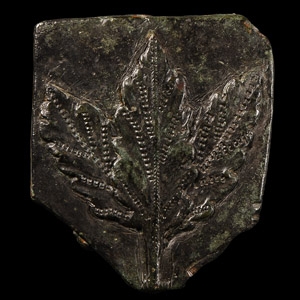
Hellenistic Acanthus Jewellery Matrix
4th-2nd century B.C.Estimate: £120 - 170 (+bp*)
Opening Bid: £60
A trapezoidal bronze matrix, likely for jewellery production, bearing an acanthus leaf motif in relief to one face, with delicate detailing. 78 grams, 57 mm
German collection before 2000. Collection of Mr.D.H., formed in UK, from the EU art market. Property of a Surrey gentleman.
In antiquity, matrices for raising jewellery elements, ornaments and plaques were made of bronze, stone or reinforced terracotta. Matrices with designs in relief were used as an alternative to matrices with hollow designs or intaglio matrices. -
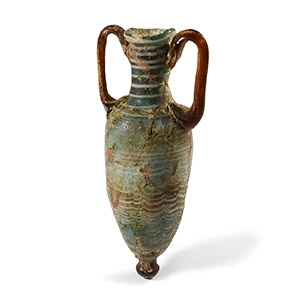
Greek Festooned Glass Amphoriskos
2nd-1st century B.C.Sold for (Inc. bp): £1,404
An aqua coloured amphoriskos with an elongated piriform shape and tubular neck with everted rim, handles and knop foot applied using a contrasting aubergine-coloured glass; decorative white trails and festooning to the body and neck; repaired. 124 grams, 14.4 cm high
Acquired early 1990s. Ex private American collection; thence by descent. Private collection since 1998. -
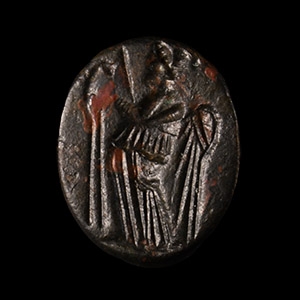
Greek Ring with Tyche
3rd-2nd century B.C.Estimate: £600 - 800 (+bp*)
Opening Bid: £300
An Eastern Greek bronze finger ring with intaglio winged Tyche in profile. 6.09 grams, 20.50 mm overall, 16.92 mm internal diameter (approximate size British K, USA 5 1/4, Europe 9.95, Japan 9)
Acquired in the late 1980s-early 1990s. Important North West London collection.
