
Loading, please wait...
LOT 0086
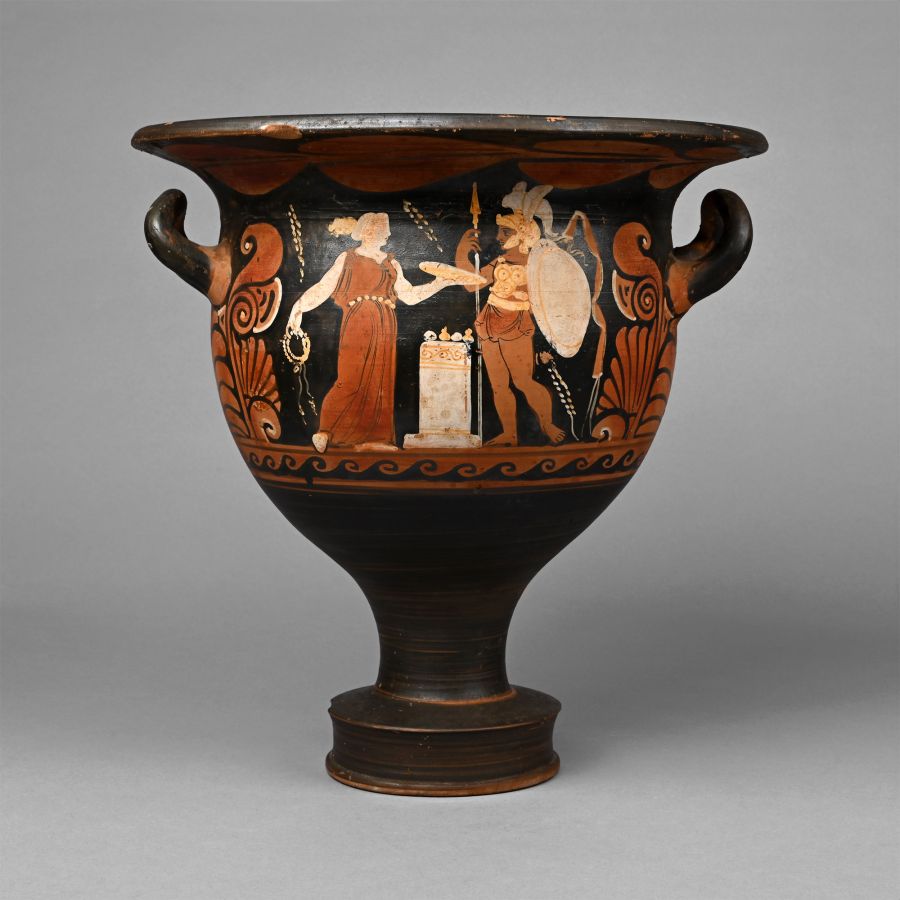
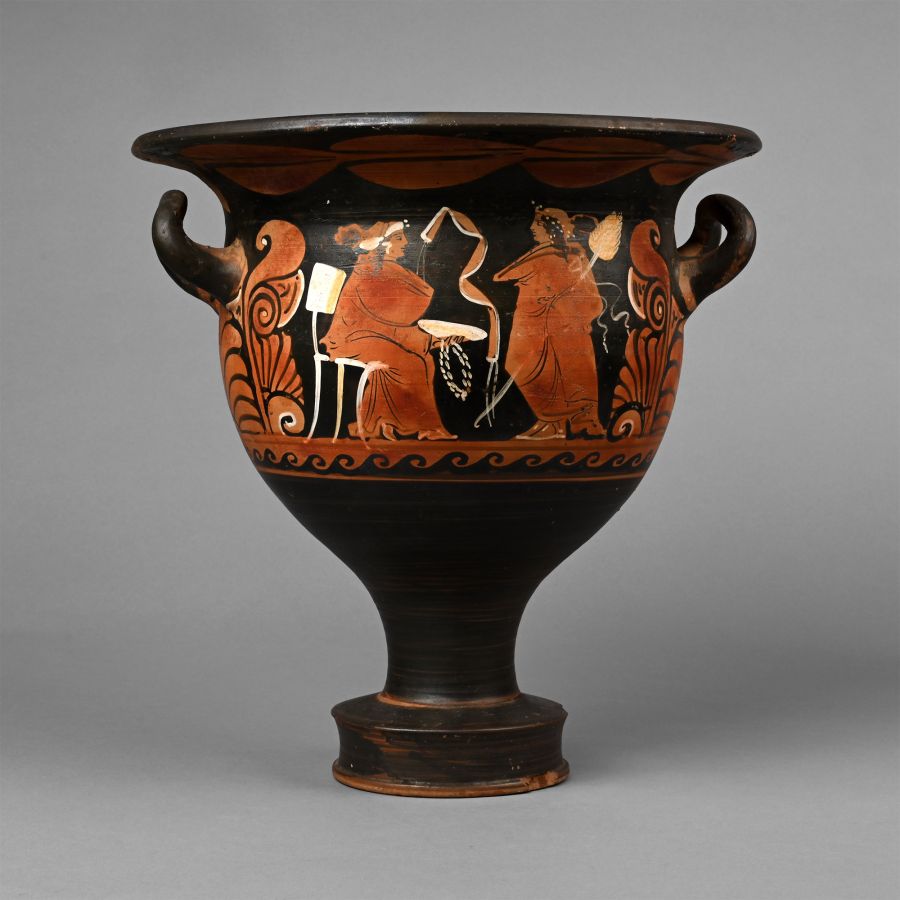
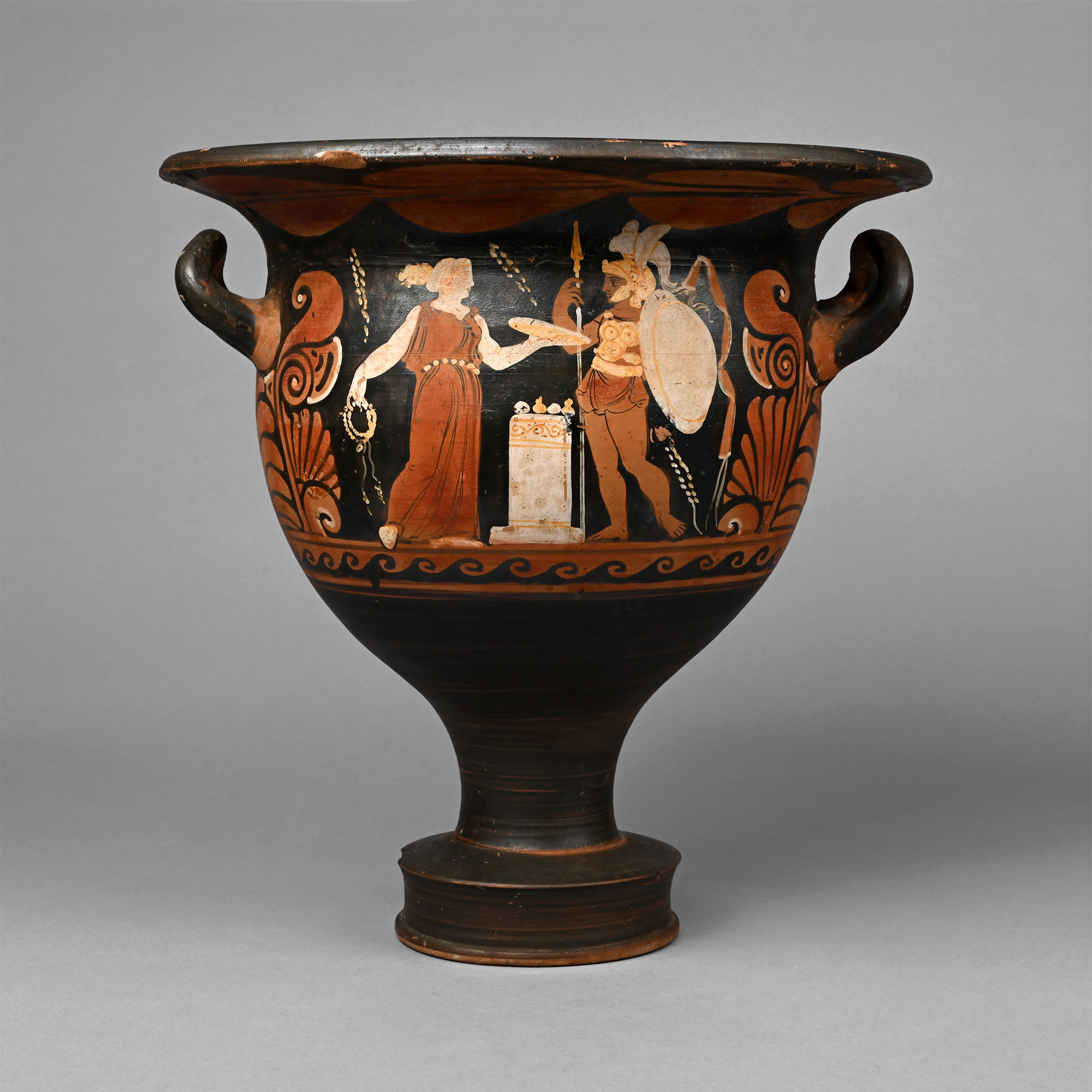
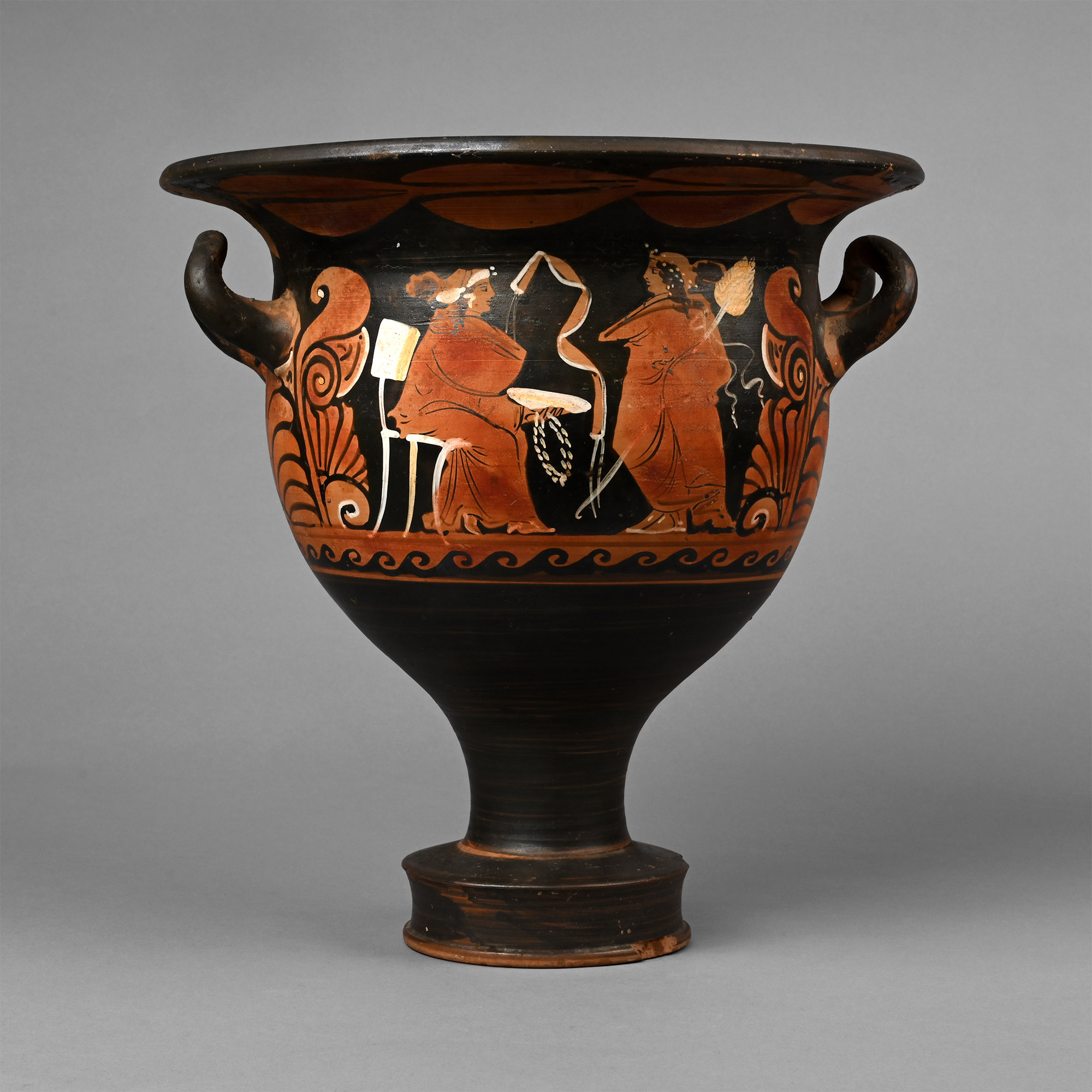
Greek Red-Figure Bell Krater with Warrior Funerary Offering Scene, Attributed to CA Painter
CAMPANIAN, 350-300 B.C.
11 5/8 in. (2.38 kg, 29.5 cm high).
Comprising a bell-shaped body with narrow stem and stepped pedestal foot, broad rim with square loop handles and palmettes beneath, frieze to sidewall: Side A: Oscan warrior with cuirass, helmet, shield and spear standing beside an altar with a female holding a patera in her extended hand, diadem in the other at her side; Side B: seated female with a patera and wreath facing a standing cloaked figure with thyrsus.
ProvenancePrivate collection, Geneva, acquired in the late 1960s.
Private collection, acquired in Geneva in 2000.
Accompanied by collector's notes and old images.
Accompanied by an original copy thermoluminescence analysis report no.QED1412/.SG-0602 from QED Laboratoire.
Accompanied by an academic report by Dr Raffaele D'Amato.
This lot has been checked against the Interpol Database of stolen works of art and is accompanied by search certificate number no.13219-249314.
Cf. similar style in Paul Getty Museum, inv. no.71.AE.301 in Jentoft-Nilsen, M.R., Corpus Vasorum Antiquorum, The J. Paul Getty Museum-Malibu, South Italian Vases, Apulian Red-Figure, Malibu, 1990, p.16 pl.151; see an identical warrior represented on a red figure lekythos at the Capua museum (fig.1) and another amphora in the same museum, coming from the Necropolis of Caivano (Napoli) (Fig.2); for other similar works see a terracotta skyphos in the MET, accession no. 91.1.444.
FootnotesThe krater offers an interesting glimpse into the local life of Campania in the 4th century B.C. Particularly noteworthy is the depiction of the Oscan Samnite warrior, fully armed in the style of Campanian, Samnite, or Lucanian mercenaries, performing a funerary sacrifice. The depiction of the Chalcidian helmet, with its central crest and twin lateral plumes (geminae pinnae), dedicated to Mars, is extremely detailed.
The style and the way in which the figures are realised, the conformation of the women, the details of the warrior, seem to point to the workshop of the CA Painter, a Campanian red-figure vase-painter whose name is unknown. Nevertheless, consistent individual characteristics of style suggest the existence of a unique artistic personality. Trendall called him the CA Painter because he was the chief painter in the first stage of Cumaean red-figure vase-painting, the initials standing for Cumaean (C), first stage (A).
TimeLine Auctions follows a vetting process to ensure the authenticity and legality of all items, reinforcing our commitment to integrity and responsible trading. Each antiquity, antique, and coin lot undergoes thorough examination by a vetting committee of at least ten external specialists, professional trade association members, scientists, and archaeologists: Our Vetting Process
AUCTIONS:
TimeLine is a leading auction house specialising in antiquities, ancient art, collectables, natural history, coins, medals, and books. Our auctions offer museums, collectors, historians, and enthusiasts the opportunity to acquire unique and historically significant pieces.
LOT 0086
Greek Red-Figure Bell Krater with Warrior Funerary Offering Scene, Attributed to CA Painter
Sold for (Inc. bp): £5,980
-
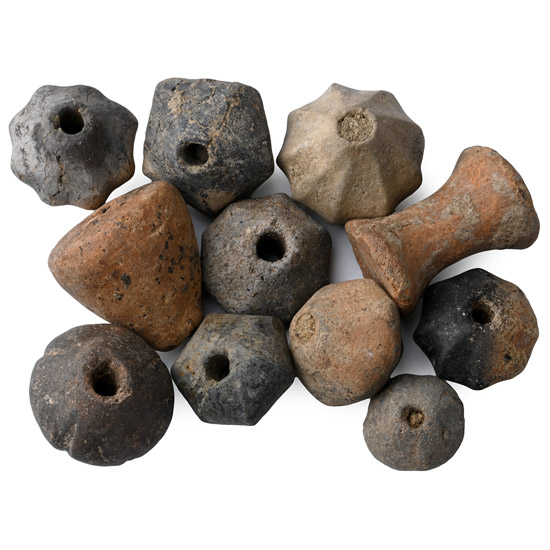
Villanovan Terracotta Artefact Collection
Iron Age, circa 8th century B.C.Sold for (Inc. bp): £65
Mainly comprising weights and spindle whorls of various shapes. 193 grams total, 22-36.6 mm
From the private collection of a European gentleman (1942-2024), formed since the 1970s. -
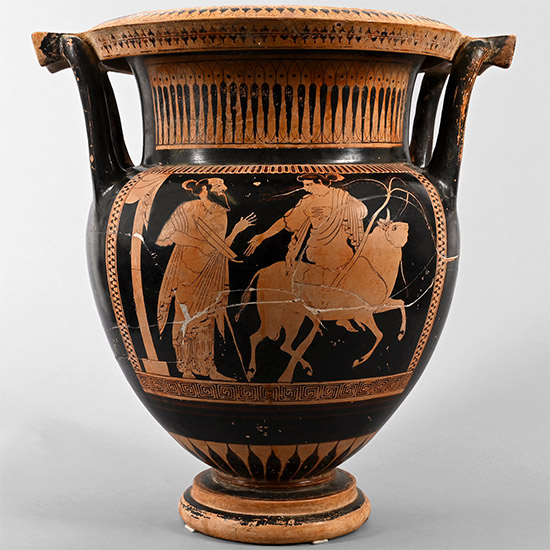
Greek Red-Figure Column Krater with Bull and Rider
Attic, 5th century B.C.Estimate: £30,000 - 40,000 (‡+bp*)
Opening Bid: £15,000
With a flared and stepped foot, poppy-head border around the lower body and neck, strap handles with palmettes to the upper faces opening to two columnar legs; red-figure scenes to the neck and body: Side A, Europa's abduction: standing bearded figure in profile wearing a loose himation holding the lid of a krater in one hand facing a female figure in draped himation revealing one breast, turning to face the male while mounted on an advancing bull and carrying a frond; Side B, Dionysiac scene: satyr standing nude, playing a lyre beside a standing robed male wearing a laurel wreath in his hair, dancing female in active pose with musical instruments in each hand, turning to face the robed figure; some restoration. 5.85 kg, 44.5 cm high
Red-figure technique, with certain details highlighted in a wine-colored hue. The surface has taken on a light yellow hue throughout. Some cracks, and the varnish is chipped in some place.
German private collection (870632). Anonymous sale, Hampel Fine Arts auction, Munich, 21 September 2012, no.625. Private collection, acquired on the German art market. Accompanied by an academic report by Dr Jacques Chamay. This lot has been checked against the Interpol Database of stolen works of art and is accompanied by search certificate number no.13218-249222.
The two figurative scenes are of equal importance. The Dionysian one depicts the god, in the centre, between a satyr playing a lyre and a dancing maenad. The other scene depicts a well-known subject: the abduction of Europa. This is the daughter of Agenor, king of Tyre in Phoenicia. Of great beauty, she is desired by Zeus. He approaches her in the form of a white bull while she is playing on the beach. Initially frightened, the young woman begins to caress the animal, then becomes more daring and climbs onto its back. Zeus immediately abducts her and rushes out to sea, toward Crete. There, he will be united with Europa, who will bear him three children, including Minos. -
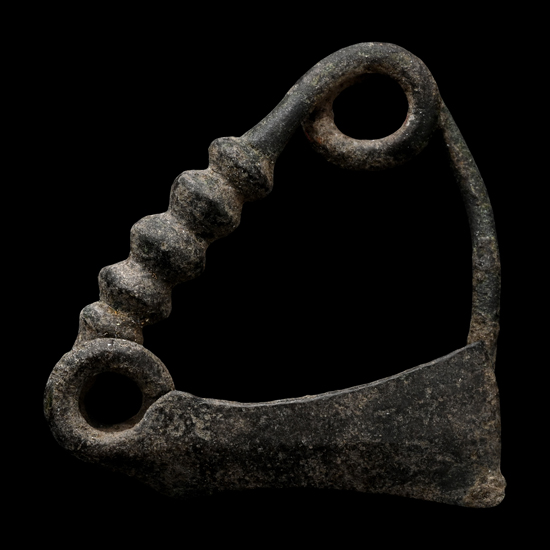
Greek Bronze Bow Brooch
Circa 7th century B.C.Sold for (Inc. bp): £72
Comprising a corrugated bow with coil to each end, one extending to the spring and the other to a broad plate with a catch at the lower end. 11.19 grams, 42.09 mm.
From the private collection of a European gentleman (1942-2024), formed since the 1970s.
