
Loading, please wait...
_900x900.jpg "Greek Red-Figure Bell Krater with Eros")
_200x200.jpg "Greek Red-Figure Bell Krater with Eros")
_900x900.jpg "Greek Red-Figure Bell Krater with Eros")
_200x200.jpg "Greek Red-Figure Bell Krater with Eros")
_900x900.jpg "Greek Red-Figure Bell Krater with Eros")
_200x200.jpg "Greek Red-Figure Bell Krater with Eros")
_900x900.jpg "Greek Red-Figure Bell Krater with Eros")
_200x200.jpg "Greek Red-Figure Bell Krater with Eros")
.jpg "Greek Red-Figure Bell Krater with Eros")
.jpg "Greek Red-Figure Bell Krater with Eros")
.jpg "Greek Red-Figure Bell Krater with Eros")
.jpg "Greek Red-Figure Bell Krater with Eros")
LOT 0036
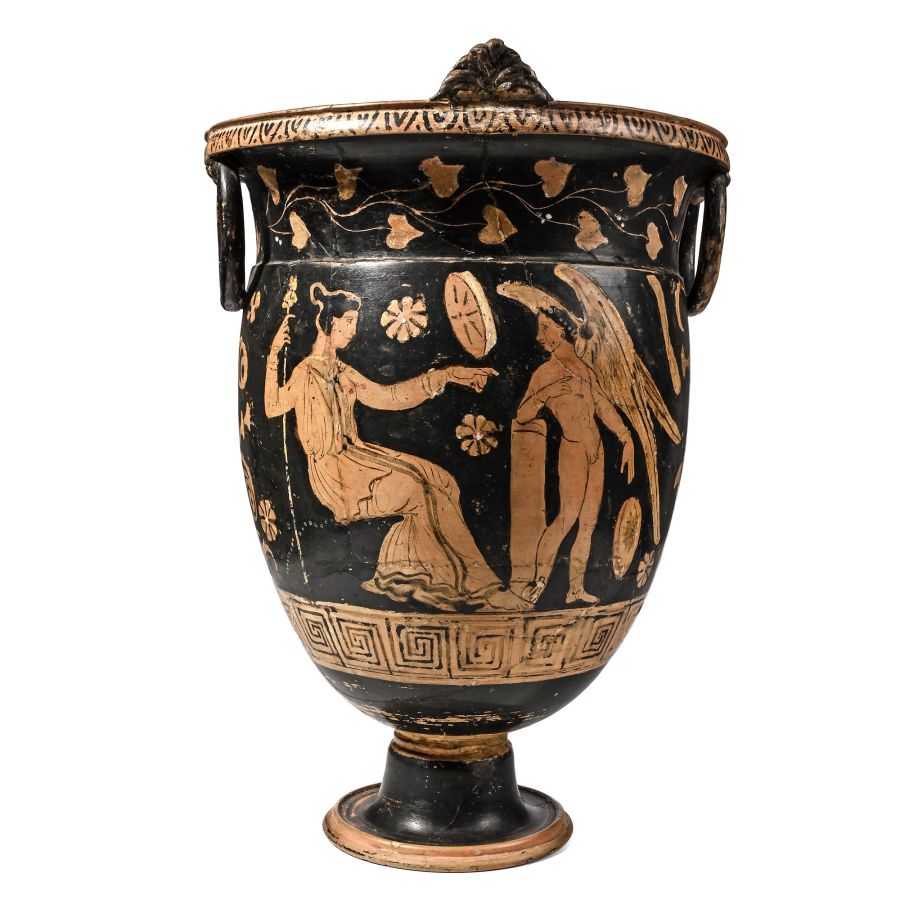
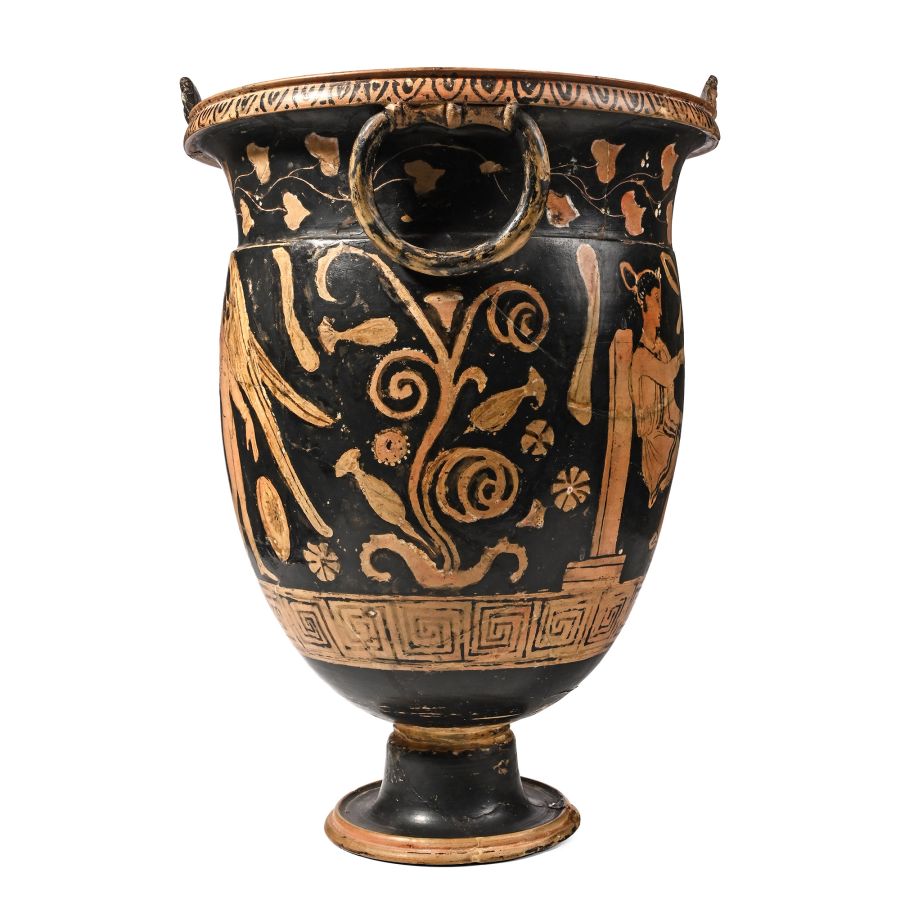
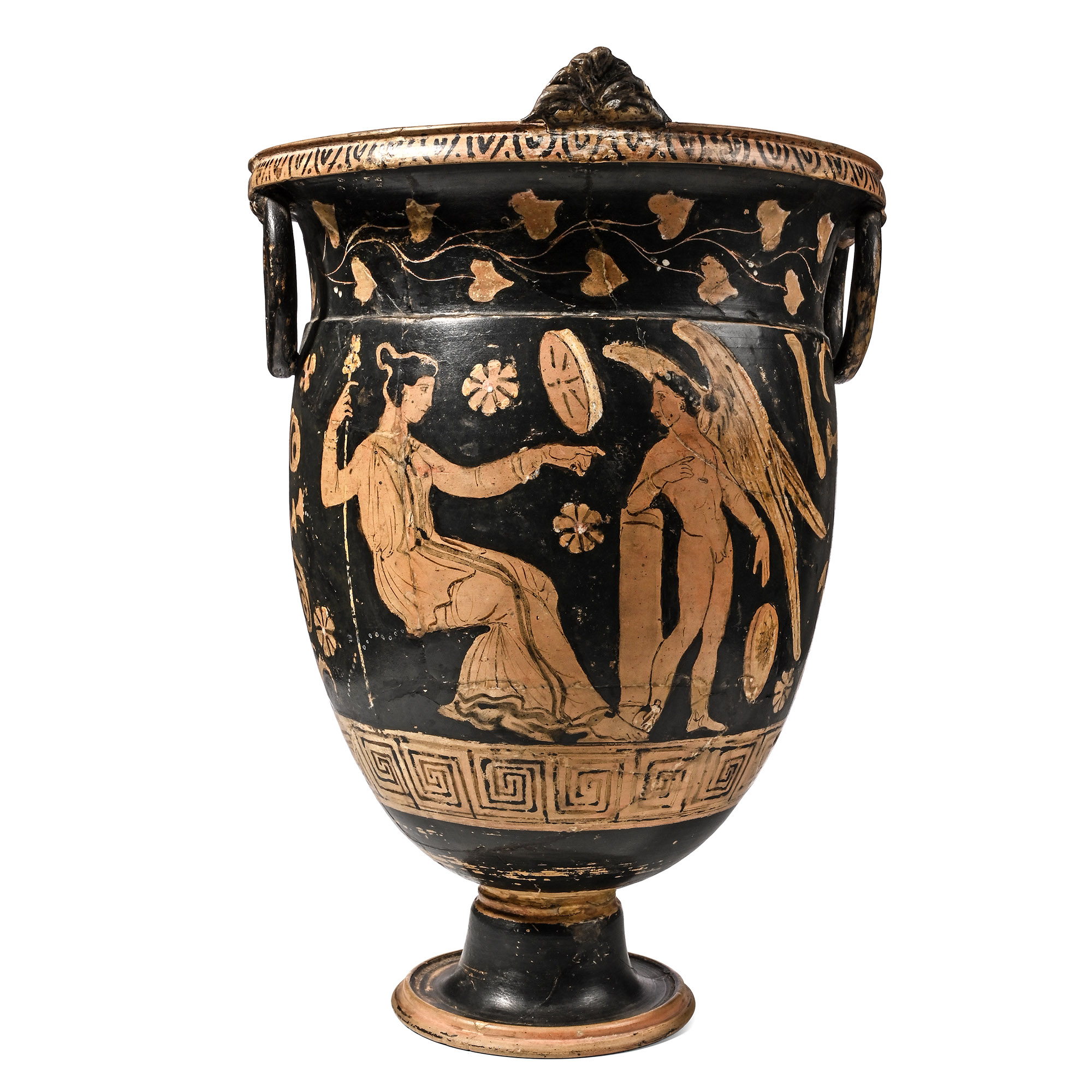
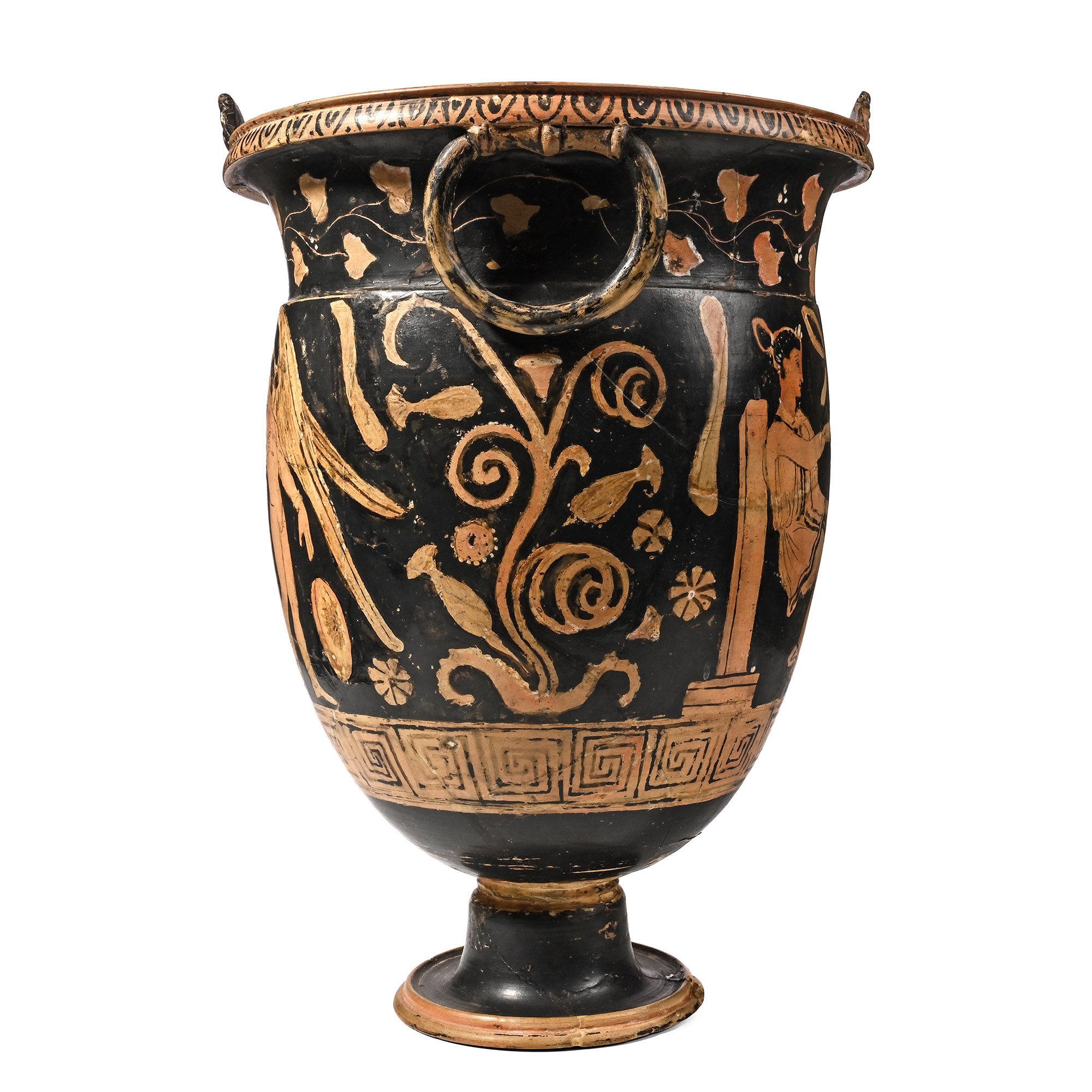
Greek Red-Figure Bell Krater with Eros
APULIA, 4TH CENTURY B.C.
13 1/4 in. (1.81 kg, 33.5 cm).
With flared and carinated foot, broad stem, ovoid body, carinated shoulder, everted rim with lip, D-shaped antefixes and lateral pendant loop handles; band of ivy to the neck and meander to the lower edge, frieze with figural scenes: Side A - seated female with thyrsos pointing towards Eros with head turned regarding her, wings spread; Side B - seated female in tiered robe pointing towards standing Eros with wreath, objects in the field; by the Ascoli Satriano Painter; restored.
ProvenanceEx private collection, previously with Bonhams, Bond Street, London, UK.
This lot has been checked against the Interpol Database of stolen works of art and is accompanied by search certificate number no.13353-259030.
Cf. a terracotta red figure of Eros by the Ascoli Satriano Painter in The Walters Art Museum, accession no.48.2765; for a similar krater cf. Hodder, A., Shaping Gender: Apulian Red-Figure Pottery and the Gender Expression of Ancient Italic Peoples, Sidney, 2023, fig.7.3.
FootnotesFemale heads and Eros figures are common features on the vases attributed to the Ascoli Satriano Painter. His real name is unknown, and he has been named after a northern Apulian town, where many of his vases have been found.
CONDITIONTimeLine Auctions follows a vetting process to ensure the authenticity and legality of all items, reinforcing our commitment to integrity and responsible trading. Each antiquity, antique, and coin lot undergoes thorough examination by a vetting committee of at least ten external specialists, professional trade association members, scientists, and archaeologists: Our Vetting Process
AUCTIONS:
TimeLine is a leading auction house specialising in antiquities, ancient art, collectables, natural history, coins, medals, and books. Our auctions offer museums, collectors, historians, and enthusiasts the opportunity to acquire unique and historically significant pieces.
-
.jpg)
Exceptionally Large Greek Gnathian Skyphos
Apulia, 5th-3rd century B.C.Sold for (Inc. bp): £1,820
Mammiform body with pedestal base and two loop handles to the rim; Side A - band of white ovolo detailing to the neck, median red band with vine leaves and tendrils; Side B - bilinear band below neck with lateral pellets. 2.21 kg, 34.4 cm
Ex Orivate collection, formerly with Art Ancient, previously Derek Glover collection. -
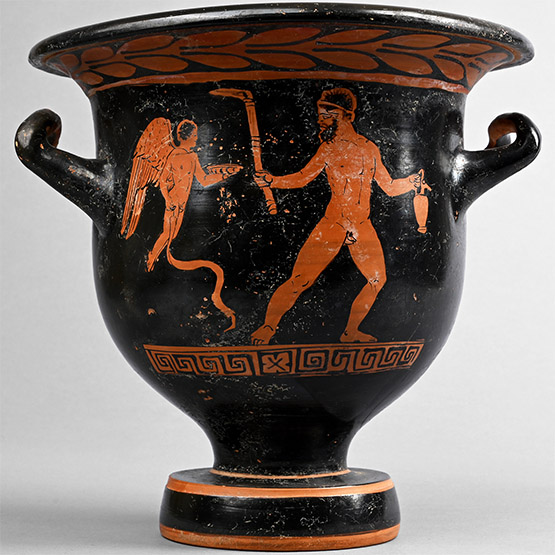
Greek Red-Figure Bell Krater with Satyr and Eros
Apulia, circa 450-400 B.C.Sold for (Inc. bp): £3,120
With laurel-leaf wreath beneath the flared rim, band of meander ornament as a baseline; Side A: striding satyr with torch and oinochoe followed by Eros holding a scroll behind; Side B: woman wearing a himation in active pose with sphere advancing towards a tendril. 814 grams, 20 cm
Acquired on the art market between the late 1990s and mid-2000s. Estate of the late Barry Paul Buxton (1944-2024), Oakham, Rutland. Acquired on the UK art market, 2025. Accompanied by an academic report by Dr Raffaele D'Amato. This lot has been checked against the Interpol Database of stolen works of art and is accompanied by search certificate no.13070-249284.
Often, the iconography of an 'elevated' mythological subject was applied to members of Dionysos' retinue. Here we have three typical examples of them: a satyr, an Eros, and a woman, all three behaving according to Bacchic ecstasies. -
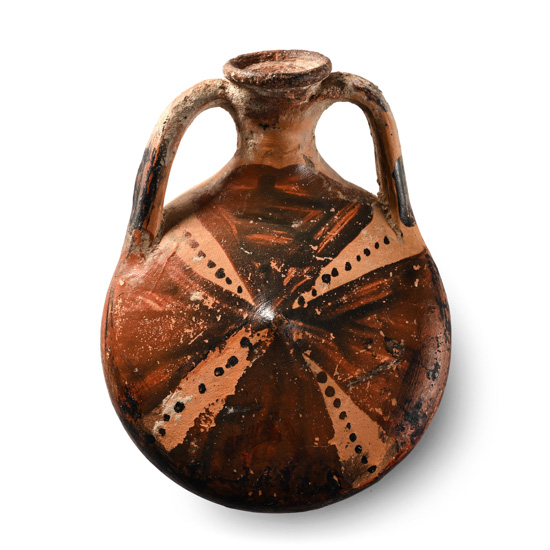
Mycenaean Painted Pottery Flask
14th-13th century B.C.Sold for (Inc. bp): £1,820
Comprising a circular body with a rounded base and two strap handles, a short neck with an everted rim; the body with a painted expanding cross motif with the arms separated by a band of pellets. 132 grams, 11.1 cm
Private collection, Switzerland, acquired in the 1994. Private family collection since the late 1990s. Accompanied by an academic report by Dr Raffaele D'Amato. This lot has been checked against the Interpol Database of stolen works of art and is accompanied by search certificate number no.13018-246795.
Mycenaean ceramics were influenced by Minoan shapes and decorative styles from the late Middle Helladic period. This close relationship – likely accompanied by the development of shared cultural practices and etiquette – creates the hypothesis that pilgrim flasks were introduced to Greece via Crete. Pilgrim flasks were produced in Mycenaean contexts from the Late Helladic IIA:1 period (1420-1390 B.C.).
