
Loading, please wait...

LOT 0641
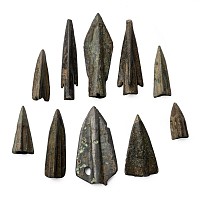
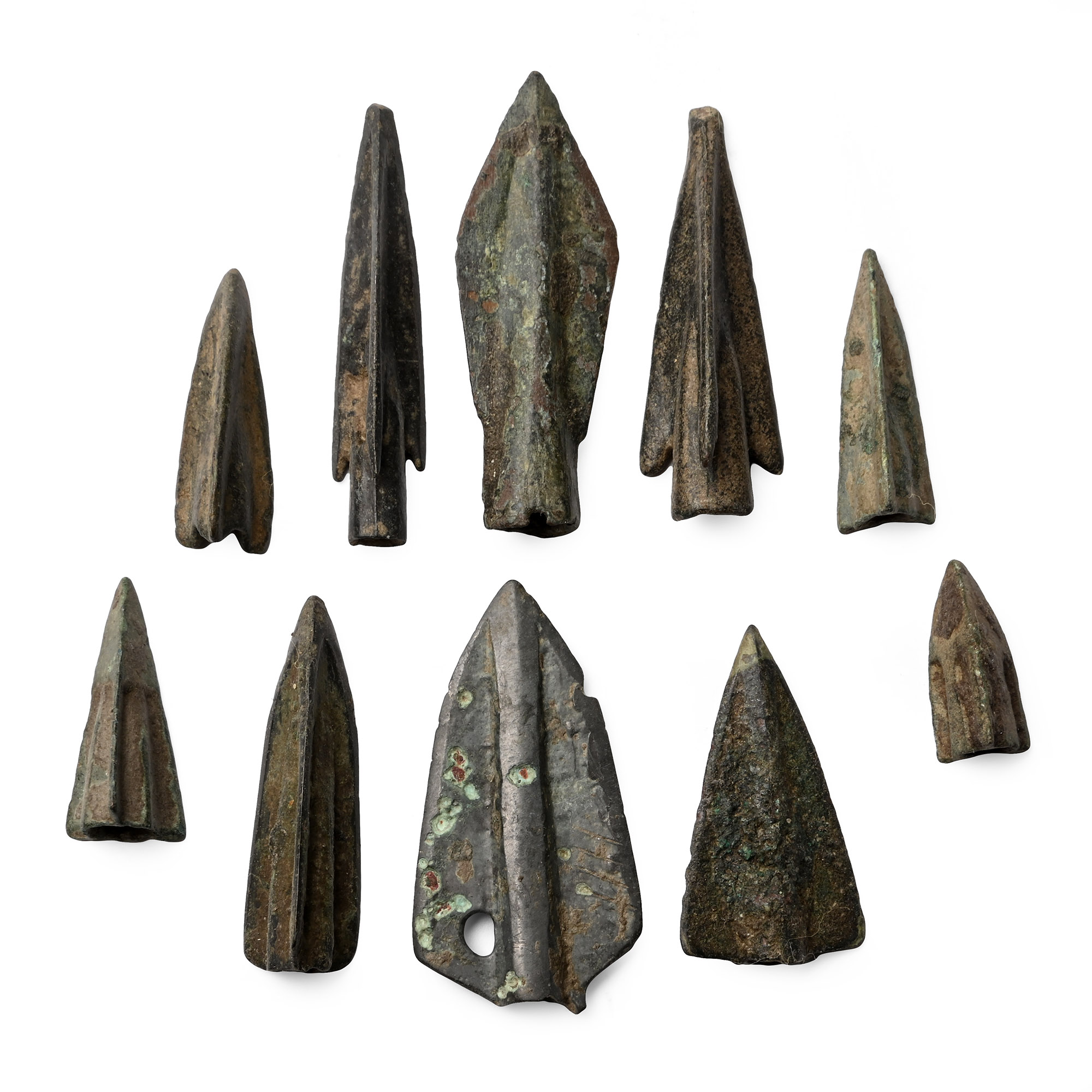
Greek Period High Quality Bronze Arrowhead Collection
5TH-3RD CENTURY B.C.
5/8 - 1 3/8 in. (28 grams total, 16-35 mm).
Mainly triangular-section socketted and deltoid types. [10, No Reserve]
ProvenanceFrom an English collection formed before 2000.
This lot is accompanied by an illustrated lot declaration signed by the Head of the Antiquities Department, Dr Raffaele D'Amato.
TimeLine Auctions follows a vetting process to ensure the authenticity and legality of all items, reinforcing our commitment to integrity and responsible trading. Each antiquity, antique, and coin lot undergoes thorough examination by a vetting committee of at least ten external specialists, professional trade association members, scientists, and archaeologists: Our Vetting Process
AUCTIONS:
TimeLine is a leading auction house specialising in antiquities, ancient art, collectables, natural history, coins, medals, and books. Our auctions offer museums, collectors, historians, and enthusiasts the opportunity to acquire unique and historically significant pieces.
-
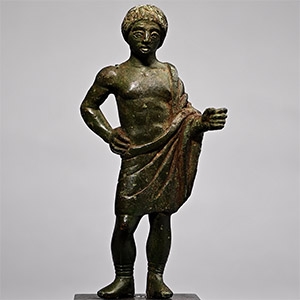
Etruscan Bronze Statuette of a Draped Hero
4th-3rd century B.C.Estimate: £15,000 - 20,000 (‡+bp*)
Opening Bid: £6,667
Modelled in the round standing erect with right hand on his hip and left arm extending from the elbow resting on the left hip and with fingers curled to hold a staff or handle, wearing a loosely draped cloth over the left shoulder and drawn around the body to hang over the arms; ribbed cuffs to the boots; youthful face with tousled hair and slightly exaggerated lentoid eyes; C-shaped staple beneath the feet for attachment; supplied with a custom-made display stand. 506 grams total, 18.7 cm including stand
with Sotheby’s, Antiquities, London, 6 July 1995, no.130. Acquired by the present owner at the above sale. This lot has been checked against the Interpol Database of stolen works of art and is accompanied by search certificate number no.12194-222321. This lot has been cleared against the Art Loss Register database, and is accompanied by an illustrated lot declaration signed by the Head of the Antiquities Department, Dr Raffaele D'Amato.
The statue was probably a cult offering and presents an archaic Etruscan hairstyle, being part of the Italic statuettes produced as votive offering to the temples or for private lararia. His warrior status can be confirmed by his boots, typical of Etruscan and Latin warriors of archaic times. -
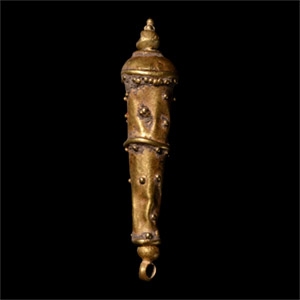
Hellenistic Gold Herakles Club Pendant
2nd-1st century B.C.Sold for (Inc. bp): £572
Formed as a tapering club with applied granule decoration, applied sphere with granulation at the top of the club, suspension loop at the handle end. 2.01 grams, 32 mm
From the collection of a late Japanese collector, 1970s. This lot is accompanied by an illustrated lot declaration signed by the Head of the Antiquities Department, Dr Raffaele D'Amato. -
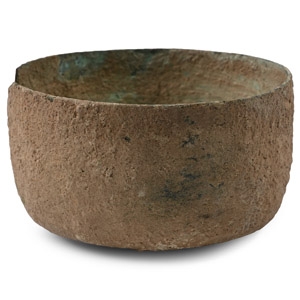
Graeco-Roman Bronze Cup
2nd century B.C.-1st century A.D.Sold for (Inc. bp): £221
Drum-shaped body with a slightly convex base. 143 grams, 93 mm
Ex London, UK, collections, 1990s-2000s. This lot is accompanied by an illustrated lot declaration signed by the Head of the Antiquities Department, Dr Raffaele D'Amato.
The small cup could belong to the typology of drinking vessels called mastos or cymbè. This denomination seems to have been derived from the inhabitants of the island of Paphos, with reference to the simple spherical vessels. Pollux mentions these vessels together with other cups, the phiale and the kumbion.
