
Loading, please wait...
_900x900.jpg "Greek Painted Pottery Aryballos")
_200x200.jpg "Greek Painted Pottery Aryballos")
.jpg "Greek Painted Pottery Aryballos")
LOT 0576
Greek Painted Pottery Aryballos
CORINTHIAN, CIRCA 6TH CENTURY B.C.
3 in. (212 grams, 75 mm).
With a narrow neck and a broad rim to the mouth, a short strap handle to the rear; painted concentric rings around the mouth.
ProvenancePrivate collection, acquired in 1994; thence by descent.
LiteratureCf. similar aryballos in the Department of Classics at the College of Art and Science of the University of the Colorado, inv.no.2006.37.T.; cf.also Bernhard, M.L., Corpus Vasorum Antiquorum Pologne-Fasc. 5: Varsovie-Musée National ii (Warsaw: Państwowe Wydawn, 1960), pl. 32 (1, 3, 4).
FootnotesFrom the 8th century B.C., Corinthian pottery vessels were exported to Greek colonies in South Italy and the coast of Asia Minor. They were used to hold perfumed oil, an essential item for the wealthy middle classes of the time. In Italy, especially in Etruria, local workshops produced imitations of Corinthian vessel types for a clientele of Greek settlers and local populations with a taste for Greek fashions.
CONDITIONTimeLine Auctions follows a vetting process to ensure the authenticity and legality of all items, reinforcing our commitment to integrity and responsible trading. Each antiquity, antique, and coin lot undergoes thorough examination by a vetting committee of at least ten external specialists, professional trade association members, scientists, and archaeologists: Our Vetting Process
AUCTIONS:
TimeLine is a leading auction house specialising in antiquities, ancient art, collectables, natural history, coins, medals, and books. Our auctions offer museums, collectors, historians, and enthusiasts the opportunity to acquire unique and historically significant pieces.
LOT 0576
Greek Painted Pottery Aryballos
Estimate £300 - 400€350 - 460 (for guidance only)$410 - 540 (for guidance only)
-
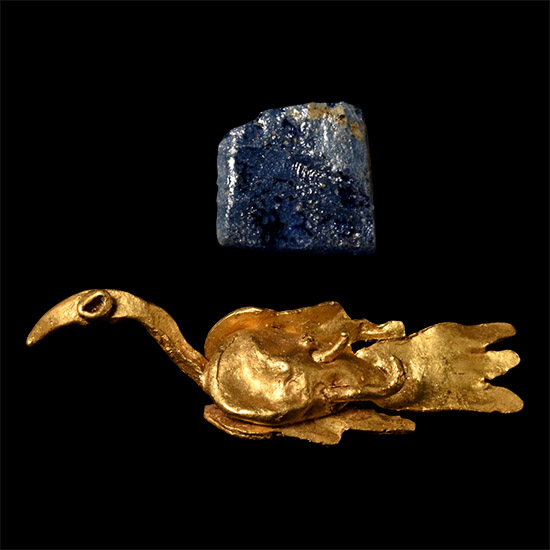
Greek Gold Amuletic Bird
5th-1st century B.C.Estimate: £1,500 - 2,000 (‡+bp*)
Opening Bid: £750
Comprising a sheet-gold hollow-formed avian figure with applied filigree detailing, and a separate beaked head; accompanied by a rectangular blue glass fragment. 0.57 grams, bird: 19 mm
Private collection, USA and Switzerland, acquired in the late 1980s-early 1990s; thence by descent. -
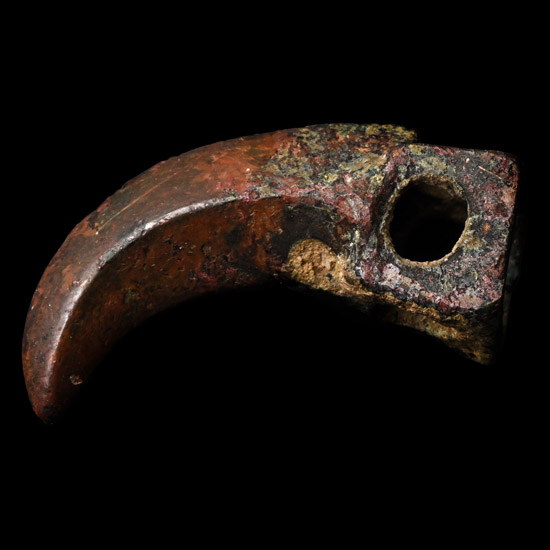
Scythian Bronze Eagle's Talon Pendant
Circa 6th century B.C.Sold for (Inc. bp): £156
Curved square-section hook with cuboid finial pierced on all four sides and to the top. 12.45 grams, 36.19 mm
From the private collection of a European gentleman (1942-2024), formed since the 1970s. -
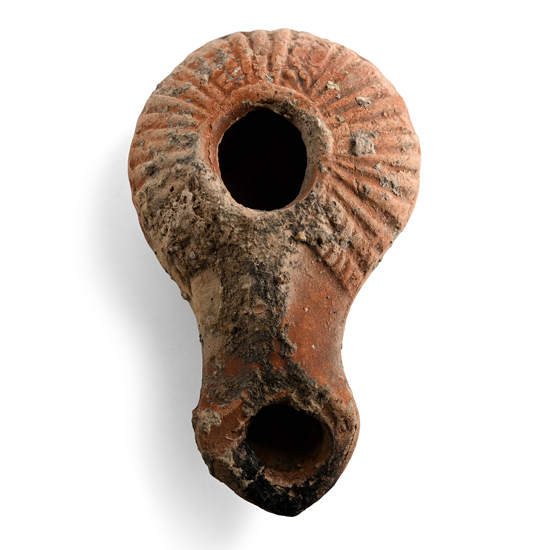
Greek Terracotta Oil Lamp
Hellenistic, late 2nd-1st century B.C.Sold for (Inc. bp): £78
Piriform body with volute nozzle, radiating linear decoration to the shoulder. 38.5 grams, 89 mm
From a collection of lamps from a late Scottish gentleman, 1970-1990s.
