
Loading, please wait...
_900x900.jpg "Greek Miniature Bronze Hydria")
_200x200.jpg "Greek Miniature Bronze Hydria")
_900x900.jpg "Greek Miniature Bronze Hydria")
_200x200.jpg "Greek Miniature Bronze Hydria")
.jpg "Greek Miniature Bronze Hydria")
.jpg "Greek Miniature Bronze Hydria")
LOT 0507
Greek Miniature Bronze Hydria
GEOMETRIC PERIOD, 6TH CENTURY B.C.
1 3/8 in. (23.5 grams, 37 mm).
With a bulbous body, flared foot, lateral loop handles to the shoulder and a strap handle to the rear.
ProvenanceAcquired by a Swiss family in the mid-1980s to late 1990s, thence by descent.
Private collection, Switzerland, since the late 1990s.
Cf. a hydria at the Museum of Fine Arts of Budapest, inv.no.2004.137.A, for the type.
FootnotesThe earliest Archaic Greek bronze hydriai enter the archaeological record in the last quarter of the seventh century. Although the appearance of bronze marks the first significant period of production in the Iron Age, these vessels represent a reawakening of an illustrious tradition dating back at least to the Helladic Bronze Age, if not considerably earlier.
CONDITIONTimeLine Auctions follows a vetting process to ensure the authenticity and legality of all items, reinforcing our commitment to integrity and responsible trading. Each antiquity, antique, and coin lot undergoes thorough examination by a vetting committee of at least ten external specialists, professional trade association members, scientists, and archaeologists: Our Vetting Process
AUCTIONS:
TimeLine is a leading auction house specialising in antiquities, ancient art, collectables, natural history, coins, medals, and books. Our auctions offer museums, collectors, historians, and enthusiasts the opportunity to acquire unique and historically significant pieces.
-
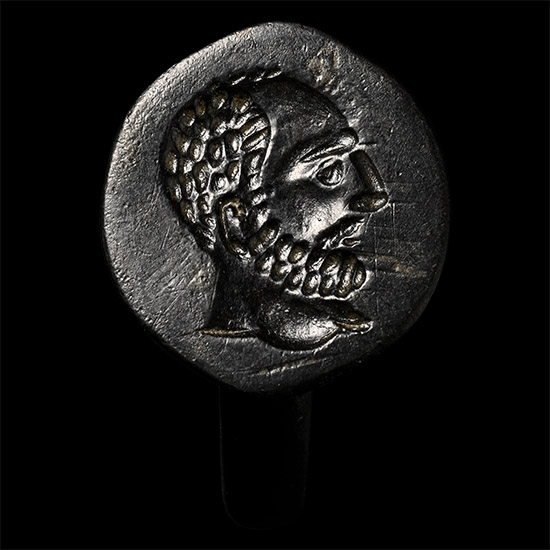
Greek Bronze Ring with Bust of a Philosopher
3rd-2nd century B.C.Sold for (Inc. bp): £260
Lentoid-section hoop with integral disc bezel, incuse profile bust of a bearded, balding male. 5.38 grams, 24.33 mm overall, 19.56 mm internal diameter (approximate size British S, USA 9, Europe 20, Japan 19)
Ex German art market, 2000s. Acquired from an EU collector living in London. From the collection of a Surrey, UK, gentleman. -
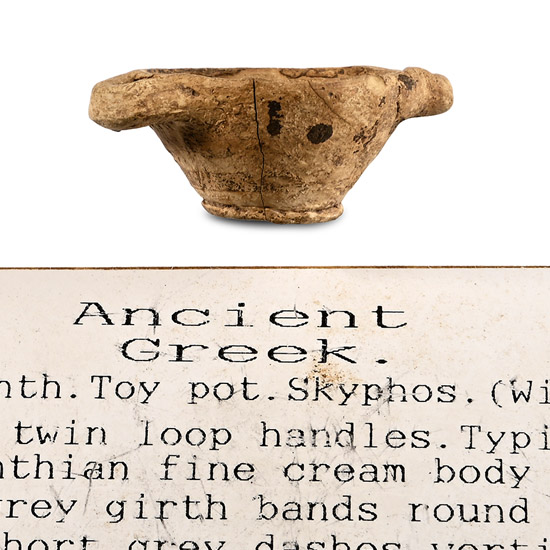
Greek Terracotta Toy Skyphos
Corinthian, circa 600 B.C.Sold for (Inc. bp): £52
Miniature skyphos with loop handles to the rim, painted horizontal bands to sidewall and vertical slashes; supplied with old collector's record card. 4.46 grams, 40 mm
From the collection of the late Bernard C. Pickard, Hampshire, UK, the owner of Bernard C. Pickard Antiquities, which closed in 1987, he had been collecting since the mid 1950s.
Bernard Pickard was a close friend of Richard Hattatt, the renowned author of several books on ancient brooches. Hattatt acknowledges in his first book, Ancient & Romano-British Brooches, published in 1982, that Mr Pickard first aroused his interest in brooches and inspired him in writing his books during his retirement. Mr Pickard also wrote the foreword to the section on Roman animal brooches, op. cit. p.158-160. -
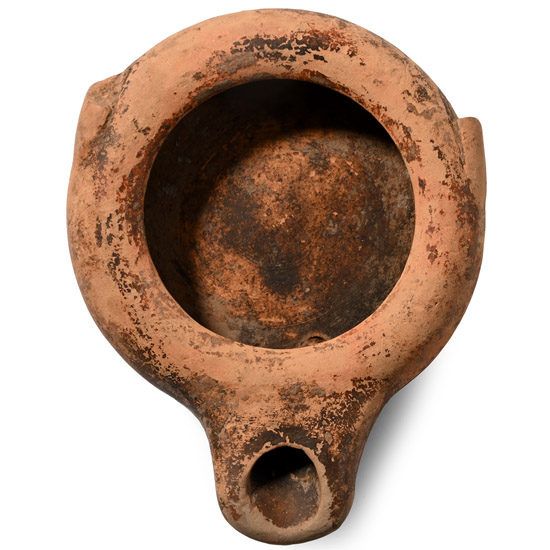
Greek Terracotta Oil Lamp
Circa late 5th century B.C.Sold for (Inc. bp): £85
Shallow, round body with inturned rim to the central vent, square-ended nozzle and low foot; lateral lugs forming attachment points for a handle (absent); old collector's labels to underside and '1801' to nozzle; typed data panel. 56 grams, 90 mm
From the collection of the late Bernard C. Pickard, Hampshire, UK, the owner of Bernard C. Pickard Antiquities, which closed in 1987, he had been collecting since the mid 1950s. Accompanied by a typed information display card.
Bernard Pickard was a close friend of Richard Hattatt, the renowned author of several books on ancient brooches. Hattatt acknowledges in his first book, Ancient & Romano-British Brooches, published in 1982, that Mr Pickard first aroused his interest in brooches and inspired him in writing his books during his retirement. Mr Pickard also wrote the foreword to the section on Roman animal brooches, op.cit. p.158-160.
