
Loading, please wait...
_900x900.jpg "Greek Marble Head of a Female")
_200x200.jpg "Greek Marble Head of a Female")
_900x900.jpg "Greek Marble Head of a Female")
_200x200.jpg "Greek Marble Head of a Female")
.jpg "Greek Marble Head of a Female")
.jpg "Greek Marble Head of a Female")
LOT 0069
Greek Marble Head of a Female
4TH-1ST CENTURY B.C.
2 3/8 in. (163 grams, 59 mm high).
A head of a female carved in white marble, modelled in the round with semi-naturalistic facial features and hair tied back into a chignon at the nape of the neck.
ProvenanceAcquired early 1990s.
Ex private American collection; thence by descent.
Private collection since 1998.
TimeLine Auctions follows a vetting process to ensure the authenticity and legality of all items, reinforcing our commitment to integrity and responsible trading. Each antiquity, antique, and coin lot undergoes thorough examination by a vetting committee of at least ten external specialists, professional trade association members, scientists, and archaeologists: Our Vetting Process
AUCTIONS:
TimeLine is a leading auction house specialising in antiquities, ancient art, collectables, natural history, coins, medals, and books. Our auctions offer museums, collectors, historians, and enthusiasts the opportunity to acquire unique and historically significant pieces.
-
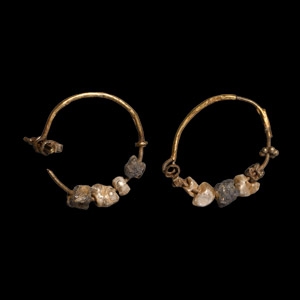
Greek Gold Hoop Earrings with Pearls
5th-3rd century B.C.Sold for (Inc. bp): £305
A matched pair of gold earrings, each composed of a round-section hoop, onto which are threaded pearl and filigree beads; one end detached. 1.4 grams total, 18-20 mm
Fine condition.
Acquired 1970-2010. Collection of a late Japanese gentleman. -
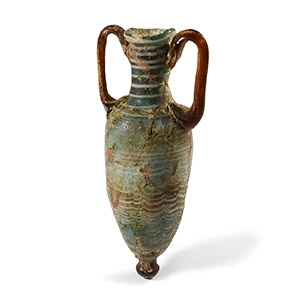
Greek Festooned Glass Amphoriskos
2nd-1st century B.C.Sold for (Inc. bp): £1,404
An aqua coloured amphoriskos with an elongated piriform shape and tubular neck with everted rim, handles and knop foot applied using a contrasting aubergine-coloured glass; decorative white trails and festooning to the body and neck; repaired. 124 grams, 14.4 cm high
Acquired early 1990s. Ex private American collection; thence by descent. Private collection since 1998. -
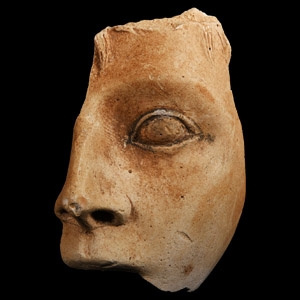
Etruscan Terracotta Fragment of a Face
6th century B.C.Sold for (Inc. bp): £780
An amorphous fragment from a terracotta face, retaining the left eye, nose, partial upper lip and fringes of hair, rendered with semi-naturalistic detailing. 125 grams, 13 cm high
Private Swiss collection, acquired 2002.
