
Loading, please wait...
LOT 1435
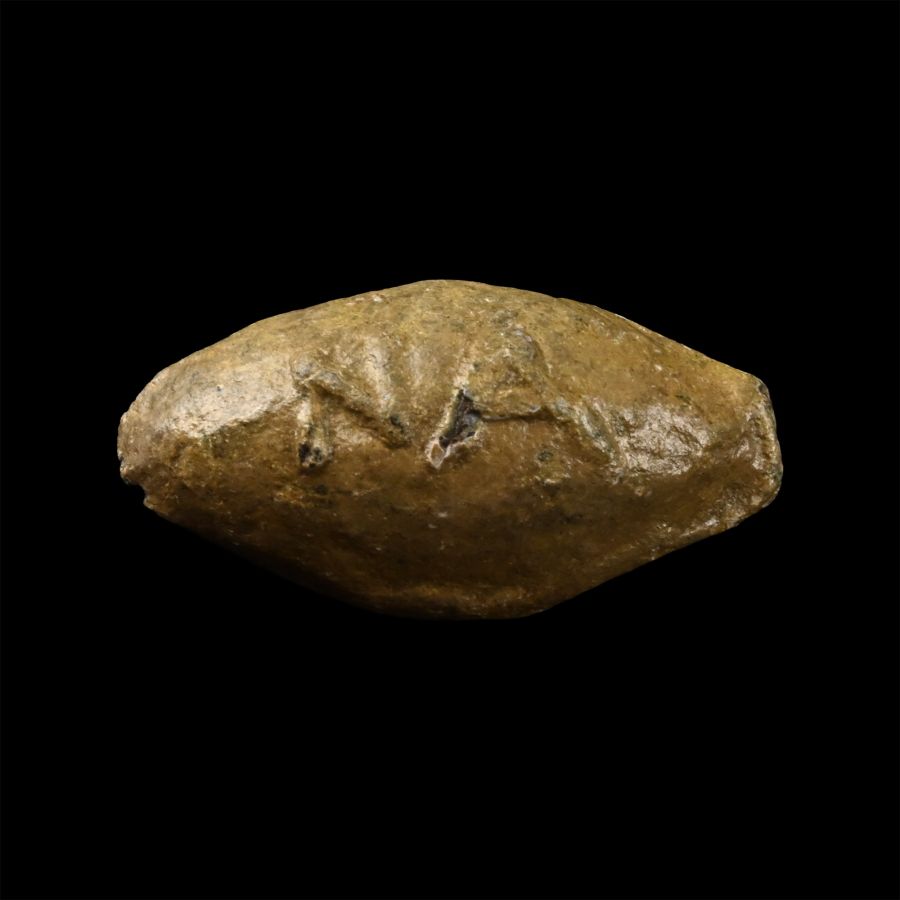
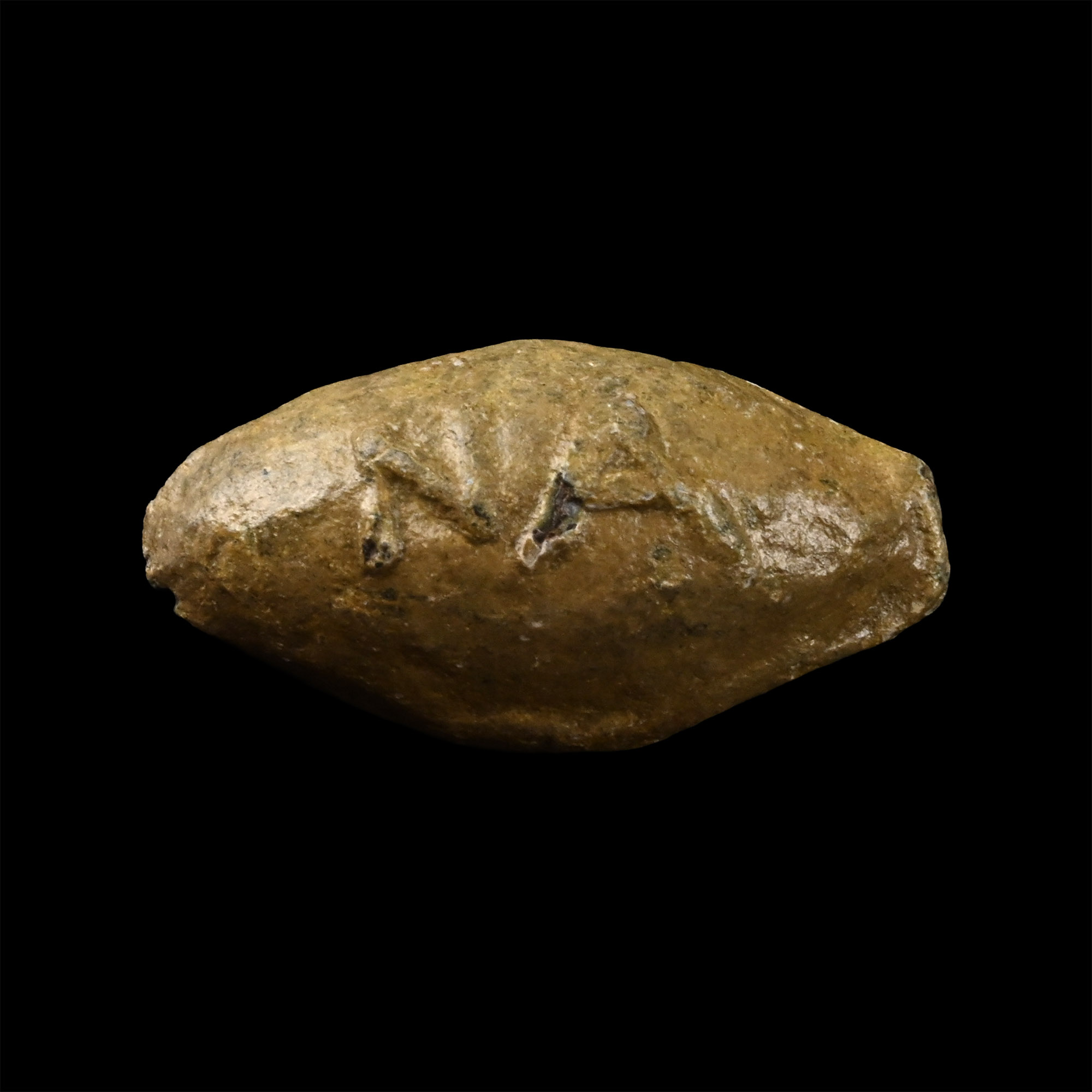
Greek Macedonian Lead Inscribed Slingshot
3RD-1ST CENTURY B.C.
1 1/8 in. (27.5 grams, 28 mm).
A biconical glans with an inscription 'MEP' to one side and 'NA' to the other. [No Reserve]
ProvenanceEx German art market, 2000s.
Acquired from an EU collector living in London.
From the collection of a Surrey, UK, gentleman.
This lot is accompanied by an illustrated lot declaration signed by the Head of the Antiquities Department, Dr Raffaele D'Amato.
For similar cf. Schinco, G., Small, A.M., 'A previously unknown siege of Botromagno/Silvium: the evidence of slingshots from Gravina in Puglia (Provincia di Bari, Puglia)' in Papers of the British School at Rome, 2019, pp.1-52, fig.37, type iib of Volling.
FootnotesThe leaden bullets, which were thrown from slings, were called in Greek Molivdainai (μολύβδαιναι), and in Latin glandes- the former indicating the material ‘lead’, the latter the shape ‘acorns’. These bullets were cast in a mould, and bore letters or devices or both, on two sides or on only one. In form they were more like an almond than an acorn, but many are pointed at both ends; in size, they are generally about one inch and a half maximum length, and under one inch in maximum width. Bullets from Mecyberna possess the abbreviated inscription MER (obverse) and NA (reverse), which some scholar translated as Mecyberna. The presence of the Mecyberna inscription is expected, since the Polis of Mecyberna produced clay moulds, which suggests local production. Inscribed bullets with the name of a city may also denote the place of manufacture
CONDITIONTimeLine Auctions follows a vetting process to ensure the authenticity and legality of all items, reinforcing our commitment to integrity and responsible trading. Each antiquity, antique, and coin lot undergoes thorough examination by a vetting committee of at least ten external specialists, professional trade association members, scientists, and archaeologists: Our Vetting Process
AUCTIONS:
TimeLine is a leading auction house specialising in antiquities, ancient art, collectables, natural history, coins, medals, and books. Our auctions offer museums, collectors, historians, and enthusiasts the opportunity to acquire unique and historically significant pieces.
-
.jpg)
Luristan Bronze Dagger
13th-7th century B.C.Sold for (Inc. bp): £260
Comprising a two-edged leaf-shaped lentoid-section blade, crescentic lower guard, ribbed hilt and domed finial. 93 grams, 20.1 cm
Acquired before 1983. Ex London gallery, 1990s. This lot is accompanied by an illustrated lot declaration signed by the Head of the Antiquities Department, Dr Raffaele D'Amato. -
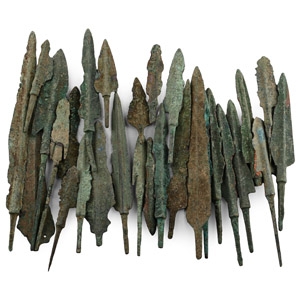
Western Asiatic Arrowhead and Blade Collection
2nd-1st millennium B.C.Sold for (Inc. bp): £169
Comprising mainly triangular and leaf-shaped tanged types, narrow blades with midrib. 725 grams total, 9.3-21 cm
From a London, UK, collection, 1990s. This lot is accompanied by an illustrated lot declaration signed by the Head of the Antiquities Department, Dr Raffaele D'Amato. -
.jpg)
Roman Imperial Bronze Legionary Helmet
Late 1st century B.C.-early 1st century A.D.Sold for (Inc. bp): £39,000
A relatively heavy legionary helmet (cassis) of ‘Imperial Gallic Type’ with deep rounded bowl, simple C-shaped cut-outs for the ears, integral flared horizontal neck-guard extending some way along the sides, two corrugated ribs to the occipital area at the rear, intermitted by two bronze rivets, and four corrugated embossed 'wings' or prominent curved eyebrows flanking three riveted bosses arranged vertically; three studs on the rear of the neck-guard for attaching suspension loops to the preserved clasps of the cheek-guards (bucculae); hinged bracket at each temple once attaching the cheek-guard; embossed beaded brow band running from one ear opening to the other; mounted on a custom-made stand. 1.03 kg, 26.5 cm front to back
Ex John Moore, York, UK, 1997. Property of a North London, UK, gentleman. Accompanied by an academic report by Dr Raffaele D'Amato. This lot has been checked against the Interpol Database of stolen works of art and is accompanied by search certificate number no. 12789-240372. This lot has been cleared against the Art Loss Register database, and is accompanied by an illustrated lot declaration signed by the Head of the Antiquities Department, Dr Raffaele D'Amato.
This early category of helmets was characterised by a hemispherical calotte and a slightly sloping neck guard. They were fitted with a pair of prominent curved eyebrows (symbolising the wings of Jupiter's thunderbolts) flanking rivetted bosses.
