
Loading, please wait...

LOT 0684
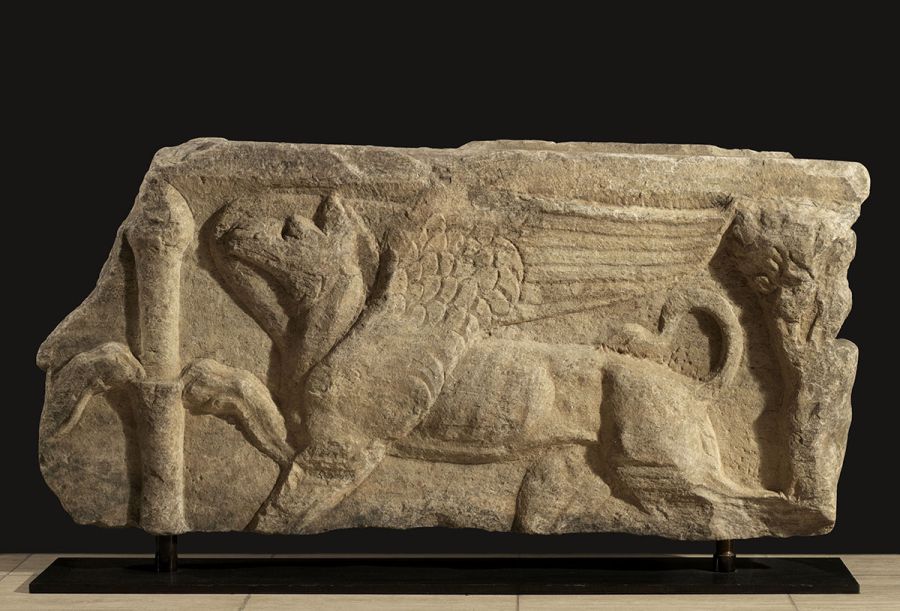
Greek Lydian Monumental Relief of a Gryphon
6TH-5TH CENTURY BC
24 x 50 3/4" (Approximately 160 kg, 60x127 cm).
An impressive marble relief of a gryphon, advancing, with its right foreleg raised to a column, originally part of a pair, possibly architectural, a second griffin would have mirrored its stance; the creature’s musculature is superbly rendered, as are the feathers of the wings and the subtle shaping of the ribs; mounted on a custom-made display stand.
ProvenanceProperty of a London gentleman; acquired on the London art market in the early 1970s.
FootnotesThe griffin, a mythological beast typically represented with the body of a lion, wings and head of an eagle, and, occasionally, a snake’s neck and tongue, was first represented in Greek art during the Mycenaean period, appearing on wall paintings at the Palace of Knossos on Crete. Arthur Evans, who excavated the palace, believed that these creatures were strongly associated with the supernatural and realms beyond the mortal world. It is probable that the griffin entered early Greek iconography via Egyptian art, where it had been depicted as early as the Predynastic period. In Mesopotamian art, similar creatures, albeit often with human heads, had been represented from the fourth millennium B.C. onwards. Later, it was a favourite motif of the Achaemenid Persian Empire. The position of Lydia at the crossroads of the Greek and Persian worlds makes this an apt motif indeed.
By the archaic and classical periods of ancient Greece, griffins had also become firmly associated with the Scythian peoples, and were believed to guard their vast reserves of gold. Widely depicted on coins, vase paintings, and notably protomai (mounts or attachments), they were also associated with the god Apollo, and the hero Orpheus. See, for comparison, the painted archaic Greek relief of a griffin pursued by a horse and rider, in the Ny Carlsberg Glyptotek, Copenhagen, Denmark.
TimeLine Auctions follows a vetting process to ensure the authenticity and legality of all items, reinforcing our commitment to integrity and responsible trading. Each antiquity, antique, and coin lot undergoes thorough examination by a vetting committee of at least ten external specialists, professional trade association members, scientists, and archaeologists: Our Vetting Process
AUCTIONS:
TimeLine is a leading auction house specialising in antiquities, ancient art, collectables, natural history, coins, medals, and books. Our auctions offer museums, collectors, historians, and enthusiasts the opportunity to acquire unique and historically significant pieces.
5th century BC
Lot No. 0700
Sold for (Inc. premium): £460
12th-8th century BC
Lot No. 0736 Opening bid: £1,080
3rd-2nd century BC
Lot No. 0701 Opening bid: £216
