
Loading, please wait...
LOT 1485
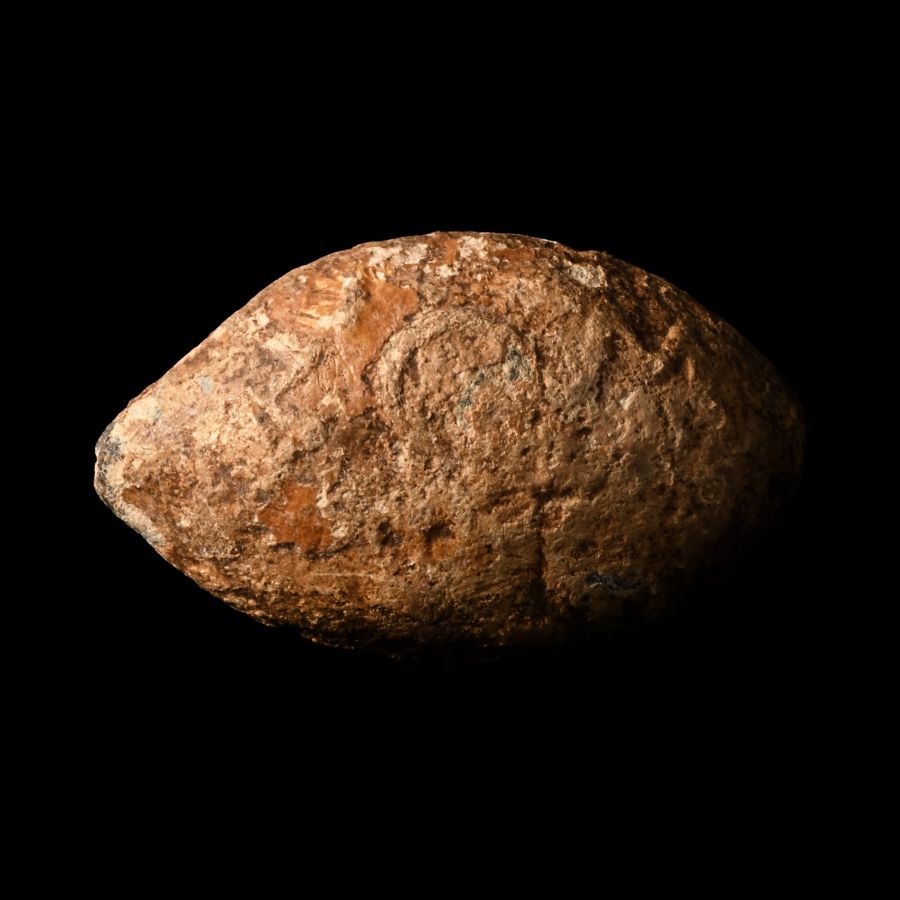
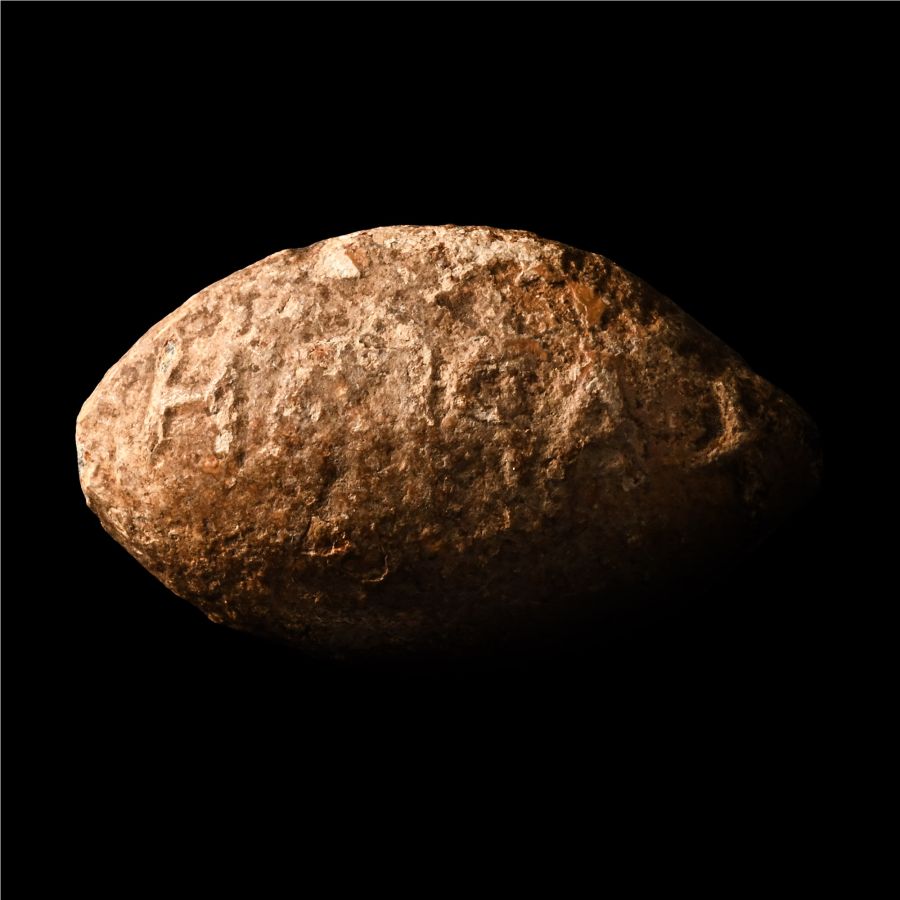
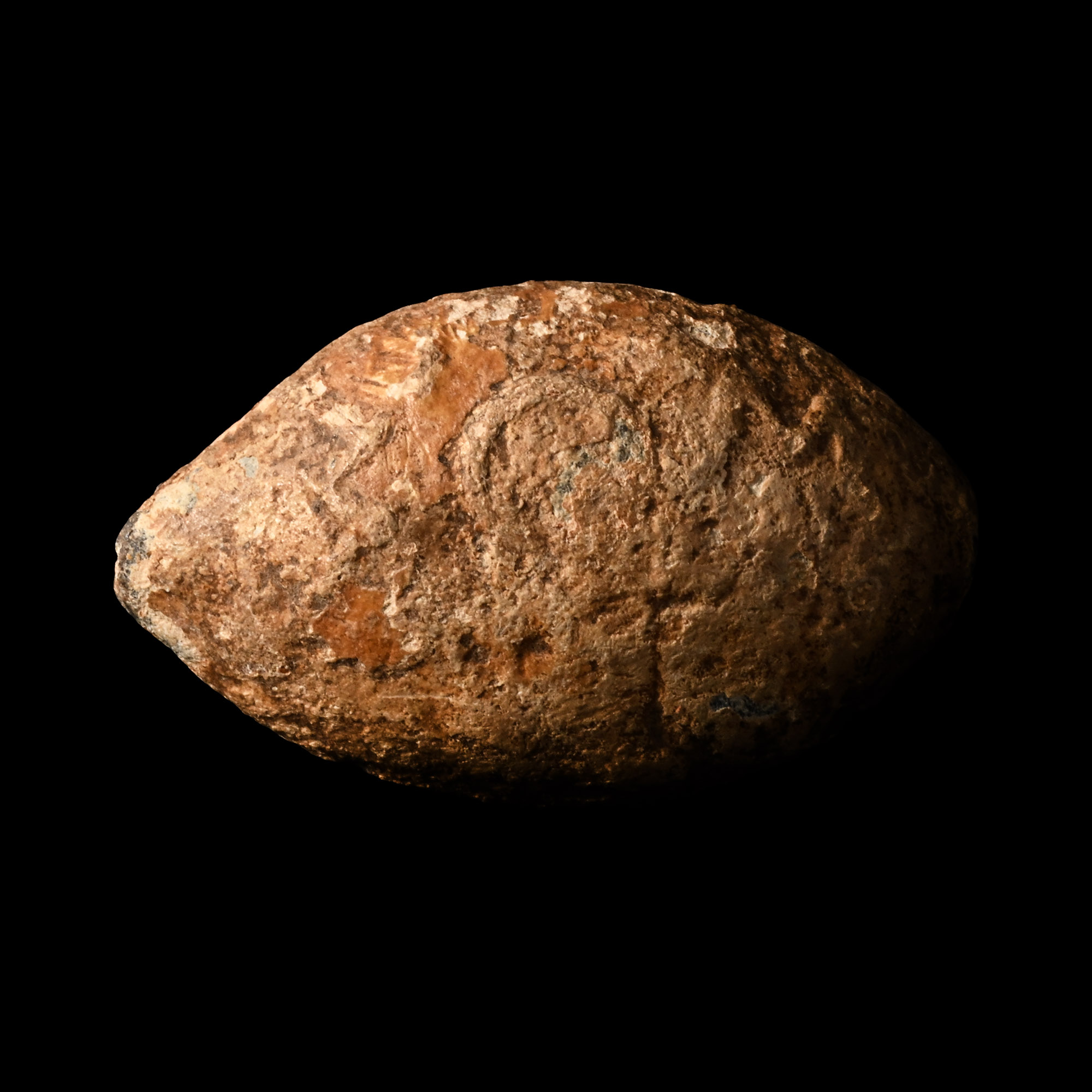
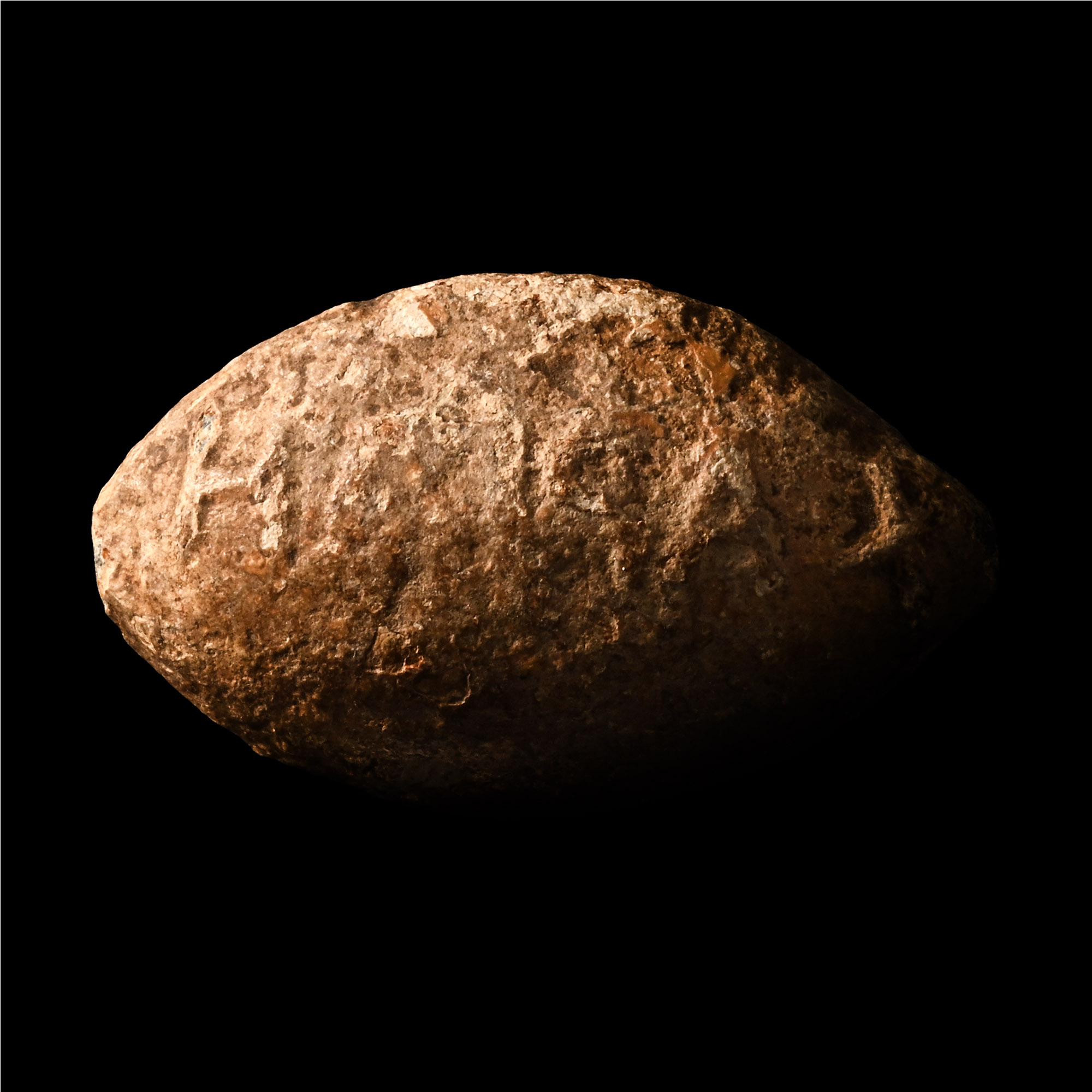
Greek Lead Slingshot
3RD-1ST CENTURY B.C.
1 1/8 in. (29.8 grams, 29 mm).
Biconical in profile with casting seam and reserved legend 'ΣΟΜA' to one face, 'HPAKAEI' to reverse, with the possible meaning 'Body of Herakles'. [No Reserve]
ProvenanceAcquired on the German art market before 2000.
Private collection, Munich, Germany.
Cf. Schinco, G., Small, A.M., 'A previously unknown siege of Botromagno/Silvium: the evidence of slingshots from Gravina in Puglia (Provincia di Bari, Puglia)' in Papers of the British School at Rome, 2019, pp.1-52, fig.37(type Volling IIb).
FootnotesThe principal varieties of the inscriptions found on sling bullets are: 1) the name of a man, a place or a person; 2) the name of a deity, sometimes on its own and sometimes in connection with ‘victory’; 3) words conveying orders, jokes or sarcasms. Here the inscription connects the power of the bullet to the mythical god of strength.
CONDITIONTimeLine Auctions follows a vetting process to ensure the authenticity and legality of all items, reinforcing our commitment to integrity and responsible trading. Each antiquity, antique, and coin lot undergoes thorough examination by a vetting committee of at least ten external specialists, professional trade association members, scientists, and archaeologists: Our Vetting Process
AUCTIONS:
TimeLine is a leading auction house specialising in antiquities, ancient art, collectables, natural history, coins, medals, and books. Our auctions offer museums, collectors, historians, and enthusiasts the opportunity to acquire unique and historically significant pieces.
-
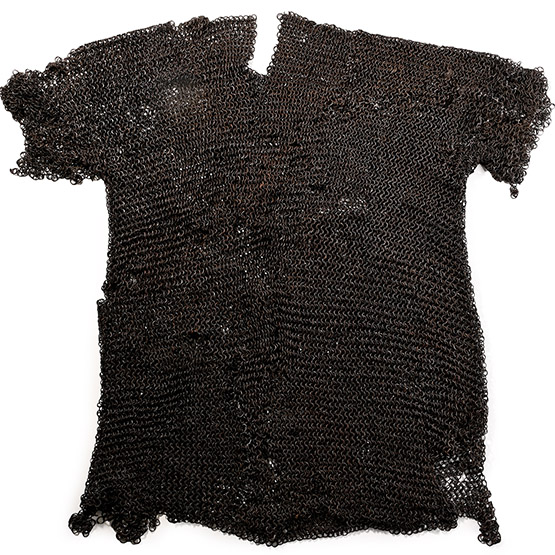
Frankish Warrior's Iron Byrnie Chain Mail Armour
Northern Europe, circa 6th-10th century A.D.Sold for (Inc. bp): £4,680
A nearly complete short-sleeved ring armour composed of interlocking links in the four-through-one formation with alternating rivetted rings. 4.71 kg, 65 x 75 cm
From the private collection of a London gentleman, from his grandfather's collection formed before the early 1970s. Accompanied by an academic report by Dr Raffaele D’Amato. This lot has been checked against the Interpol Database of stolen works of art and is accompanied by a search certificate number no.13041-248010.
The rings are arranged in rows, and the links within the same row do not join. Instead, each ring connects to two rings in the row above and two in the row beneath. A great majority of all-rivetted mail comes from Southern Scandinavia and Northern Europe, notably Sweden, northern Germany and Poland. All-rivetted mail already occurs there during the Roman Iron Age, and continues into the Migration, the Vendel, and then the Viking periods. Rivetted rings were usually fabricated by shaping metal wire into a circle with the ends overlapping several mm. Here, the riveted rings seem to be of reshaped oval form. -
.jpg)
Western Asiatic Bronze Arrowhead Collection
2nd-1st millennium B.C.Sold for (Inc. bp): £338
Comprising tanged arrowheads, four with large elongated triangular blades and raised midrib, sharp central groove, three with barbed shoulders and cylindrical stem with handle for the shaft; three with barbed shoulders and convex on sides, one elongated triangular type with barbed shoulders and flat socket, one with trilobate blade and another with short tang and barbed blade with raised midrib. 305 grams total, 6.5-13.6 cm
Ex London, UK, collection, 1990s.
These arrowheads seem to belong to the type V, subcategory types A, B, C and D according to the classification of Khorasani and Negahban. In the four categories of triangular bronze arrowheads from Luristan, Marlik, and Northern Iran, individuated by Negahban, subtypes C and D of type V are larger arrow or javelin heads, C with barbed shoulders and D with round shoulders. Most of them were cast in moulds. -
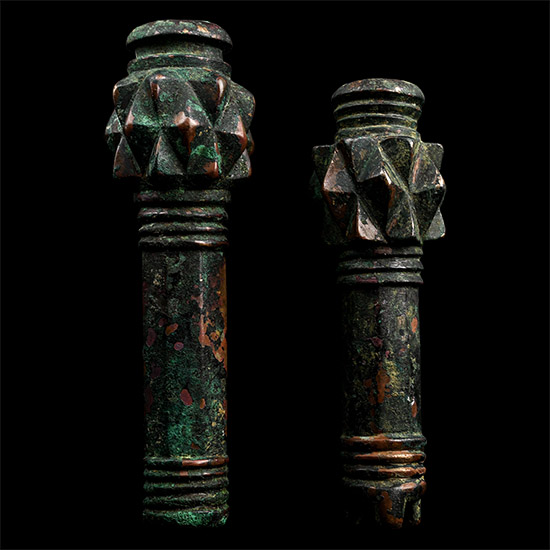
Luristan Bronze Macehead Collection
Circa 900-800 B.C.Sold for (Inc. bp): £1,300
With long septagonal and octagonal shank, rounded knobs around the swollen head, flanked by horizontal bands. 876 grams total, 15.5-17.3 cm
UK private collection before 2000. Acquired on the UK art market. Private collection, London, UK.
