
Loading, please wait...
LOT 1567
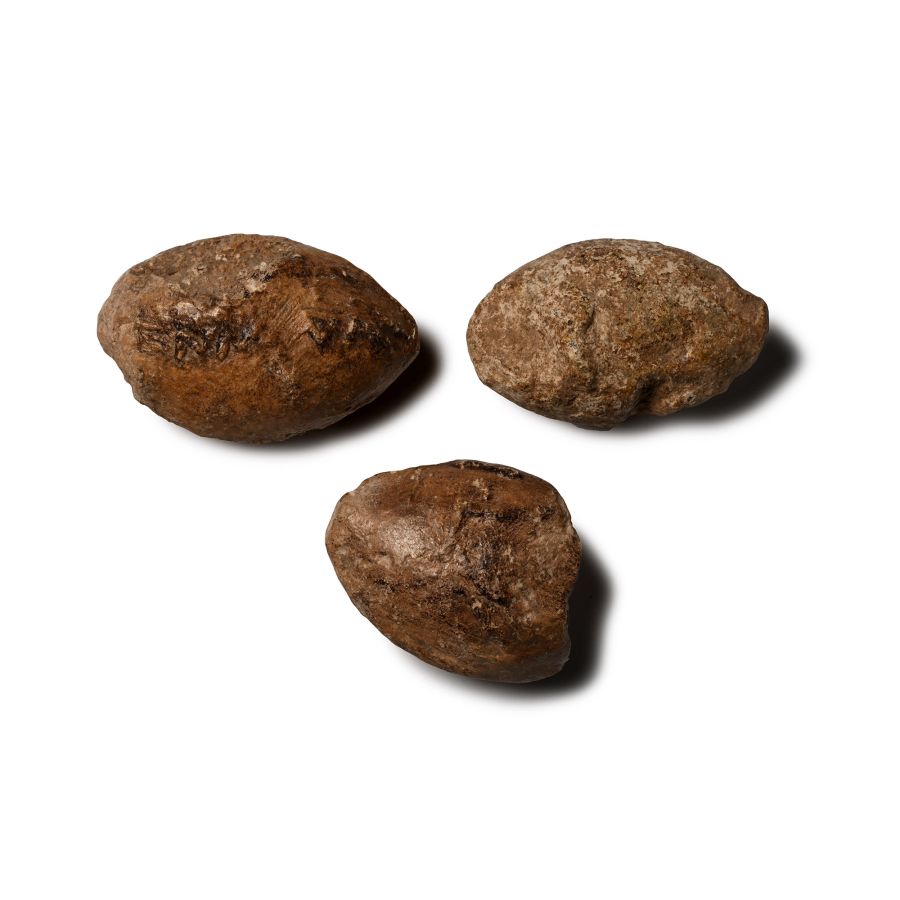
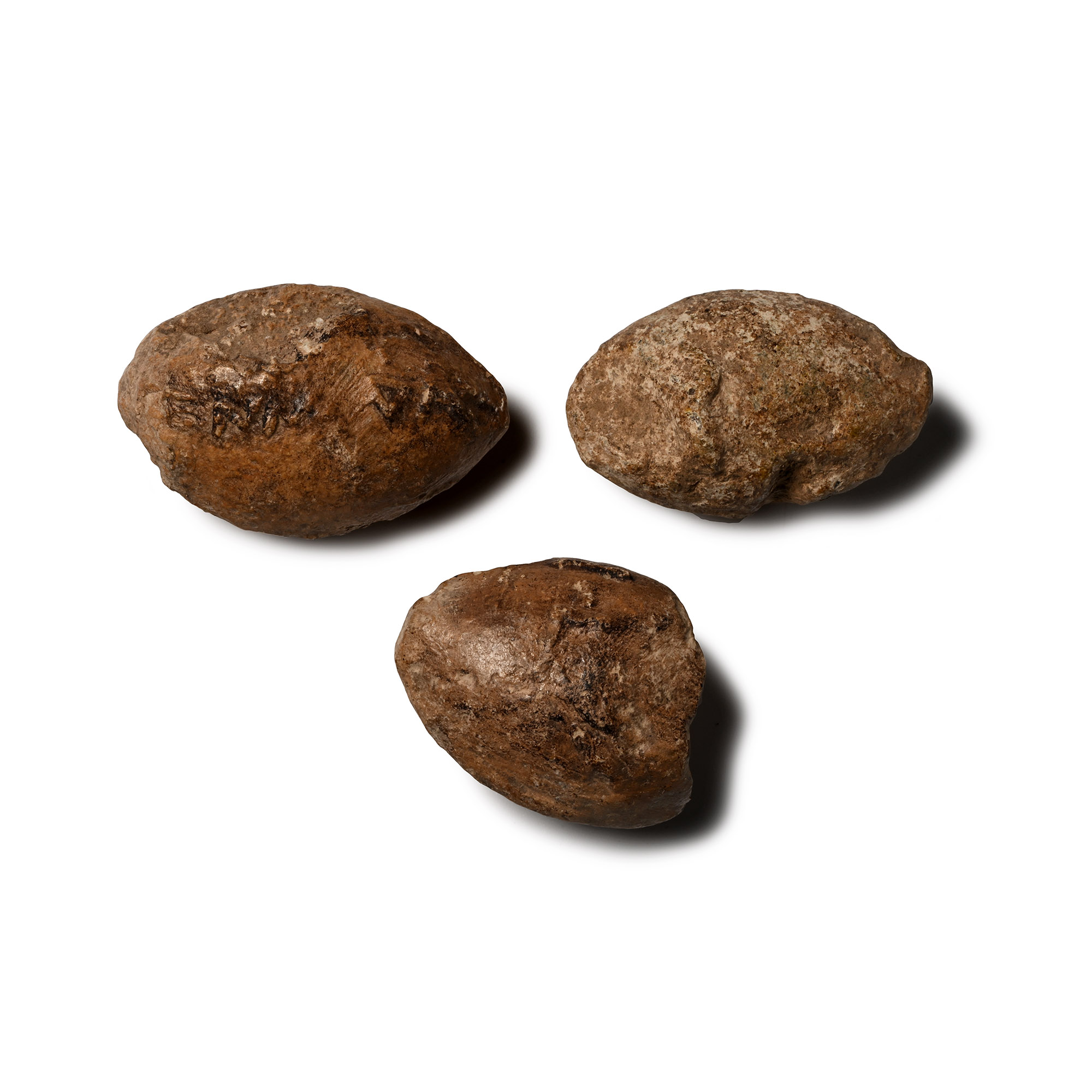
Greek Lead Impacted Slingshot Group
3RD-1ST CENTURY B.C.
1 - 1 1/4 in. (118 grams total, 25-31 mm).
Three lentoid-section lead slingshots (glandae), each deformed due to impact, one with the Greek letters 'ΓΕΜ…ΔΑ' (Ghemonidas?). [3, No Reserve]
ProvenanceEx German art market, 2000s.
Acquired from an EU collector living in London.
From the collection of Surrey, UK, gentleman.
This lot is accompanied by an illustrated lot declaration signed by the Head of the Antiquities Department, Dr Raffaele D’Amato.
Cf. Schinco, G., Small, A.M., 'A previously unknown siege of Botromagno/Silvium: the evidence of slingshots from Gravina in Puglia (Provincia di Bari, Puglia)' in Papers of the British School at Rome, 2019, pp.1-52, fig.34, for similar.
FootnotesThe use of lead slingshots in battle is attested in Greece as early as the 5th century B.C. Numerous finds were excavated in Olynthus, usually olive or plump-almond-shape. The type continued to be used in the Italian peninsula, and similar specimens, bearing the title ‘Commander of the Units of Slingers’ have been attested from the period of the Punic Wars.
CONDITIONTimeLine Auctions follows a vetting process to ensure the authenticity and legality of all items, reinforcing our commitment to integrity and responsible trading. Each antiquity, antique, and coin lot undergoes thorough examination by a vetting committee of at least ten external specialists, professional trade association members, scientists, and archaeologists: Our Vetting Process
AUCTIONS:
TimeLine is a leading auction house specialising in antiquities, ancient art, collectables, natural history, coins, medals, and books. Our auctions offer museums, collectors, historians, and enthusiasts the opportunity to acquire unique and historically significant pieces.
-
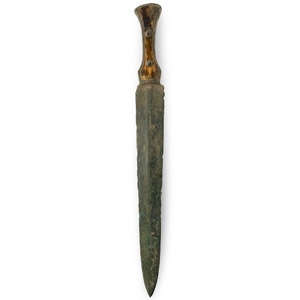
Luristan Bronze Dirk
10th century B.C.Sold for (Inc. bp): £390
A short sword with lentoid-section triangular blade, rhomboid guard, hilt with later organic filling to each face. 228 grams, 34 cm
Acquired 1980-2015. Ex Abelita family collection. This lot is accompanied by an illustrated lot declaration signed by the Head of the Antiquities Department, Dr Raffaele D’Amato.
The type Dirk I according to the classification of Medvedskaya is common among dirks and daggers attributed to Luristan. The hilt is flanged and accepts inlays remnants of organic material on the handle. There are also two angular indentations on each side of the guard. -
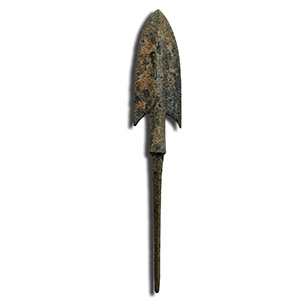
Luristan Bronze Arrowhead
13th-7th century B.C.Sold for (Inc. bp): £20
Heater-shaped with barbs to the rear and midrib developing to a tang. 30 grams, 15 cm
Acquired 1980-2015. Ex Abelita family collection. This lot is accompanied by an illustrated lot declaration signed by the Head of the Antiquities Department, Dr Raffaele D’Amato. -
.jpg)
Mesopotamian Bronze Javelin Head
3rd-2nd millennium B.C.Sold for (Inc. bp): £234
With foliate blade, raised mid-rib, medium length stem widening at its base and forming a small stop, rectangular-section tang with bent terminal. 184 grams, 46.7 cm
Acquired 1980-2015. Ex Abelita family collection. This lot is accompanied by an illustrated lot declaration signed by the Head of the Antiquities Department, Dr Raffaele D’Amato.
The specimen belongs to the category of tripartite spears with long pointed biconvex blade and single bevelled tang. They seem to be a Mesopotamian and Susian (Elamite) variant, and this type also includes decorated blades, like the spear from Tello with the inscription 'King of Kish'.
