Loading, please wait...

Use mousewheel to zoom in and out, click to enlarge

Details

LOT 0555

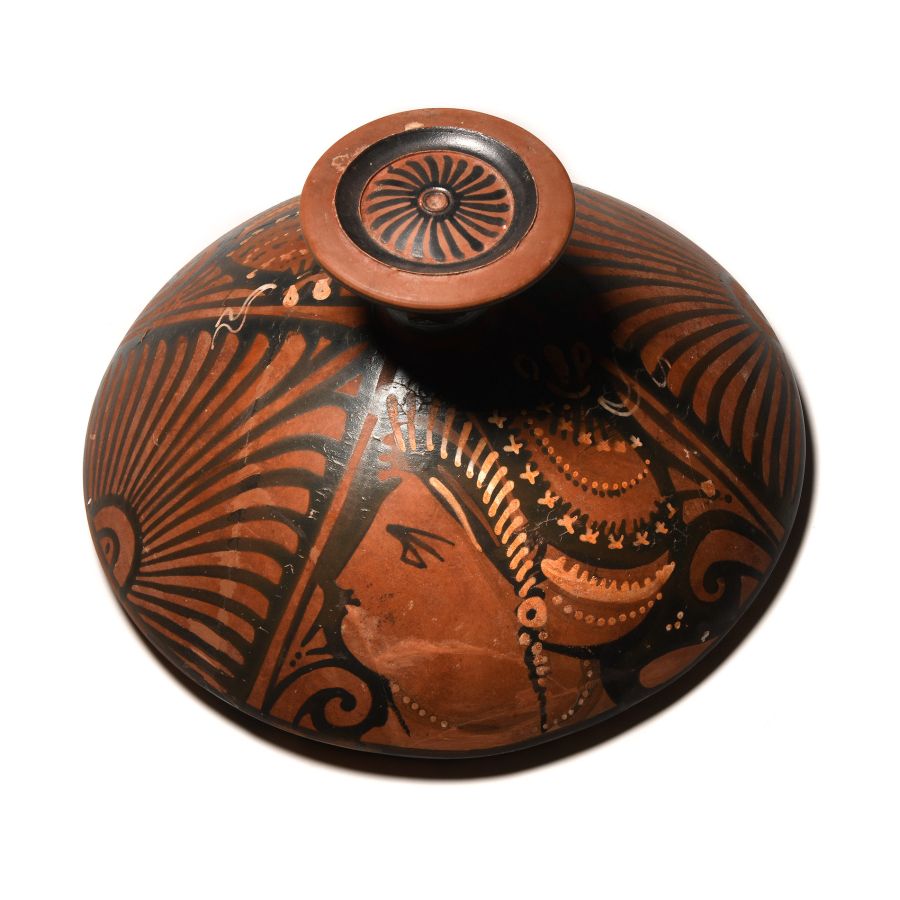
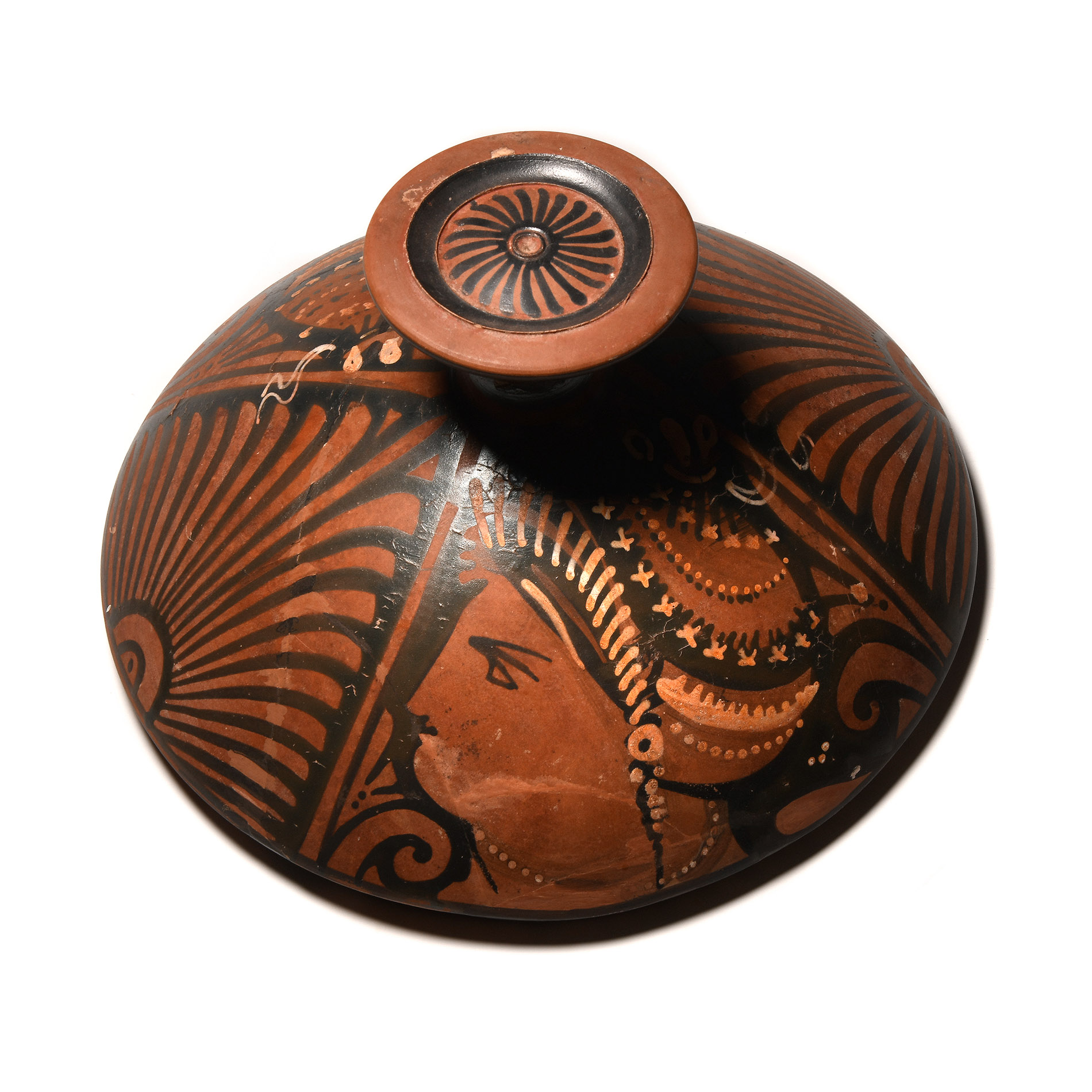
Greek Large Lekanis Lid with Lady of Fashion

5TH-4TH CENTURY B.C.

8 7/8 in. (596 grams, 22.5 cm wide).

A lid from a large lekanis, composed of a domed body with inverted rim and large, tiered finial, the centre of the handle painted with lines radiating from a central circle, the painted motif to the body with areas of polychrome detailing and featuring the head of a lady of fashion to two sides, stylised shell panels between, waves around the rim; repaired.

Provenance

Acquired in the 1990s.
Ex Cummings collection, UK.

Literature

Cf. The Metropolitan Museum, New York, accession number 2021.40.31a, b, for a similar example.

Footnotes

A lekanis was a covered dish.

CONDITION

VETTING:

TimeLine Auctions follows a vetting process to ensure the authenticity and legality of all items, reinforcing our commitment to integrity and responsible trading. Each antiquity, antique, and coin lot undergoes thorough examination by a vetting committee of at least ten external specialists, professional trade association members, scientists, and archaeologists: Our Vetting Process


AUCTIONS:

TimeLine is a leading auction house specialising in antiquities, ancient art, collectables, natural history, coins, medals, and books. Our auctions offer museums, collectors, historians, and enthusiasts the opportunity to acquire unique and historically significant pieces.

LOT 0555

Greek Large Lekanis Lid with Lady of Fashion

Sold for (Inc. bp): £247

Print page

RELATED LOTS

  • Greek Seal Ring with Centaur
    Greek Seal Ring with Centaur
    4th-3rd century B.C.

    Sold for (Inc. bp): £221

    A copper-alloy ring composed with a slender hoop with large elliptical bezel, engraved with a centaur rearing left. 5.80 grams, 24.33 mm overall, 20.62 mm internal diameter (approximate size British P, USA 7 1/2, Europe 16.23, Japan 15)


    Acquired before 2000. From the collection of a European gentleman living in the UK.

    Lot Details

  • Campanian Red-Figure Bail Amphora from a Cumae Workshop
    Campanian Red-Figure Bail Amphora from a Cumae Workshop
    330-300 B.C.

    Sold for (Inc. bp): £4,680

    A ceramic red-figure bail amphora with round-section strap handle and pierced lug at the apex, tall waisted neck with vertical rib detailing, rounded shoulder with running wave pattern ornament, tapering body with figural designs of standing females wearing a himation and a stephane in red and white on black ground, one figure holding a thyrsus and the other an ear of corn, with accessories in the field; flared base; from a workshop in Cumae. 862 grams, 37 cm high


    Ex collection H.& P. Payot, Clarens, by descent. Accompanied by an academic report by Dr Raffaele D’Amato. This lot has been checked against the Interpol Database of stolen works of art and is accompanied by search certificate number no.11577-199027. Accompanied by an original thermoluminescence analysis report no.QED2223/SG0-0105 from QED Laboratoire.

    The bail amphora, named for the tall handle arching over the mouth, was a shape made primarily in Campania, where red-figure vases were produced at both Capua and Cumae in the 4th century B.C. The decoration offered a remarkable range of subjects associated not only with mythological images, but with representations of the local life, costumes and customs. The simple, single figure compositions decorating each side of this vase are also characteristic of the style, which tended to avoid complex mythological scenes often found on much larger vessels like volute craters, favouring representation of the daily life of south Italic people.

    Lot Details

  • Greek Silver Wine Strainer
    Greek Silver Wine Strainer
    4th-3rd century B.C.

    Estimate: £20,000 - 30,000 (‡+bp*)

    Opening Bid: £10,000

    A high-quality silver wine strainer composed of a shallow bowl and broad flange rim, two integral scalloped handles with scrolled flourishes, tapering to a loop handle with swan head terminals with incised eye and beak detailing, perforated whirl within roundel to interior base; accompanied by a custom-made display stand. 160 grams, 22.2 cm wide (526 grams total including stand)


    Ex private South German collection, 1980s. with Christie's, New York, 8 June 2012, lot 86. Accompanied by an academic report by Dr Raffaele D’Amato. This lot has been checked against the Interpol Database of stolen works of art and is accompanied by search certificate number no.11578-198980.

    Elaborate silver strainers, such as this present example, were used at symposia and festive occasions for the purpose of preventing the dregs of wine from entering the wine cup. This and other related silver utensils became popular in the later 4th and 3rd century B.C. These highly decorated wine strainers were fitted with dual handles forming loops in the shape of twisting animals, here a swan. Usually they took the form of a shallow dish complete with four rings of perforations in the centre in order to drain the wine. Strainers of this type were used to separate out sediments which could be found in the thick Greek wine. Examples similar to this one have been found in royal tombs in northern Greece, as well as the tomb of a monarch in Sudan.

    Lot Details

Stay up-to-date with the latest from TimeLine Auctions by joining our mailing list