
Loading, please wait...
LOT 0507
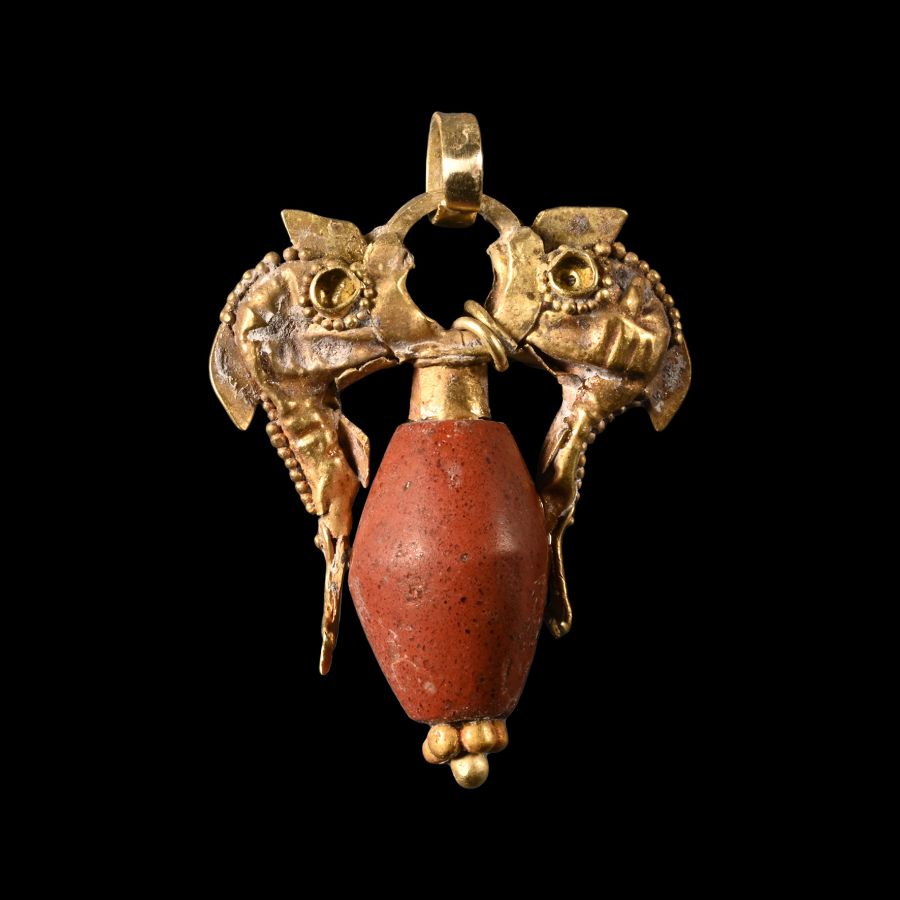
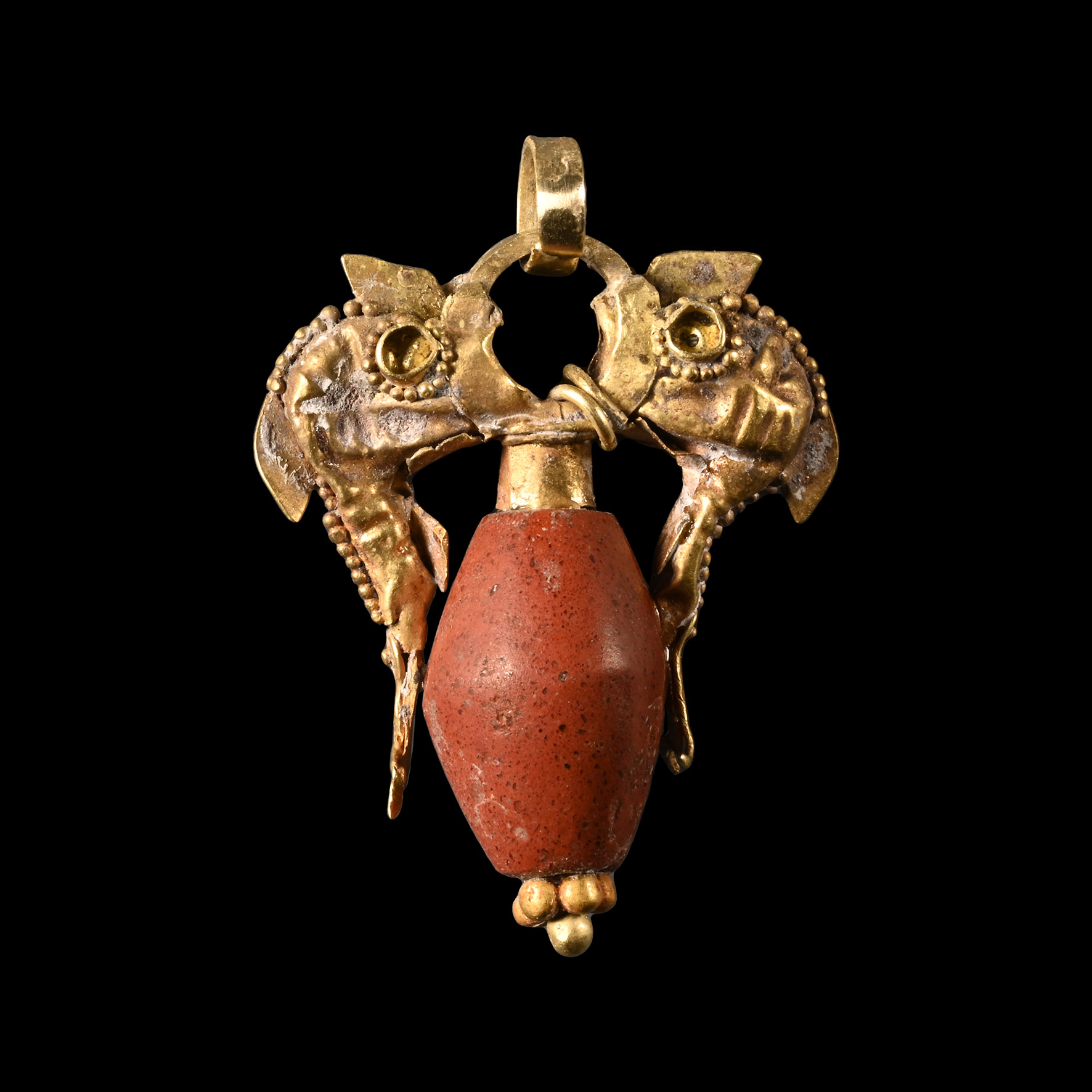
Greek Large Gold Dolphin Pendant
CIRCA 4TH-3RD CENTURY B.C.
1 1/4 in. (4.68 grams, 33 mm).
Formed as an amphora with dolphin handles, the body composed of a biconical jasper bead, repoussé and filigree detailing to the animals, suspension loops between; restored.
ProvenanceFrom a late Japanese specialist collector, 1970-2000s.
CONDITIONTimeLine Auctions follows a vetting process to ensure the authenticity and legality of all items, reinforcing our commitment to integrity and responsible trading. Each antiquity, antique, and coin lot undergoes thorough examination by a vetting committee of at least ten external specialists, professional trade association members, scientists, and archaeologists: Our Vetting Process
AUCTIONS:
TimeLine is a leading auction house specialising in antiquities, ancient art, collectables, natural history, coins, medals, and books. Our auctions offer museums, collectors, historians, and enthusiasts the opportunity to acquire unique and historically significant pieces.
LOT 0507
Greek Large Gold Dolphin Pendant
Estimate £600 - 800€700 - 930 (for guidance only)$810 - 1,080 (for guidance only)
-
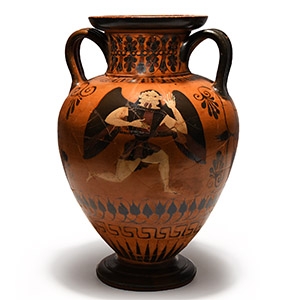
Attic Black-Figure Neck-Amphora with Gorgon and Quadriga Attributed to the Swing Painter
Circa 550 B.C.Estimate: £50,000 - 70,000 (‡+bp*)
Opening Bid: £22,222
With inverted echinus lip and tall neck, a ribbed handle to each side with coiling lotus buds and palmettes beneath the handles; Side a) a running winged Gorgon depicted frontally, dressed in a black and red chiton; Side b) an aristocratic warrior wearing a Chalcidian helmet and driving a quadriga, the two central horses superimposed, the other two turned outward; a frieze of lotus buds and a band Greek key motifs below, the neck decorated with red and black palmettes, and elongated lotus blossoms; restored. 3.25 kg, 39 cm high
Acquired in Geneva in 1954. Formerly in the Y. Forrer collection, Geneva, Switzerland. Private collection, Switzerland, 1999. with Gorny & Mosch, Munich, 20 June 2012, lot 73. Accompanied by an academic report by Dr Raffaele D’Amato. This lot has been checked against the Interpol Database of stolen works of art and is accompanied by a search certificate number no.11798-206784.
This wonderful vase can be attributed to the Swing Painter, active in Athens during the last part of the 6th century B.C. Beazley named him after the subject of a girl on a swing that he painted more than once. He was a pot painter, perhaps a pupil of the Princeton Painter. His black-figure paintings included a range of mythological subjects and some quite unusual images. A very large number of vases have been attributed to his hand on the basis of style. Characteristics of his painting in the mythological scenes, are the presence of hoplites, that give a very realistic rendering of the Greek Archaic warriors of mid-6th century B.C. (München, Staatliche Antikensammlungen 1385 [J 729] Beazley Archive Pottery Database 301590; Poseidon fighting the giant Polybotes, Louvre F226). An important artwork is the famous representation of the Tyrant Pysistratos and his Rabdophoroi (bodyguards armed with clubs, Athens National Archaeological Museum 15111, Beazley Archive Pottery Database 301523). -
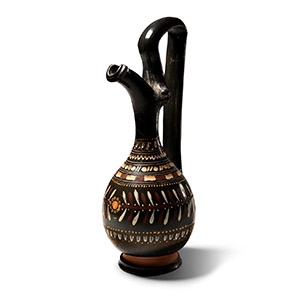
South Italian Gnathian Ware Pottery Oinochoe
Circa 4th century B.C.Estimate: £1,000 - 1,400 (‡+bp*)
Opening Bid: £500
Piriform bodied with u-shaped spout and high handle, polychrome painted egg, zig-zag, bar, dot and laurel pattern with flower arranged in rows to the front face. 193 grams, 20.2 cm high
Acquired in Europe before 2001. European collection. -
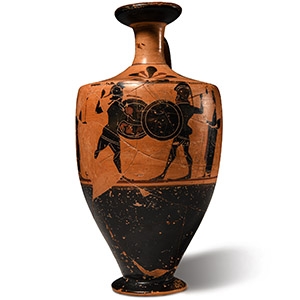
Greek Attic Black-Figure Lekythos with Fighting Hoplites
6th century B.C.Sold for (Inc. bp): £3,380
The piriform body tapering towards the splayed foot, D-section strap handle and calyx-shaped mouth with flat rim; the body painted with a scene of two duelling hoplites, dressed in full armour comprising shields, greaves and helmets, dressed in short chitons and assisted by their arbiters holding staffs and dressed in long himation; the shoulder with palmette decoration and facing figures of a man and a woman with long garments around the shoulder; restored. 381 grams, 23 cm high
Old Swiss collection. Acquired in Europe before 2011. Private collection, Europe. Accompanied by an academic report by Dr Raffaele D’Amato. This lot has been checked against the Interpol Database of stolen works of art and is accompanied by search certificate number no.11815-206482.
To the Greeks, lekythoi were containers for dispensing oil. The characteristics shape of this vessel was that of a long body, narrow neck, one handle and a cup-shaped mouth. The shape was fit for the function of the lekythos: the narrow neck prevented the unnecessary loss of oil by enabling small amounts to be distributed evenly and the mouth to collect the excess. The represented scene is probably taken from the Iliad and could represent the combat between Ajax and Hector, assisted by arbiters.
