
Loading, please wait...
LOT 0545
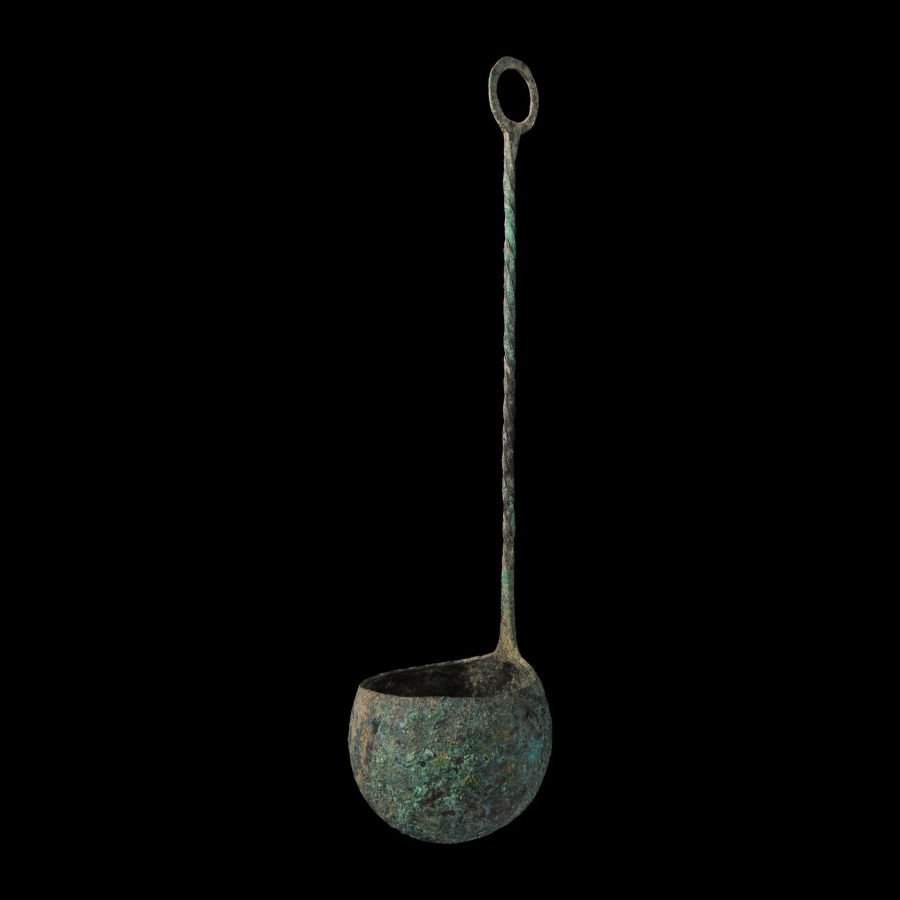
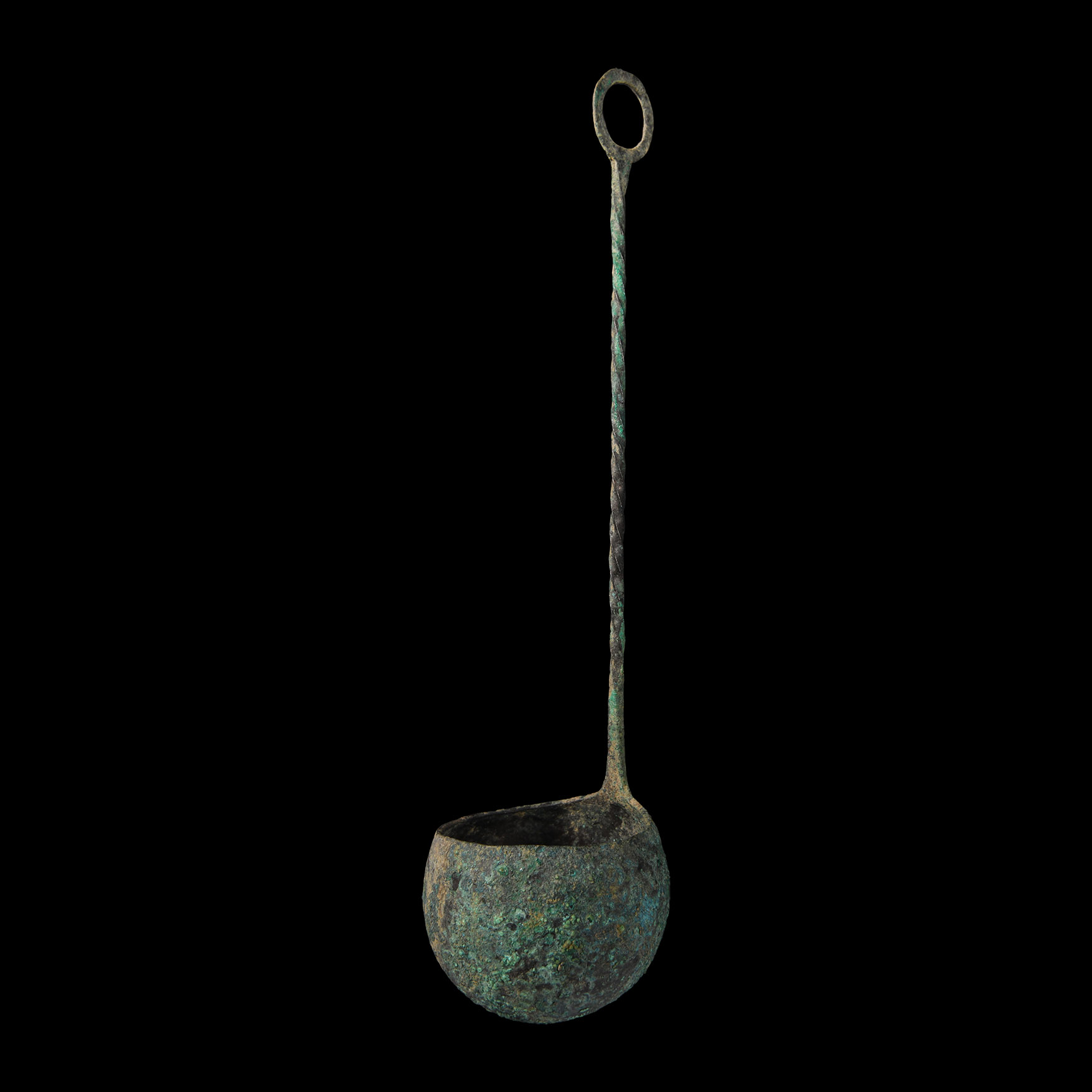
Greek Ladle with Twisted Handle
5TH-3RD CENTURY A.D.
10 1/4 in. (77 grams, 26.2 cm).
A bronze ladle with deep bowl, integral bronze handle twisted about it own axis, loop finial.
ProvenanceUK private collection before 2000.
UK art market.
Property of a London gentleman.
TimeLine Auctions follows a vetting process to ensure the authenticity and legality of all items, reinforcing our commitment to integrity and responsible trading. Each antiquity, antique, and coin lot undergoes thorough examination by a vetting committee of at least ten external specialists, professional trade association members, scientists, and archaeologists: Our Vetting Process
AUCTIONS:
TimeLine is a leading auction house specialising in antiquities, ancient art, collectables, natural history, coins, medals, and books. Our auctions offer museums, collectors, historians, and enthusiasts the opportunity to acquire unique and historically significant pieces.
LOT 0545
Greek Ladle with Twisted Handle
Estimate £300 - 400€350 - 460 (for guidance only)$410 - 540 (for guidance only)
-
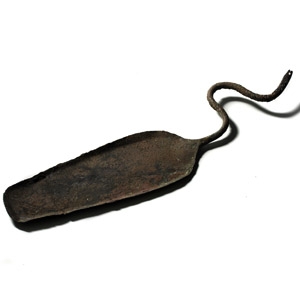
Greek Silver Medical Implement with Snake Handle
4th-3rd century B.C.Estimate: £450 - 650 (+bp*)
Opening Bid: £250
A silver and copper-alloy medical instrument, oval in shape, the handle formed as a snake with shallow hatched pattern on the body representing scales, stylised rendering of the snake's head. 68 grams, 25 cm long
Fair condition.
Acquired mid 1980s to early 1990s. Private family collection formed in London, UK. Accompanied by a metal test assessment number 182971/HM1456 from an Oxford specialist.
The use of this spatula (probe) for medical assessment can be confirmed by its snake-shaped handle, evidently a reference to the god Asklepios, whose symbol was a staff with a serpent wrapped around it. Such implements, called 'ἀπυρομήλη', were used in the Graeco-Persian world. The survival of the handle in this example makes it a rare find. -
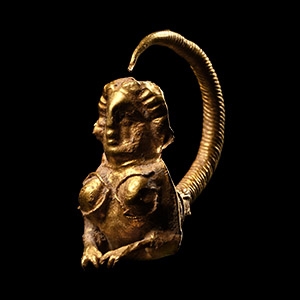
Greek Gold Sphinx Earring
3rd-2nd century B.C.Sold for (Inc. bp): £390
A single gold earring composed of a twisted wire hoop, stylised bust of a sphinx with detailed breast and lion paws. 2.55 grams, 26 mm
Acquired 1980-2015. Ex Abelita family collection.
Earrings with a sphinx represent a variety of the earrings created by the Hellenised goldsmiths of the Black Sea area. These figures usually had an inlaid garnet and are dated between late 3rd and 2nd century B.C. They belong to the category of earrings with a female head, often visible in graves of the Black Sea area and not always of good quality. -
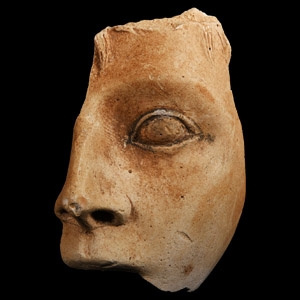
Etruscan Terracotta Fragment of a Face
6th century B.C.Sold for (Inc. bp): £780
An amorphous fragment from a terracotta face, retaining the left eye, nose, partial upper lip and fringes of hair, rendered with semi-naturalistic detailing. 125 grams, 13 cm high
Private Swiss collection, acquired 2002.
