
Loading, please wait...
LOT 0317
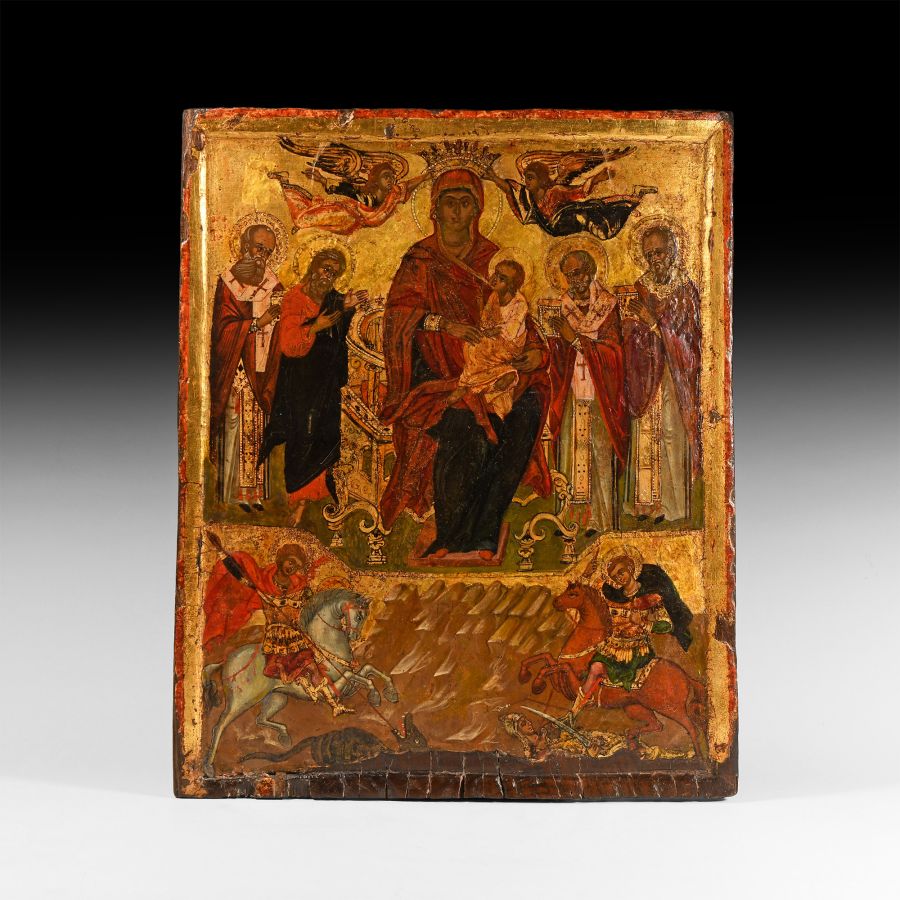
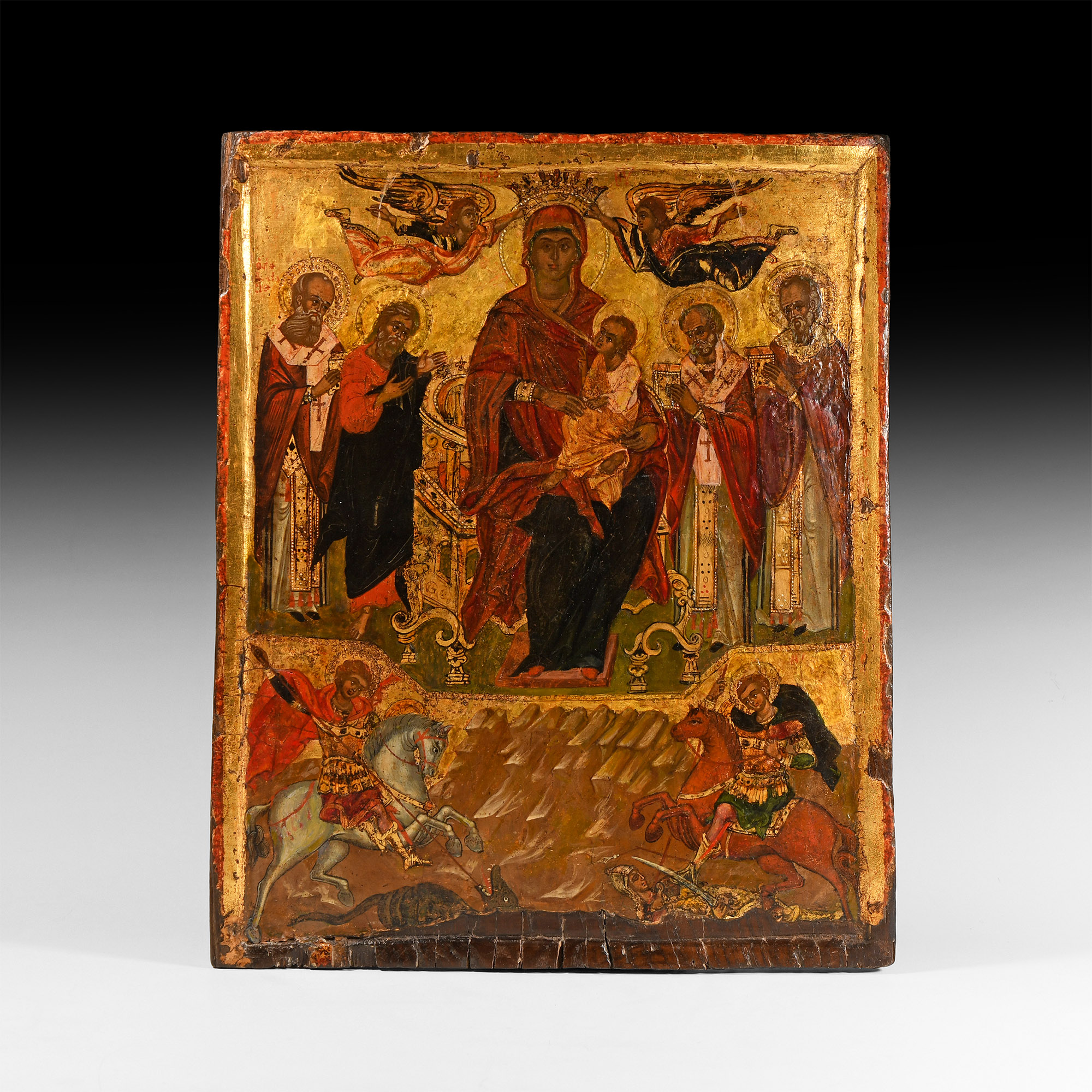
Greek Icon with Virgin and Saints George and Demetrius on Horseback
17TH CENTURY A.D.
17 1/4 x 13 3/4 in. (2.4 kg, 44 x 35 cm).
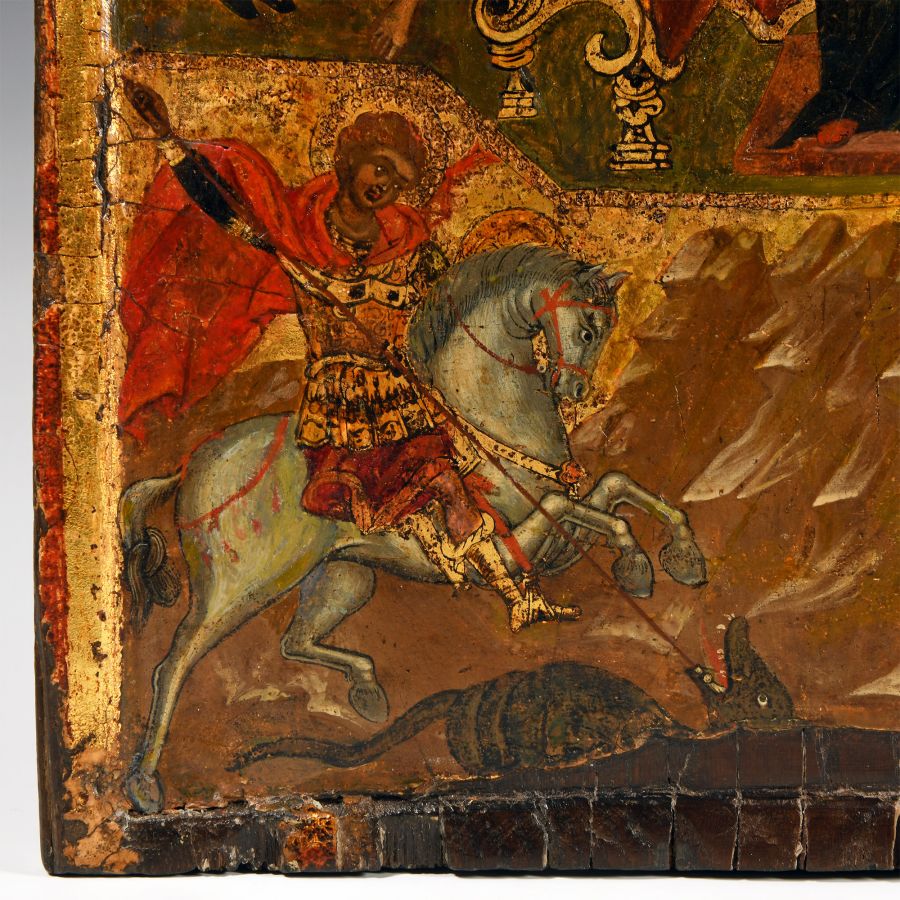
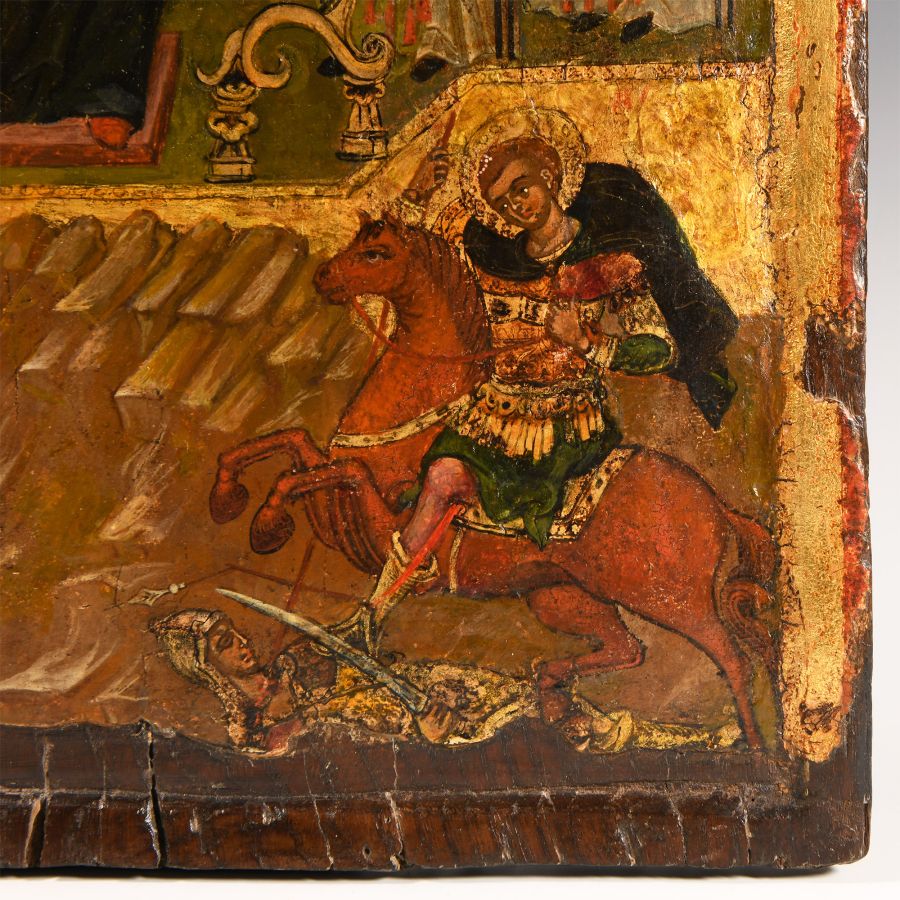
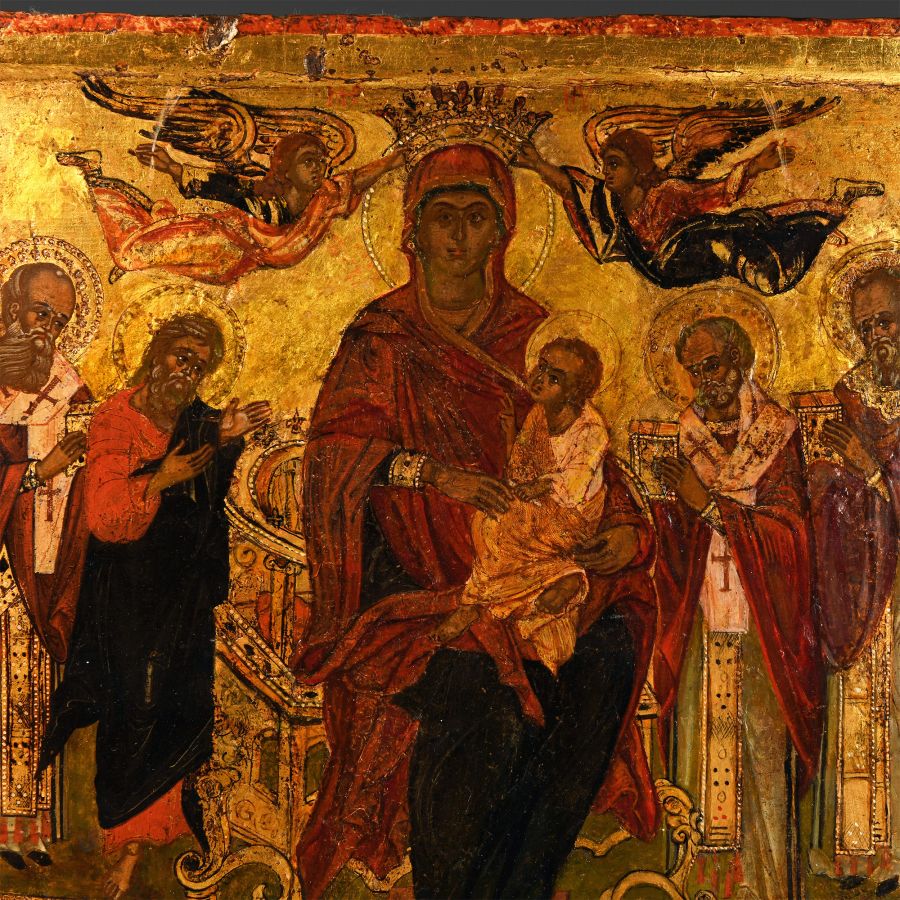
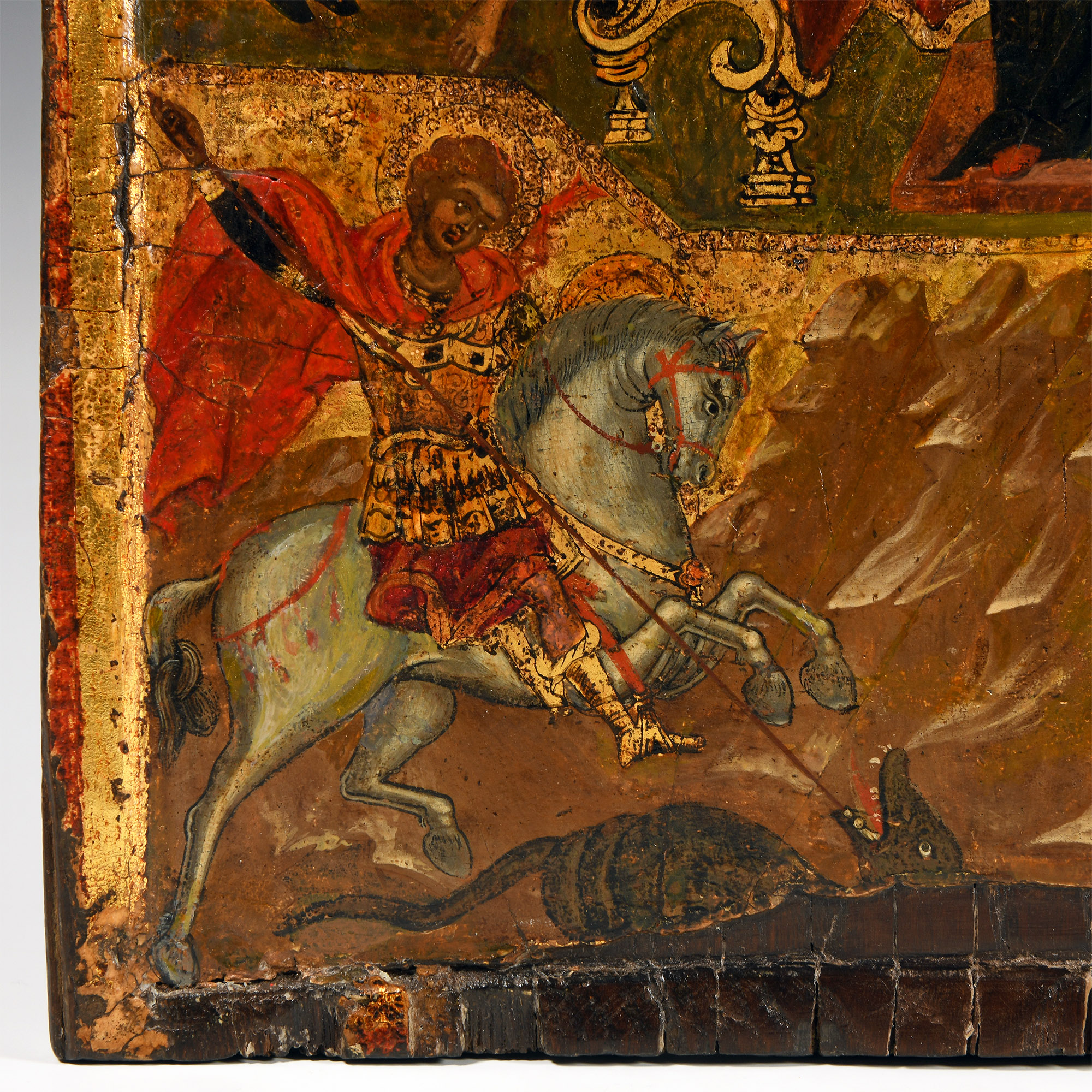
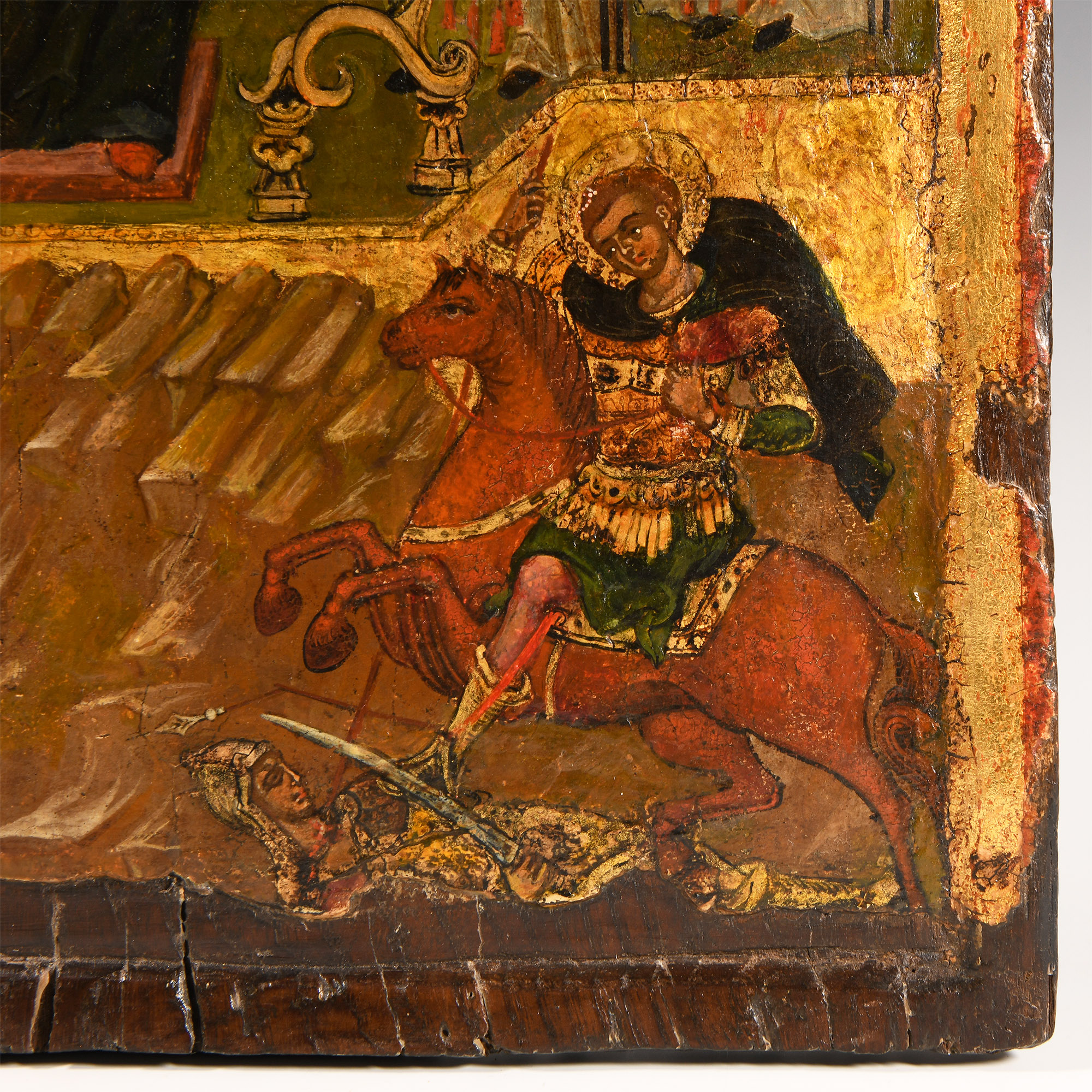
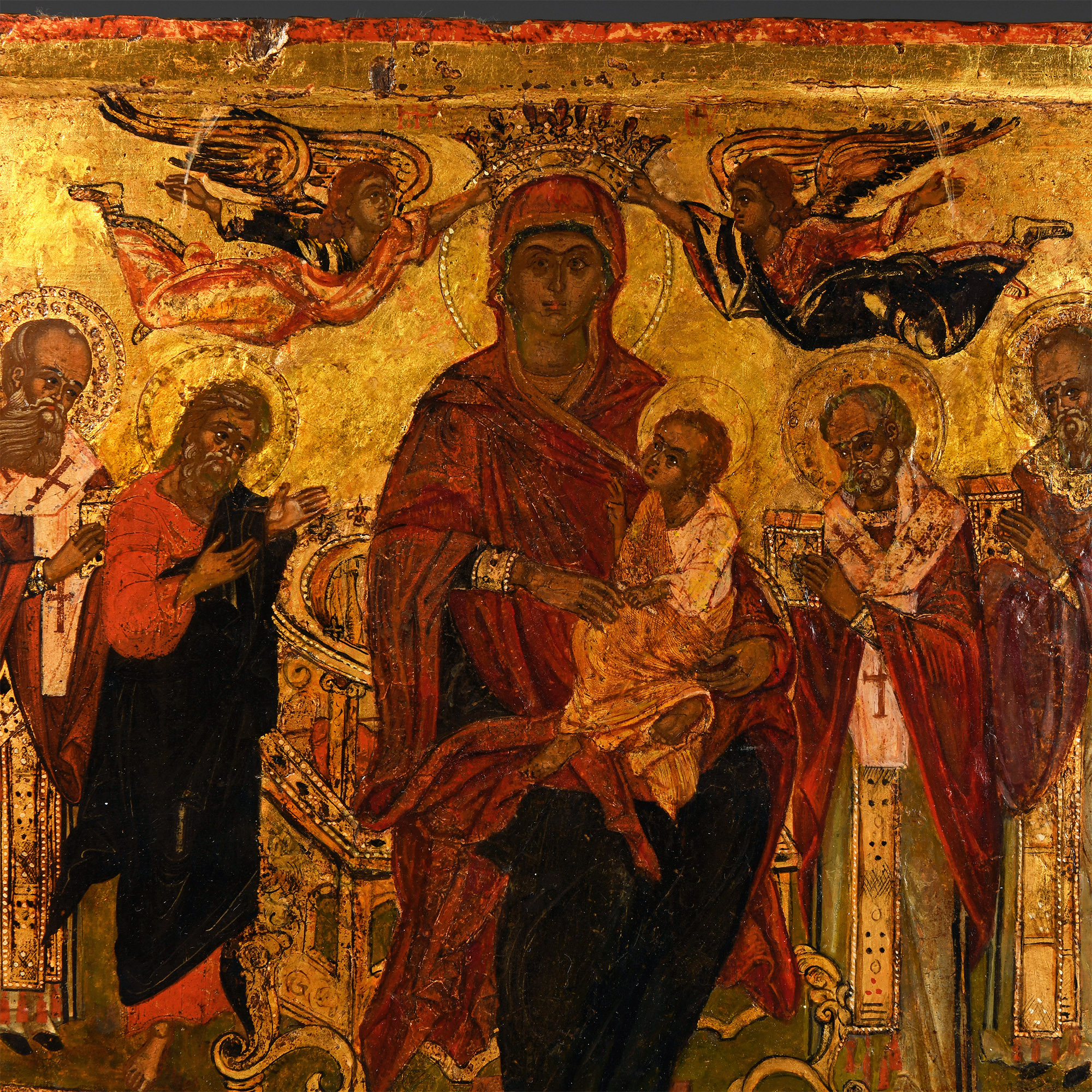
An exquisite tempera with gold ground on wood icon depicting Mary surrounded by saints and holding the Divine Child in her arms; Mary seated on an elaborate throne and crowned as the Queen of the Universe with two angels supporting her crown, Greek inscription 'MP' and 'ΘΥ' for Mother of God to each side of the crown, wearing a scarlet red maphorion embroidered with gold and a long dark blue tunica talaris; Jesus dressed in a linen tunic and a yellow cloak, affectionately gazing up and making the sign of blessing with his right hand; four saints flanking the throne, three of whom dressed in Bishop's attire, far left Saint Basil with his name written in Greek, and the others possibly saints Elias, Nicholas and Gregorius Nazianzus; the lower part of the icon with Saint George on horseback killing the dragon and Saint Demetrius on horseback killing the king of Avars, both saints dressed in pseudo-Roman armour and armed with a spear.
ProvenanceProperty of a London lady, part of her family's collection.
Accompanied by an academic report by Dr Raffaele D’Amato.
This lot has been checked against the Interpol Database of stolen works of art and is accompanied by search certificate number no.11570-198597.
Cf. Vassilaki, Images of the Mother of God, London-New York, 2016, fig.25.7, p.318, for similar icons; Tourta, A. (ed.), Icons from the Orthodox Communities of Albania, Thessaloniki, 2006, p.130.
FootnotesThe representation of the icon is centred on the image of the Mother of God as ‘The Sovereign’ (Vasilissa, Queen of the Universe). Here, Mary assumes the function of the protector of the believers, reinforced by the presence of the angels. Due to her earthly origin, Mary always maintained an intermediary position in the heavenly realms, becoming an indispensable intercessor on behalf of humans before the Lord. The protection offered by her is reinforced by the presence of the two major protectors of the humans against evil: Saint George and Saint Demetrius.
CONDITIONTimeLine Auctions follows a vetting process to ensure the authenticity and legality of all items, reinforcing our commitment to integrity and responsible trading. Each antiquity, antique, and coin lot undergoes thorough examination by a vetting committee of at least ten external specialists, professional trade association members, scientists, and archaeologists: Our Vetting Process
AUCTIONS:
TimeLine is a leading auction house specialising in antiquities, ancient art, collectables, natural history, coins, medals, and books. Our auctions offer museums, collectors, historians, and enthusiasts the opportunity to acquire unique and historically significant pieces.
LOT 0317
Greek Icon with Virgin and Saints George and Demetrius on Horseback
Sold for (Inc. bp): £2,860
-
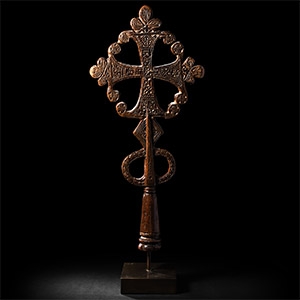
Ethiopian Processional Cross
17th-18th century A.D.Sold for (Inc. bp): £715
A bifacial wooden Qäqwami Mäsqäl processional cross, three-lobed extremities on three sides, decorated with geometric motifs representing crosses of different types, supported by a lanceolate shaft with two round openwork openings; socketted shaft with vertical grooves and fitted with a double horizontal groove; inscriptions on two of the lobed sides of the cross; accompanied by a custom-made display stand. 600 grams, 42 cm high (49cm high including stand)
Acquired on the London art market, 2003. UK private collection.
The large wooden crosses are often used by ddbtdras, who are unordained members of the Orthodox Ethiopian clergy, for their liturgical dance. In the countryside, one or two of these crosses are kept on the church window-sills close to the area where the dance is performed, instead of being kept in the church storehouse. Sometimes they are mounted upon a shaft and worn in procession. The characteristic feature of a processional cross is a socketted shaft which serves for mounting them on a strong pole known as masor or handle. Although technically the shaft serves to support the cross, according to the interpretation of Ethiopian church scholars, its real function is to protect the cross from being touched. -
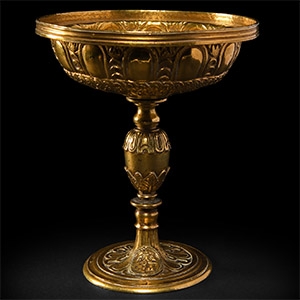
Post Medieval Gilt Silver Dated Decorated Chalice
15th-16th century A.D.Sold for (Inc. bp): £1,950
A gilt silver chalice with bowl decorated with repoussé arcading, fluting and entwined motifs, balustered stem with ovoid centre adorned with pseud-architectural and leaf detailing, fluting below splaying out onto a circular foot bearing an applied oval armorial cartouche; interior base with foliate roundel in raised relief; dated 1589 in Roman numerals incised on the base. 309 grams, 13.5 cm high
English private collection. -
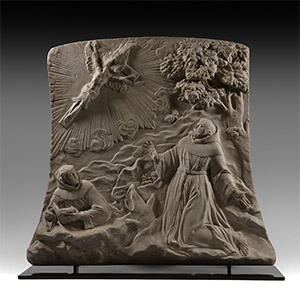
Post Medieval Relief with St Francis Scene
Italian, 18th century A.D. or laterEstimate: £1,200 - 1,700 (+bp*)
Opening Bid: £600
A carved marble figural panel depicting a religious scene, probably St. Francis of Assisi receiving the Holy Stigmata; a kneeling figure in loose-fitting cowl and habit with knotted cord to the waist, arms spread and head raised towards a chiaroscuro sunburst with a figure at the centre, wearing a loincloth and affixed to a plain cross, borne up by three pairs of wings attached to the shoulders and thighs; below, a second, smaller figure holding a book; all in a landscape with a tree at right behind the larger figure; mounted on a custom-made stand. 75 cm high including stand
English private collection.
The scene probably represents the events just prior to the end of the life of St. Francis of Assisi: while he was praying on a mountain with his companion, Brother Leo, he is said to have had a vision of a seraph (a six-winged angel on a cross) which gave him the gift of the stigmata, the five wounds of Christ. The apparition caused a deterioration in Francis's health and no cure could be found, so the saint spent the remaining days of his life dictating his spiritual message to Leo, who preserved the record of these events.
