
Loading, please wait...

LOT 2226
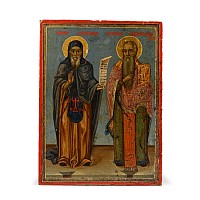
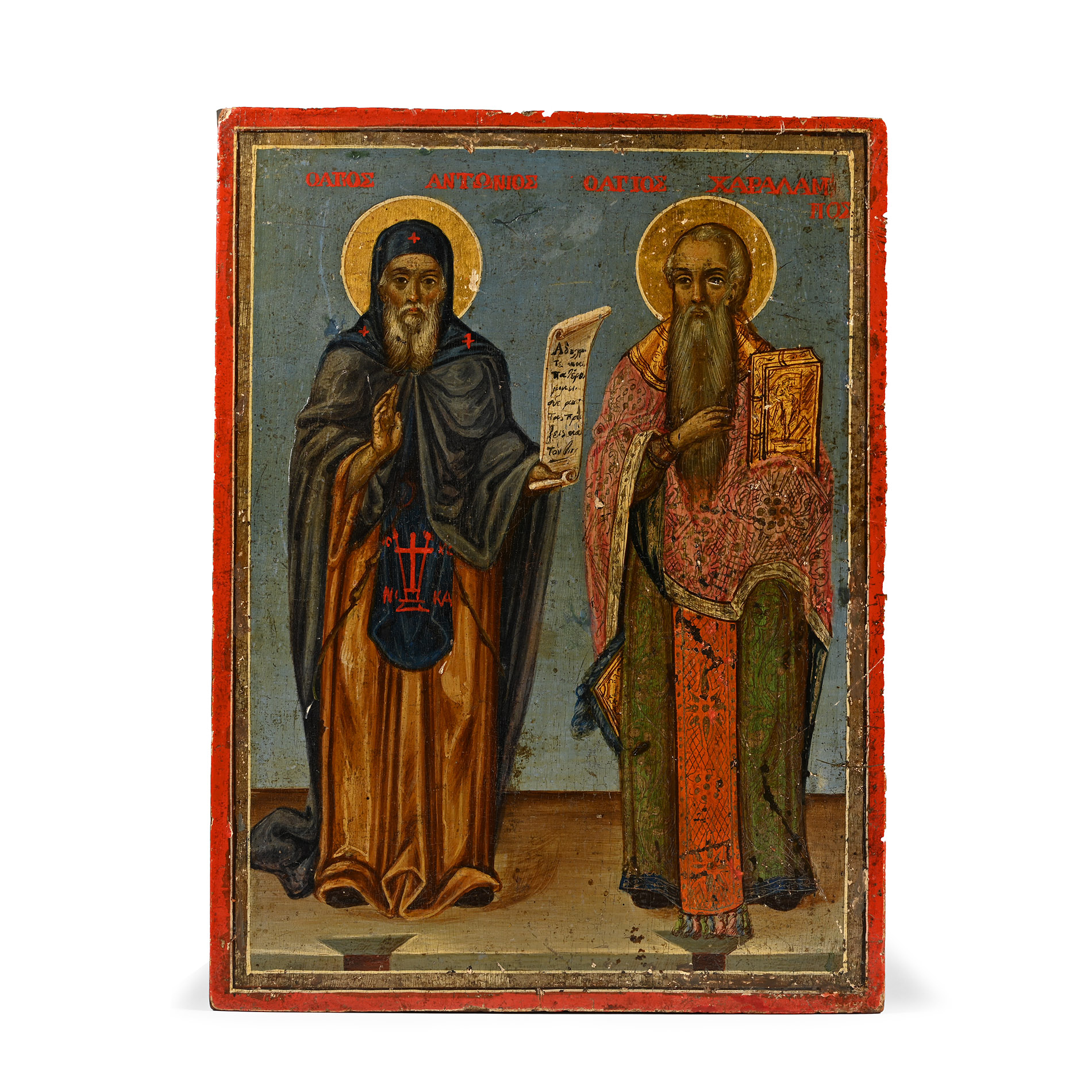
Greek Icon with Saint Anthony the Abbot and Saint Charalambos
EARLY 19TH CENTURY A.D.
9 7/8 x 7 1/4 in. (558 grams, 25 x 18.6 cm).
Saint Anthony the Great on the left, represented in monastic dress holding a scroll of holy writings with his left hand; Saint Charalambos dressed as a bishop, with a green sticharion embroidered in gold, covered by a pink gold embroidered phelonion, a gold embroidered square epigonation with blue edges, and a long orange gold embroidered epitrachelion, holding a gold covered gospel with the image of Christ's resurrection with his left hand; tempera on wood.
ProvenanceAcquired from Portobello Road, London, in the 1990s.
Property of a London, UK, gentleman collector.
This lot is accompanied by an illustrated lot declaration signed by the Head of the Antiquities Department, Dr Raffaele D’Amato.
Cf. Matthieson, S., Morrison, G., Heavenly Beings, Icons of the Christian Orthodox World, Auckland, 2022, p.192, for icons of Saint Charalambos; for an icon of Saint Anthony the Great see the prototype of his icons made by Michail Damaskinos, in Chatzidakis, M., Musee Byzantin d'Athenes, Icons, Athens, 1979, icon no.15.
FootnotesSaint Anthony the Great, who lived in the 3rd-4th century A.D., was the father of the Eastern Monachism. According to the tradition, Saint Charalambos was martyrised in 202 A.D. He is the protector of prosperity and health
CONDITIONTimeLine Auctions follows a vetting process to ensure the authenticity and legality of all items, reinforcing our commitment to integrity and responsible trading. Each antiquity, antique, and coin lot undergoes thorough examination by a vetting committee of at least ten external specialists, professional trade association members, scientists, and archaeologists: Our Vetting Process
AUCTIONS:
TimeLine is a leading auction house specialising in antiquities, ancient art, collectables, natural history, coins, medals, and books. Our auctions offer museums, collectors, historians, and enthusiasts the opportunity to acquire unique and historically significant pieces.
LOT 2226
Greek Icon with Saint Anthony the Abbot and Saint Charalambos
Estimate £300 - 400€350 - 460 (for guidance only)$410 - 540 (for guidance only)
-
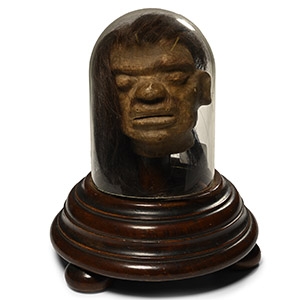
Victorian 'Freaks Fair' Model of a Shrunken Head
19th century A.D.Sold for (Inc. bp): £845
A tribal head modelled from leather with applied hair, moustache, eyebrows and eyelashes; pierced through the lips and ears; set in a later glass dome with base. 810 grams total, 20.5 cm including stand
Acquired Mellors & Kirk, circa 2019. Ian Wilkinson collection, Nottinghamshire, UK, formed since 1985. This lot is accompanied by an illustrated lot declaration signed by the Head of the Antiquities Department, Dr Raffaele D’Amato.
The freak show was the archetypal expression of popular culture, enjoyed by everyone regardless of their class. The freak show was presented to the public as entertaining and educational, offering the opportunity to learn about anatomy and the ‘realities’ of people from foreign lands. The real 'shrunken heads' known as tsantsas were severed human heads that were used by tribal cultures as war trophies or for ceremonial purposes. They were also used to scare off an enemy, using the heads as a threat, or also in religious rituals. -
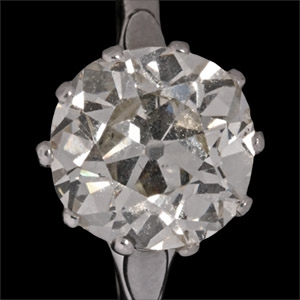
3.2 Carat Diamond Solitaire White Gold Ring
20th century A.D.Sold for (Inc. bp): £5,200
A brilliant cut diamond set in an 18 carat white gold claw setting, slender D-shaped hoop; the diamond chipped. 3.65 grams, 24.68 mm overall, 15.44 mm internal diameter (approximate size British J, USA 4 3/4, Europe 8.69, Japan 8)
Acquired on the UK art market. Ex property of a County Durham collector. This lot has been checked against the Interpol Database of stolen works of art and is accompanied by search certificate no.12489-230248. This lot has been cleared against the Art Loss Register database, and is accompanied by an illustrated lot declaration signed by the Head of the Antiquities Department, Dr Raffaele D’Amato. -
.jpg)
Bronze Parvati Statue with Baby Ganesha
Late 20th century A.D.Sold for (Inc. bp): £111
Standing on a lotus-flower dais; Parvati with floor-length robe and mandorla, Ganesha with axe, rope and other implements in his various hands; after the antique. 2.58 kg, 39.3 cm
Acquired on the UK art market from various auction houses and collections mostly before 2000. From an important Cambridgeshire estate; thence by descent. This lot is accompanied by an illustrated lot declaration signed by the Head of the Antiquities Department, Dr Raffaele D’Amato.
