
Loading, please wait...
LOT 0322
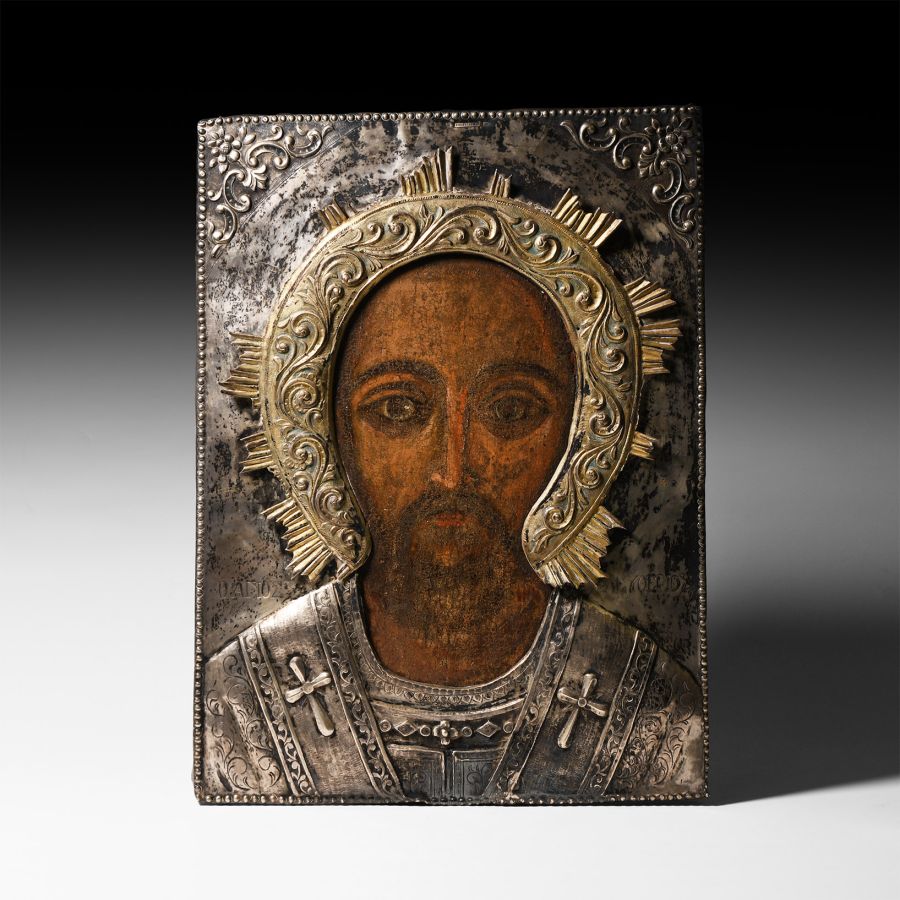
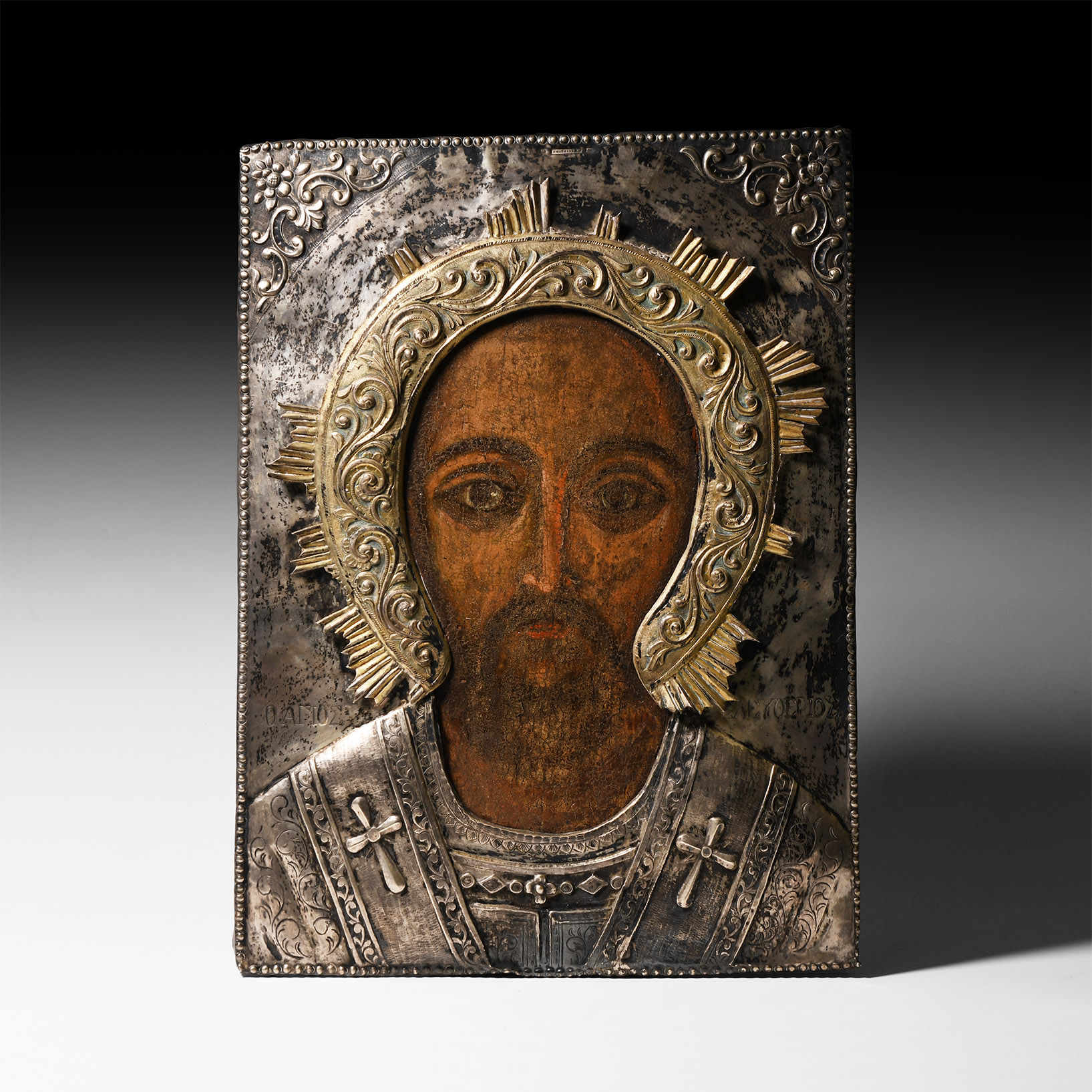
Greek Icon with Bust of Saint Eleutherios
18TH CENTURY A.D.
14 3/4 x 11 1/4 in. (1.9 kg, 37.5 x 28.7 cm).
A wooden painted icon of Saint Eleutherios with a repoussé silver oklad that covers all but the face, embossed in rich priestly robes, representing the priest's omophorion decorated with crosses, over an embroidered robe or sticharion, the nimbus gilded and embossed with foliage and rays over a silver background, Greek inscription 'O AΓΙΟΣ ΕΛΕΥΘΕΡΙΟΣ' (Saint Eleutherios) to the sides.
ProvenanceProperty of a London lady, part of her family's collection.
LiteratureCf. similar icon (style and face) of Nikolaos Kallergis (18th century), in Byzantine Museum of Zakynthos; for the iconography of Saint Eleftherios Charalambos D. Vasilopolou, Αγιος Ελευθεριος (Saint Eleftherios, in Greek), Livani, 2019.
FootnotesAs bishop in Illyricum, Eleutherios promoted the cause of at a time when the persecutions not only made it difficult to win and hold converts, but also at a time when the gravest danger was in being a high-ranking prelate of the Church. Oblivious to this threat, he was acclaimed in the inner circle of Christianity as the brightest luminary of Christian Rome since the apostles. His immense popularity grew and thereby became more dangerous to the state. He was finally brought to the attention of Emperor Hadrian, who ordered his arrest, and then cast into prison, tortured, and put to death on December 15th.
CONDITIONTimeLine Auctions follows a vetting process to ensure the authenticity and legality of all items, reinforcing our commitment to integrity and responsible trading. Each antiquity, antique, and coin lot undergoes thorough examination by a vetting committee of at least ten external specialists, professional trade association members, scientists, and archaeologists: Our Vetting Process
AUCTIONS:
TimeLine is a leading auction house specialising in antiquities, ancient art, collectables, natural history, coins, medals, and books. Our auctions offer museums, collectors, historians, and enthusiasts the opportunity to acquire unique and historically significant pieces.
-
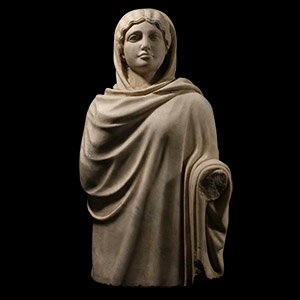
Life-Size Draped Statue of Venus
19th century A.D.Estimate: £3,000 - 4,000 (+bp*)
Opening Bid: £1,400
A life-size marble upper body of a young female figure, likely the goddess Venus, shrouded in a palla mantle worn over the robe and draped over the head as a hood; the left arm bent to form folds and gatherings in the cloth, the right arm shown beneath the cloth held bent to the right breast. 133 kg, 84 cm high
French collection, 1960s-early 2000s. From an important Paris gallery, France. This lot has been checked against the Interpol Database of stolen works of art and is accompanied by search certificate number no.11687-199355.
In Roman mythology, Venus was the goddess of love, sex, beauty and fertility. Married to the god Vulcan, Venus' principal divine lover was Mars, with whom she was famously trapped in bed with a net by Vulcan. The goddess also had numerous mortal lovers - Adonis for example. The earliest known appearance of a temple dedicated to Venus was founded on the Aventine Hill in 295 B.C. She is most closely associated with the month of April, the beginning of the season of spring. -
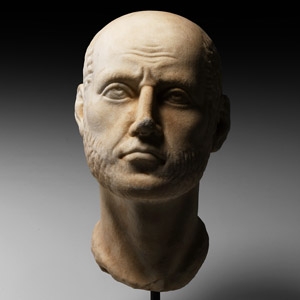
Marble Head of a Roman Emperor
20th century A.D.Estimate: £4,000 - 6,000 (+bp*)
Opening Bid: £2,000
A carved marble bust of a mature male with stern features, likely the emperor Carus, shown with short, neatly-dressed hair and beard; mounted on a custom-made display stand. 10.4 kg, 38 cm high including stand
French collection, 1960s-early 2000s. From an important Paris gallery, France. This lot has been checked against the Interpol Database of stolen works of art and is accompanied by search certificate number no.11694-199338.
Carus reigned 282-283 A.D. He served as a prefect of the guard to emperor Probus, whom he succeeded. Whilst leading a campaign against the Sassanians, Carus died suddenly and under mysterious circumstances, leading to the belief that he was struck by lightning. Little is known of his life, owing to the relative instability of that time period. Whether he had Probus murdered, or whether he was killed by mutinous troops was disputed even by his contemporaries. Carus was succeeded by his sons Carinus and Numerian, although their reigns were short-lived and his dynasty was soon supplanted. Carinus’ lasting legacy was principally the suppression of the authority of the senate. He has gone down in history as one of the tyrants of ancient Rome. -
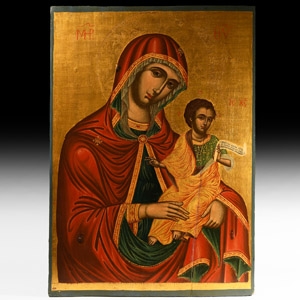
Large Veneto-Cretan Icon of Virgin and Child
17th century A.D. or laterEstimate: £5,000 - 7,000 (+bp*)
Opening Bid: £2,250
A large icon depicting the Virgin holding the Christ on her lap on a gilt background, both nimbate, the haloes with punched foliate decoration; the Virgin wearing a carmine red maphorion embellished with golden embroidery and fringes, elaborate cuffs and neckline to the himation; the Christ seated on the lap, holding his right arm out and making the blessing sign with his hand, left hand holding an open scroll inscribed in Greek πνευμα κυριου επ εμε ου ενεκεν εχρισεν με ευαγγελιζεσθαι πτωχοις απεσταλκεν με for 'The Spirit of the Lord is on me, because he has anointed me to proclaim good news to the poor' (Luke 4:18-21), the green chiton and orange himation embellished with red folds; Greek inscription 'ΜΡ ΘΥ' for 'Mother of God' flanking the Virgin's halo, 'IC XC' for 'Jesus Christ' to the right of the Child and inside his nimbus 'O Ѿ N' for 'The Only One who always exists'; some restoration. 4.3 kg, 60 x 42.5 cm
very good condition; tempera on wood panel; vertical crack minimally restored.
Property of a London lady, part of her family's collection. Accompanied by an academic report by Dr Raffaele D’Amato. This lot has been checked against the Interpol Database of stolen works of art and is accompanied by searcher certificate no.11572-198599.
In the Orthodox church, the spaces between the columns close to the central doors of the Iconostasis (Holy Doors) are occupied by two proskynesis icons, representing Christ giving his blessings to the right and to the left the Virgin Mary, with or without the infant, or in interceding position known as Virgin Chalkoprateia type.
