
Loading, please wait...

LOT 0016
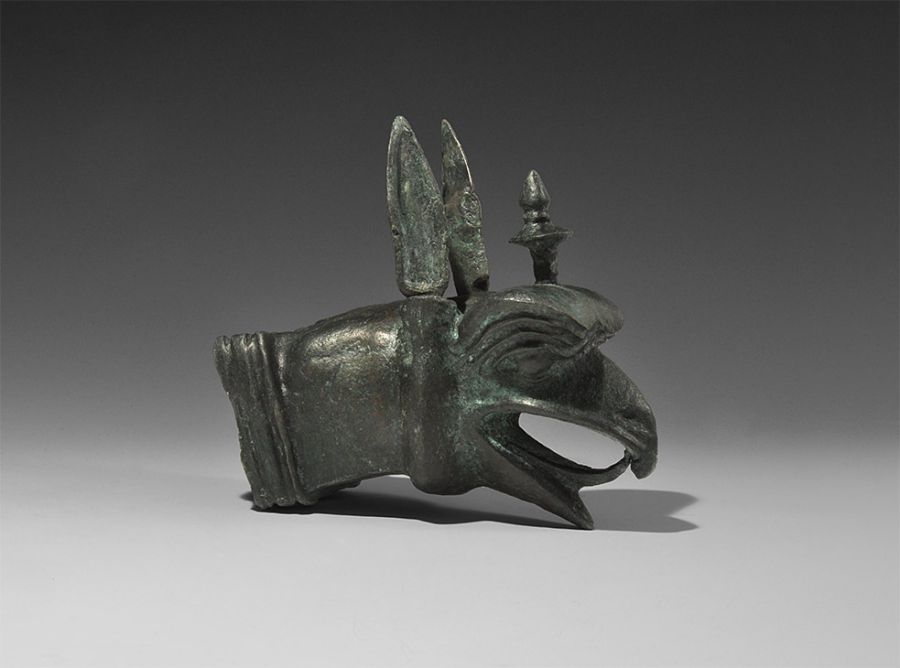
Greek Gryphon-Head Cauldron Mount
7TH CENTURY BC
6 1/2" (1.1 kg, 16.5cm).
A large bronze hollow-formed cauldron decoration in a form of a griffin-head with open beak and curved pointed tongue, olive-shaped eyes decorated with heavy quadruple 'eyebrows'; the head encircled by a U-shaped ring; the square-section neck decorated with three raised ribs to the rear, a central knob and conical finial projecting from the crown of the head between two leaf-shaped separately-formed ears.
ProvenanceProperty of an East Anglian, UK, gentleman by descent; acquired by the owner's father in London before 1980.
LiteratureCf. Richter, G. A Handbook of Greek Art, London, 1959, items 296-297; Yalouris, A. and N. Olympia, Guide to the Museum and the Sanctuary, Athens, 1987, items B2358, B6108, B288; Durando, F. Greece, Splendours of an Ancient Civilization, London, 2005, item 122.
FootnotesBronze cauldrons set on tripods or conical stands, decorated with protomes or attached heads of gryphons, lions, bulls or sphinxes, came into the Greek world from the east, perhaps from the region of Urartu. They were an important element in the Orientalising period of Greek art - the time during the 7th century BC when Greek craftsmen took revitalising inspiration from the east. Cast-bronze gryphons' heads often decorated the cauldron rims; they projected outward from the shoulder of the vessel on long necks made of hammered or cast bronze. Such attachments were decorative rather than functional, though gryphons were no doubt thought to have the ability to turn away evil. Over six hundred bronze gryphons' heads from cauldrons are known today; most have been found at the sanctuary of Zeus at Olympia or at that of Hera on Samos. Some of the cauldrons could be huge and the historian Herodotus described one made for King Kroisos of Lydia that could hold two thousand seven hundred gallons.
CONDITIONTimeLine Auctions follows a vetting process to ensure the authenticity and legality of all items, reinforcing our commitment to integrity and responsible trading. Each antiquity, antique, and coin lot undergoes thorough examination by a vetting committee of at least ten external specialists, professional trade association members, scientists, and archaeologists: Our Vetting Process
AUCTIONS:
TimeLine is a leading auction house specialising in antiquities, ancient art, collectables, natural history, coins, medals, and books. Our auctions offer museums, collectors, historians, and enthusiasts the opportunity to acquire unique and historically significant pieces.
4th century BC
Lot No. 0024
Sold for (Inc. premium): £223
4th century BC
Lot No. 0033 Opening bid: £27
5th-3rd century BC
Lot No. 0009
Sold for (Inc. premium): £1,364
