
Loading, please wait...


LOT 2215
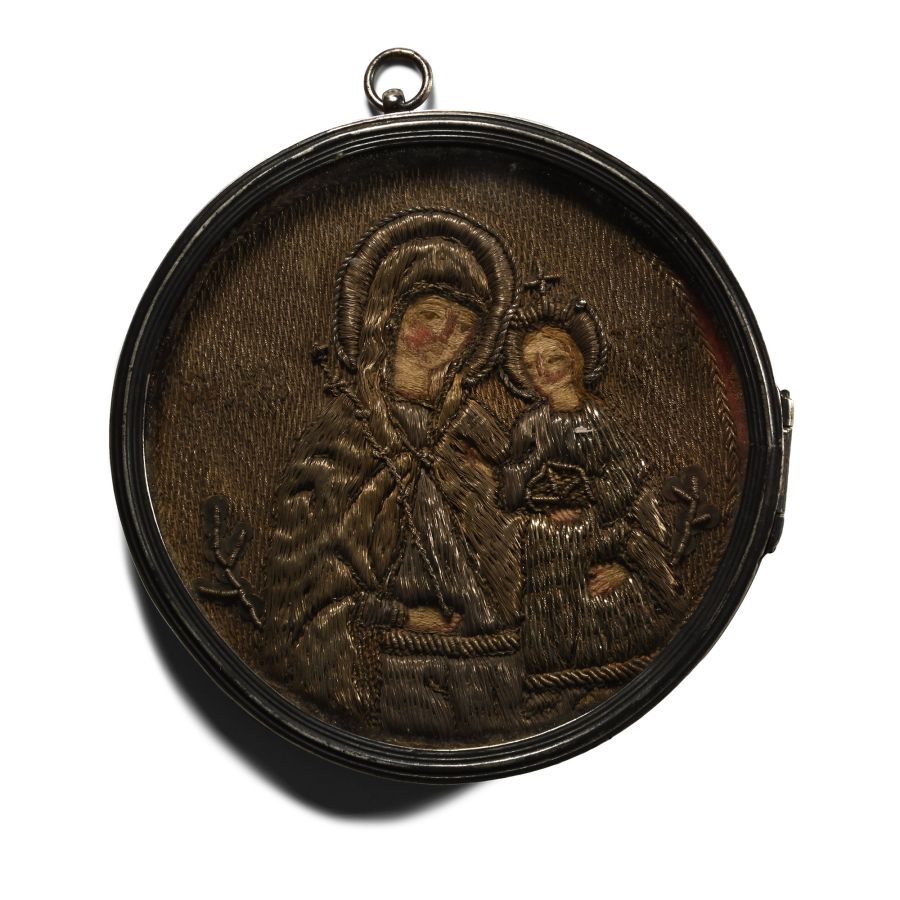
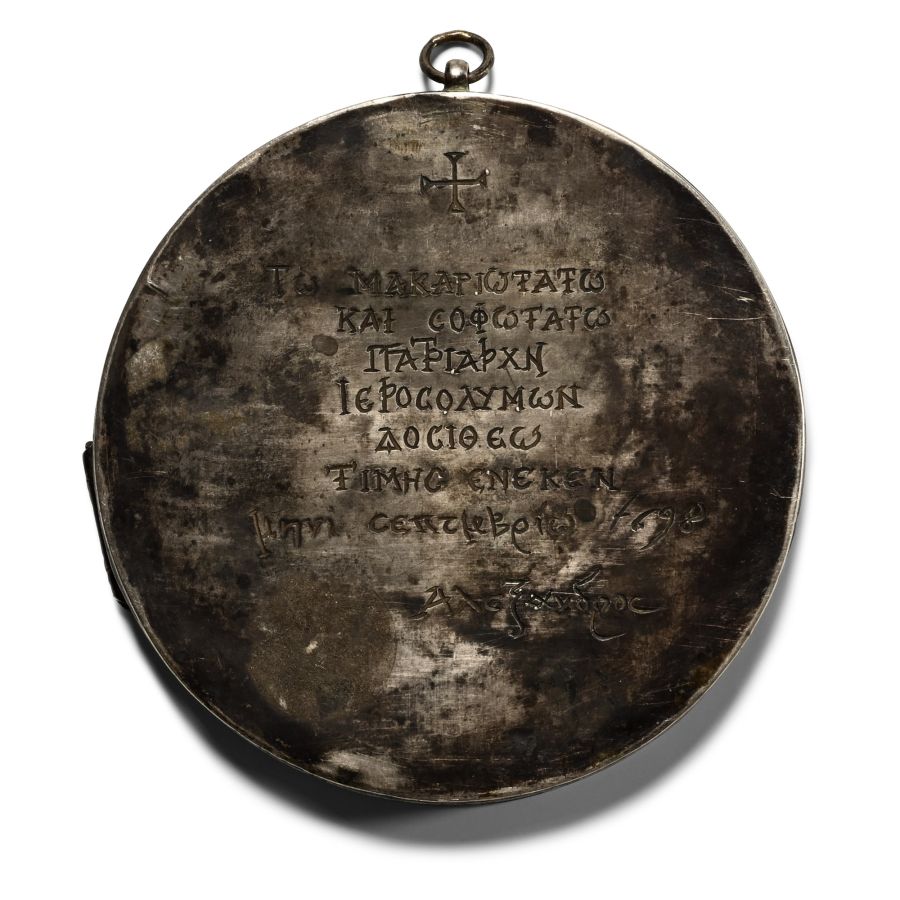
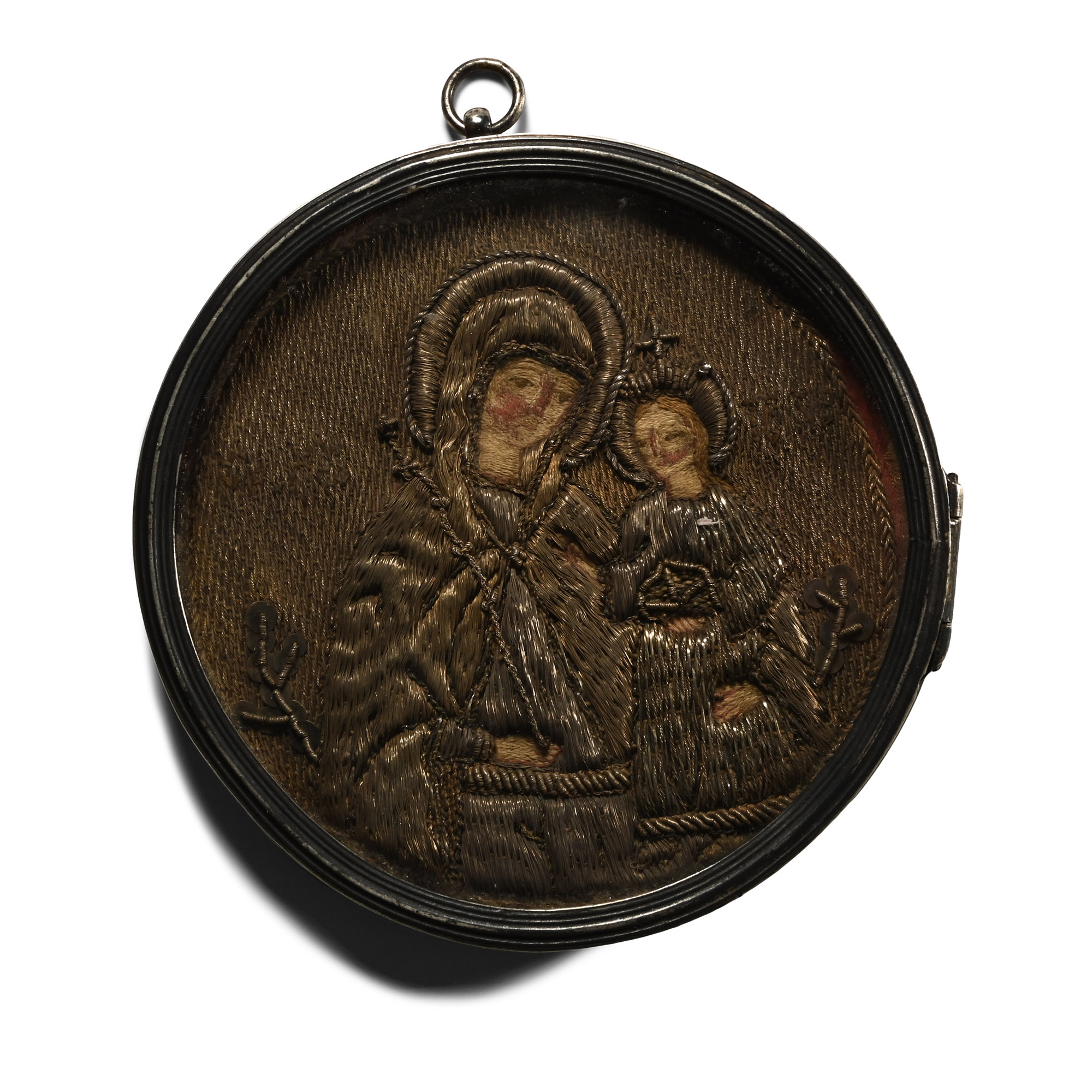
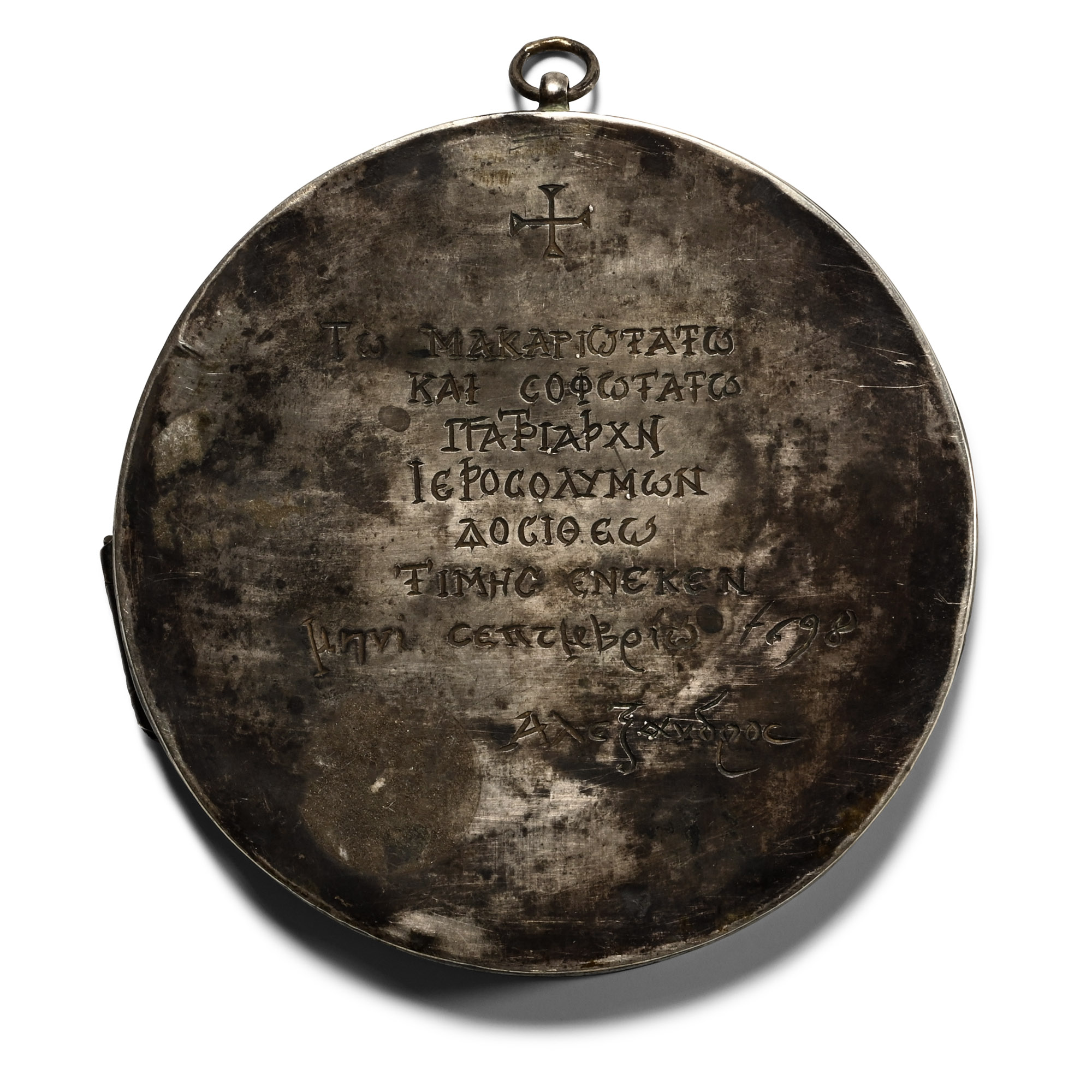
Greek Gold Thread Needle Point with Mary and Jesus in Silver with Inscription to the Archbishop of Jerusalem
DATED 1698 A.D.
4 in. (82 grams, 10 cm).
Depicting Mary holding a lily flower with her right hand and supporting infant Jesus with her left arm; Jesus crowned by a crossed diadem and holding a gospel in his hand; background in gold thread, framed in a circular silver frame with dedicatory inscription to the reverse from a certain Alexander to the Jerusalem’s Archbishop Dositheus, reciting: + Τω ΜΑΚΑΡΙΟΤΑΤω ΚΑΙ CΟΦωΤΑΤω ΠΑΤΡΙΑΡΧΗ ΙΕΡΟCΟΛΥΜωΝ ΔΟCΙΘΕω ΤΙΜΗC ΕΝΕΚΕΝ – μηνι cεπτεμβριω 1698 – Αλεξανδρος – To His Beatitude and Enlighted Patriarch of Jerusalem Dositheus, as a sign of respect – September 1698 – Alexander; internal padding with floral decoration.
ProvenanceProperty of a London, UK, gentleman collector.
This lot is accompanied by an illustrated lot declaration signed by the Head of the Antiquities Department, Dr Raffaele D’Amato.
Cf. Hellenic Ministry of Culture, Embroiderers, Embroideresses & Embroideries in Constantinople, (17th-19th c.), Athens, 2008, nos.BXM 21078, 20717, 20718, 21069, 21072, 21055, for similar embroideries.
FootnotesThe art of gold embroidery developed in Constantinople, with its own guild, and continued also after the end of the empire. Important artists like the legendary Despoineta, Mariora, Eusebia and Kokona, were famous in the 'painterly' rendering of religious subjects, not with the brush, but with the needle: red satin, and silver and gold wire created dresses, shadows, volumes with a sense of depth and sculptural quality. The artists conceived their works like a true prayer: a hope, based on human creativity.
CONDITIONTimeLine Auctions follows a vetting process to ensure the authenticity and legality of all items, reinforcing our commitment to integrity and responsible trading. Each antiquity, antique, and coin lot undergoes thorough examination by a vetting committee of at least ten external specialists, professional trade association members, scientists, and archaeologists: Our Vetting Process
AUCTIONS:
TimeLine is a leading auction house specialising in antiquities, ancient art, collectables, natural history, coins, medals, and books. Our auctions offer museums, collectors, historians, and enthusiasts the opportunity to acquire unique and historically significant pieces.
LOT 2215
Greek Gold Thread Needle Point with Mary and Jesus in Silver with Inscription to the Archbishop of Jerusalem
Sold for (Inc. bp): £520
-
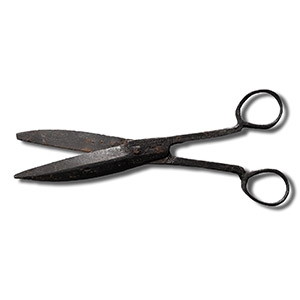
Georgian 'Thames' Iron Scissors
Mid 18th century A.D.Sold for (Inc. bp): £59
Pointillé decoration to the body, keeled blades and small loop handles, mechanism still working. 54.1 grams, 17 cm
Found on the Thames foreshore in the 1980s. Property of an Essex collector. This lot is accompanied by an illustrated lot declaration signed by the Head of the Antiquities Department, Dr Raffaele D’Amato. -

Post Medieval Gilt Plaque with Winged Cherub
17th-18th century A.D.Sold for (Inc. bp): £234
Depicted with a young face, curly hair, crowned by a halo, six radiating wings with feather detail; two holes for attachment. 33 grams, 19 cm
Acquired Brigantia Antiques, York, UK, circa 2007. Ian Wilkinson collection, Nottinghamshire, UK, formed since 1985. This lot is accompanied by an illustrated lot declaration signed by the Head of the Antiquities Department, Dr Raffaele D’Amato.
The plaque represents the central applique of a riphidion, an ecclesiastic fan worn by the Deacons during the Liturgical celebration of the Orthodox Church. The iconography refers to the Cherubim, the Angelic creatures with many wings and many eyes, ‘Singing the triumphal hymn, exclaiming, proclaiming, and saying' Holy, holy, holy. Fans are appointed to symbolise the invisible presence of the angels during significant liturgical acts. They are carried in the Great Entrance while the choir sings, ‘We who mystically represent the Cherubim and who sing the thrice-holy hymn to the life-creating Trinity, now lay aside all cares of this life, that we may receive the King of All, who comes invisibly escorted by the angelic host’. The altar servers take the place of angels, and they carry seraphic fans like the ancient Roman soldiers who carry the banner of their regiment. -

Tudor Period Lead 'Hornbook' Writing Aid
Circa 1500-1633 A.D.Sold for (Inc. bp): £520
A Tudor or Stuart period lead-alloy 'hornbook': incomplete rectangular plaque with small rectangular handle; bearing raised, moulded text on the obverse with hatched forms between four registers, which frame the letters of the alphabet 'ABCDE/FG[reversed]HIKL/MNOPq/RST[VW]XYZ'; low-relief octofoil in centre to the reverse. 51 grams, 75 mm
Found Yorkshire, UK. This lot is accompanied by an illustrated lot declaration signed by the Head of the Antiquities Department, Dr Raffaele D’Amato.
The letter 'U' has been omitted from the alphabet as is common with such objects, as has the letter 'J', suggesting that the book was produced prior to the publication of Charles Butler's English Grammar (1633) which first distinguished between I and J. The letter Z is reversed. Hornbooks were employed as learning aids and commonly made from paper mounted onto wood together with a transparent sheet of horn. Smaller, more portable lead-alloy examples such as this one are generally believed to have been mass produced, whilst still falling within the genre of 'hornbooks'. Interestingly, some scholars have argued that the mistakes and inconsistencies found on lead examples rendered them less effective learning tools, used as children's toys in families with low levels of literacy, or possibly serving as dolls' accessories.
