
Loading, please wait...
LOT 0578
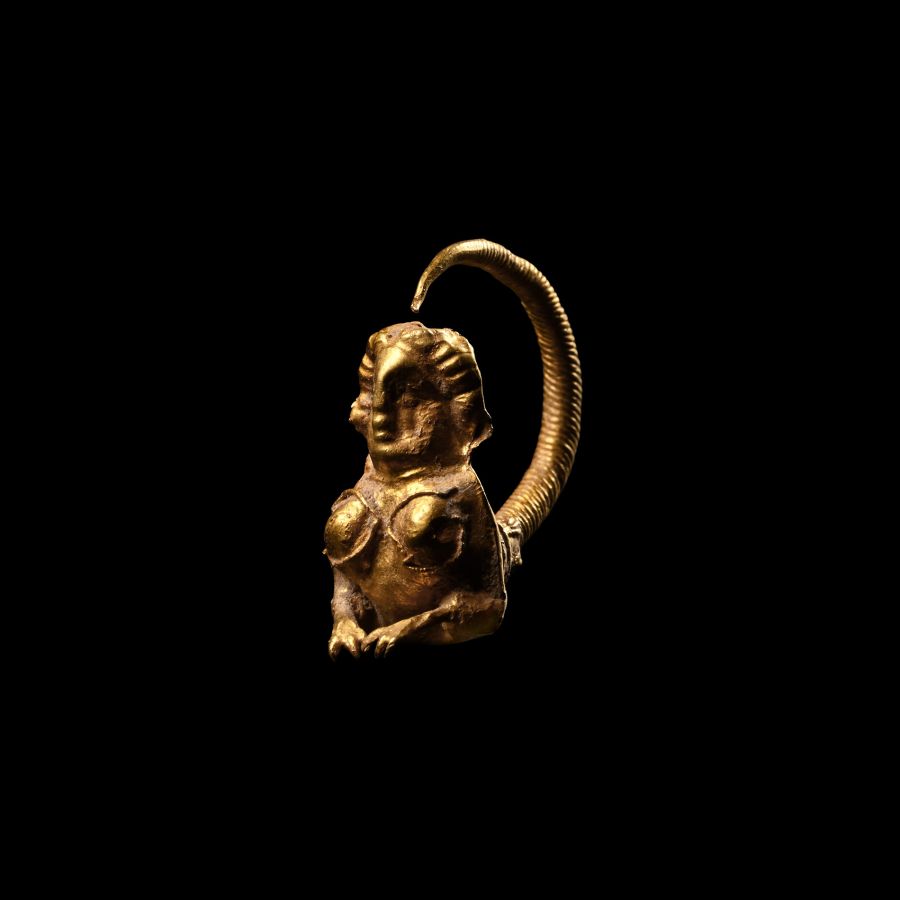
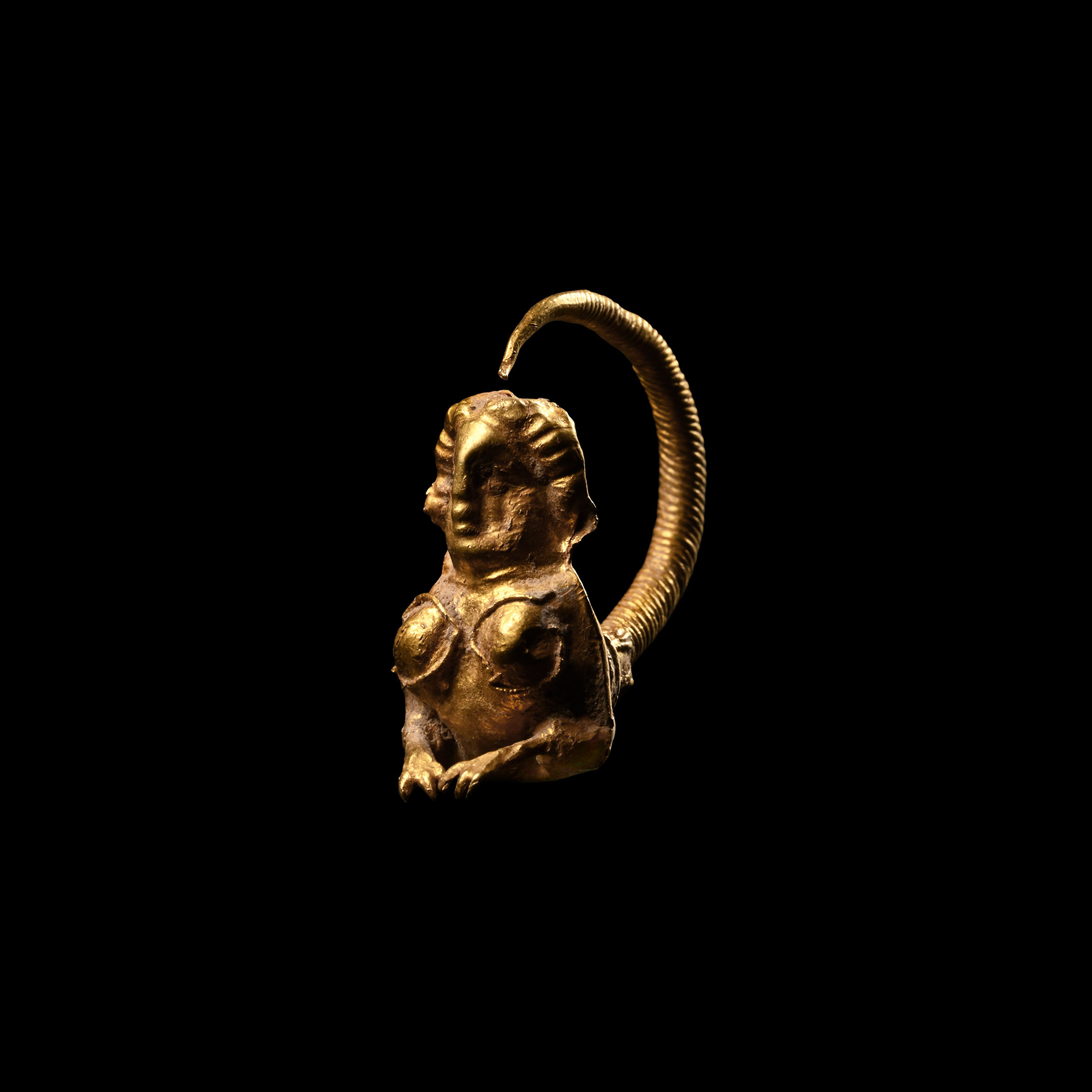
Greek Gold Sphinx Earring
3RD-2ND CENTURY B.C.
1 in. (2.55 grams, 26 mm).
A single gold earring composed of a twisted wire hoop, stylised bust of a sphinx with detailed breast and lion paws.
ProvenanceAcquired 1980-2015.
Ex Abelita family collection.
Cf. Dimitrova Tonkova, 'Hellenistic Jewellery from the Colonies on the West Black Sea Coast,' in Archaeology in Bulgaria, Vol.1, no.1, 1997, pp.83-102, figs.5, 7, pl.IV, no.4, pl.V, nos.1,2, pl.VI,3 for the type.
FootnotesEarrings with a sphinx represent a variety of the earrings created by the Hellenised goldsmiths of the Black Sea area. These figures usually had an inlaid garnet and are dated between late 3rd and 2nd century B.C. They belong to the category of earrings with a female head, often visible in graves of the Black Sea area and not always of good quality.
CONDITIONTimeLine Auctions follows a vetting process to ensure the authenticity and legality of all items, reinforcing our commitment to integrity and responsible trading. Each antiquity, antique, and coin lot undergoes thorough examination by a vetting committee of at least ten external specialists, professional trade association members, scientists, and archaeologists: Our Vetting Process
AUCTIONS:
TimeLine is a leading auction house specialising in antiquities, ancient art, collectables, natural history, coins, medals, and books. Our auctions offer museums, collectors, historians, and enthusiasts the opportunity to acquire unique and historically significant pieces.
-
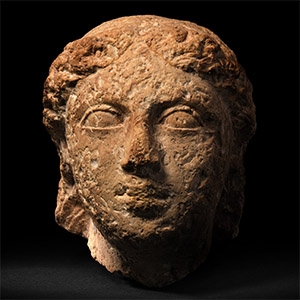
Greek Stone Head of a Female
4th-3rd century B.C.Sold for (Inc. bp): £2,340
A carved stone head modelled with semi-naturalistic facial features and dressed hair falling down the neck in tight curls. 4.2 kg, 17 cm high
Acquired early 1990s. Ex private American collection; thence by descent. Private Swiss collection since 1998. This lot has been checked against the Interpol Database of stolen works of art and is accompanied by search certificate no.11613-198981. -
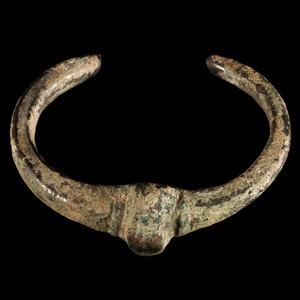
Greek Heavy Bronze Bracelet with Central Bar
1st millennium B.C.Sold for (Inc. bp): £72
A penannular bronze bracelet with a facetted convex hoop, the arms tapering to an expanded bezel with raised vertical bar. 27.7 grams, 64 mm
Acquired 1990s. English private collection. Property of an Essex gentleman. -
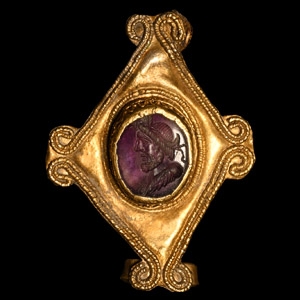
Greek Gold Brooch with Portrait Gemstone
3rd-2nd century B.C. and laterSold for (Inc. bp): £910
A lozengiform gold brooch with bifurcated corners picked out in filigree, catchplate to reverse; central oval cell with filigree borders, set with a intaglio gemstone displaying a male bust facing left. 9.55 grams, 41 mm
Acquired in the 1950s-1990s. Ex Mansees collection. Ex private Chicago, USA, collection, 1995. English private collection.
