
Loading, please wait...
LOT 0112
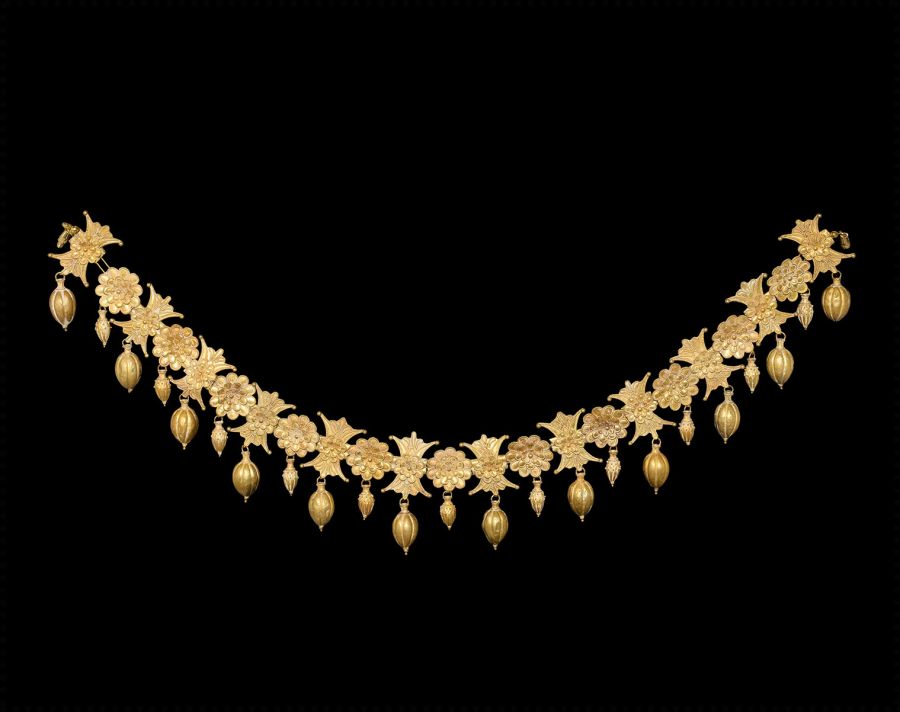
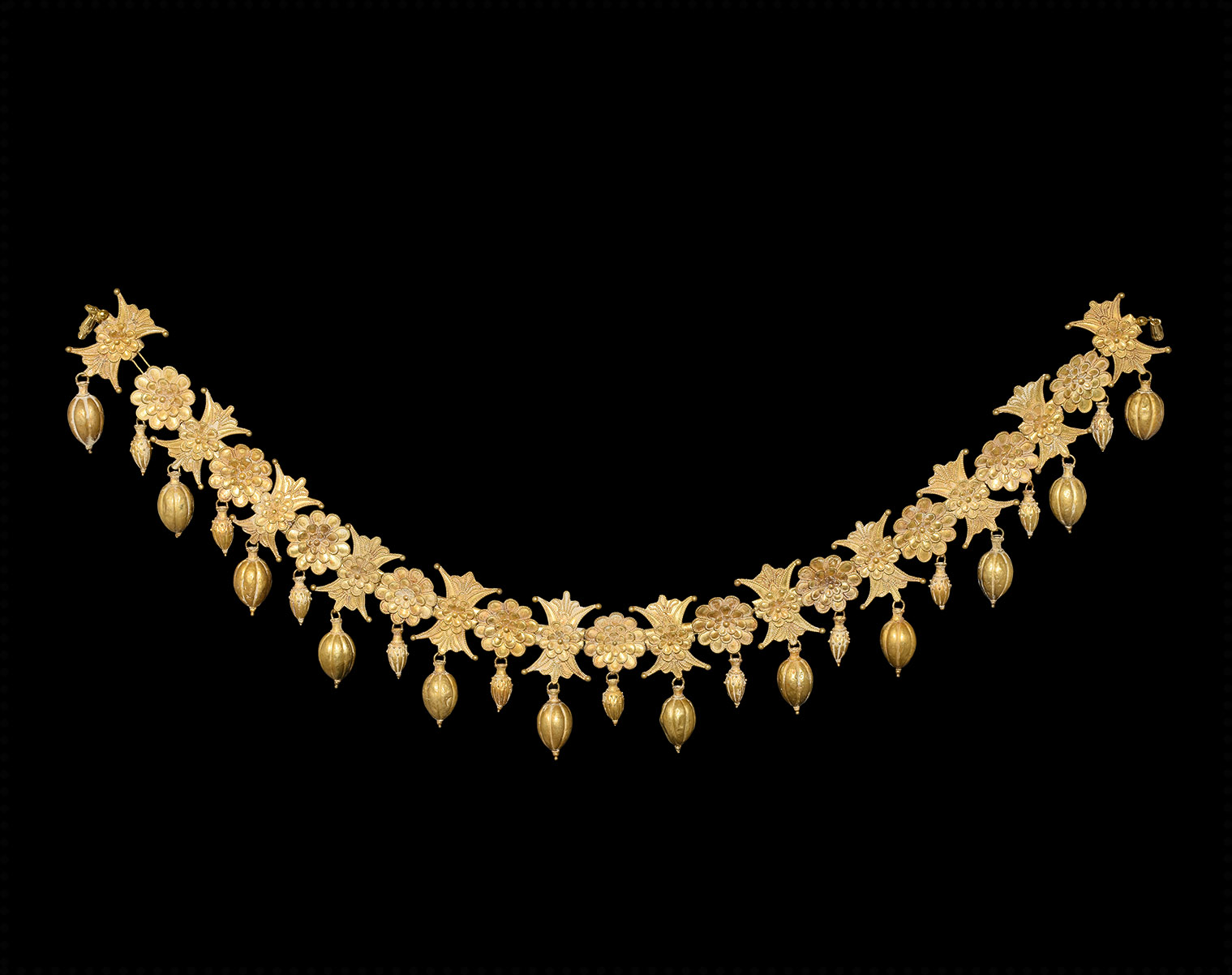
Greek Gold Rosette and Pendant Set
4TH CENTURY BC
14 1/4" (71 grams, 36cm).
A restrung set of gold elements comprising: rosette plaques with beaded wire to the outer petals, hollow piriform vase pendants with filigree and granule detailing; pairs of lotus blossoms with beaded wire and granule detailing, hollow ribbed pendants with filigree loop and granule finial.
ProvenanceEx an important American collection from Chicago, Illinois, USA; disposed of in 1995; previously in the Mansees collection; formed 1950s-early 1990s. Supplied with a positive X-Ray Fluorescence metal analysis certificate.
LiteratureCf. the Taranto necklace in Despini, A. Greek Art. Ancient Gold Jewellery, Athens, 1996, item 138-9.
FootnotesGold occurs rarely in Central Greece, but resources in Thrace, Asia Minor, Egypt and Spain were all exploited. Herodotus mentions Hyperborean sources, in the far north, which might indicate deposits in the Urals; he also writes of gold obtained by the Carthaginians who sailed beyond the Pillars of Herakles, known to us as the Straight of Gibraltar, to the Atlantic coast of Africa. Most famous in ancient literature is the gold of Asia Minor, where the mythical king Midas of Phrygia and the historical king Croesus of Lydia became synonymous with vast wealth.
In Greece itself, Herodotus saw gold mines on the north Aegean island of Thasos, as well as the Cycladic island of Siphnos. The style of this necklace is in keeping with the tastes of the Eastern Greeks and the Hellenistic kingdoms. The pieces that come from the Black Sea region show the taste for gold, rendered beautifully by immigrant Greeks and local goldsmiths, was indulged in by both chieftains grown rich from the trading of grain, timber and other natural resources and Greek merchants and settlers, who may have adopted local customs. While some of their treasures are clearly the work of local craftsmen, others, like this piece, are highly refined works of unadulterated Greek style, suggesting that they were either imports or the products of Greek craftsmen who settled abroad in order to profit from serving wealthy foreign clients.
TimeLine Auctions follows a vetting process to ensure the authenticity and legality of all items, reinforcing our commitment to integrity and responsible trading. Each antiquity, antique, and coin lot undergoes thorough examination by a vetting committee of at least ten external specialists, professional trade association members, scientists, and archaeologists: Our Vetting Process
AUCTIONS:
TimeLine is a leading auction house specialising in antiquities, ancient art, collectables, natural history, coins, medals, and books. Our auctions offer museums, collectors, historians, and enthusiasts the opportunity to acquire unique and historically significant pieces.
3rd century BC
Lot No. 0138 Opening bid: £180
3rd century BC-3rd century AD
Lot No. 1462
Sold for (Inc. premium): £37
4th century BC
Lot No. 1424 Opening bid: £135
