
Loading, please wait...
_900x900.jpg "Greek Gold Ring with Stylised Warrior")
_200x200.jpg "Greek Gold Ring with Stylised Warrior")
.jpg "Greek Gold Ring with Stylised Warrior")
LOT 0660
Greek Gold Ring with Stylised Warrior
3RD-2ND CENTURY B.C.
3/4 in. (1.27 grams, 20.44 mm overall, 18.90 mm internal diameter (approximate size British O, USA 7, Europe 14.98, Japan 14)).
Narrow butted hoop, lentoid bezel with low-relief figure in profile standing with sword and shield raised.
ProvenanceAcquired in the 1992.
Private collection, Switzerland, thence by descent.
Private collection, since the late 1990s.
This lot is accompanied by an illustrated lot declaration signed by the Head of the Antiquities Department, Dr Raffaele D'Amato.
Cf. Chadour, A.B., Rings. The Alice and Louis Koch Collection, volume I, Leeds, 1994, item 64, for type.
CONDITIONTimeLine Auctions follows a vetting process to ensure the authenticity and legality of all items, reinforcing our commitment to integrity and responsible trading. Each antiquity, antique, and coin lot undergoes thorough examination by a vetting committee of at least ten external specialists, professional trade association members, scientists, and archaeologists: Our Vetting Process
AUCTIONS:
TimeLine is a leading auction house specialising in antiquities, ancient art, collectables, natural history, coins, medals, and books. Our auctions offer museums, collectors, historians, and enthusiasts the opportunity to acquire unique and historically significant pieces.
-
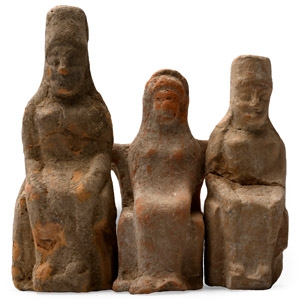
Archaic Greek Terracotta Seated Goddess Group
6th century B.C.Sold for (Inc. bp): £208
Each seated on a high-backed throne, wearing a polos headdress with two long braids falling from underneath the headdress, wearing a long chiton. 266 grams total, 9.5-11.7 cm
with H.A.C., Basel, prior 1999. This lot is accompanied by an illustrated lot declaration signed by the Head of the Antiquities Department, Dr Raffaele D'Amato. -
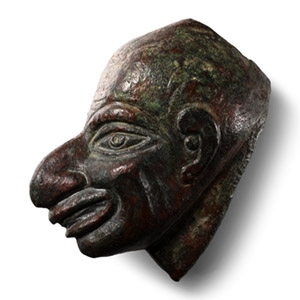
Greek Bronze Head of a Grotesque Man
3rd century B.C.Estimate: £2,000 - 3,000 (‡+bp*)
Opening Bid: £1,111
Hollow-formed 'moneybox' with exaggerated nose and lips, small crescent-and-pellet ears, low-relief eyes with impressed pupils, small lock of hair to the scalp, vesica-shaped socket to the underside; pierced at the scalp and at the right ear. 67 grams, 48 mm
with Artemis Gallery, Munich, before 1998. Acquired by the present owner from the above in 2003. This lot has been checked against the Interpol Database of stolen works of art and is accompanied by search certificate number no.12212-222320. This lot has been cleared against the Art Loss Register database, and is accompanied by an illustrated lot declaration signed by the Head of the Antiquities Department, Dr Raffaele D'Amato. -
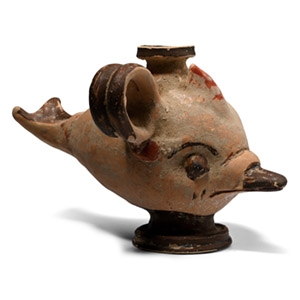
Greek Tarentine Jug in the Shape of a Dolphin
4th-3rd century B.C.Sold for (Inc. bp): £4,680
Hollow-formed as a stylised dolphin with trumpet-shaped filler hole above, ribbed loop handle to one side, socle base and scooped tail forming the spout. 170 grams, 14.6 cm
Acquired in 1992. Private collection, thence by descent. Private collection, since the late 1990s. This lot has been checked against the Interpol Database of stolen works of art and is accompanied by a search certificate number no.12855-241750. This lot has been cleared against the Art Loss Register database, and is accompanied by an illustrated lot declaration signed by the Head of the Antiquities Department, Dr Raffaele D'Amato.
