
Loading, please wait...
LOT 0558
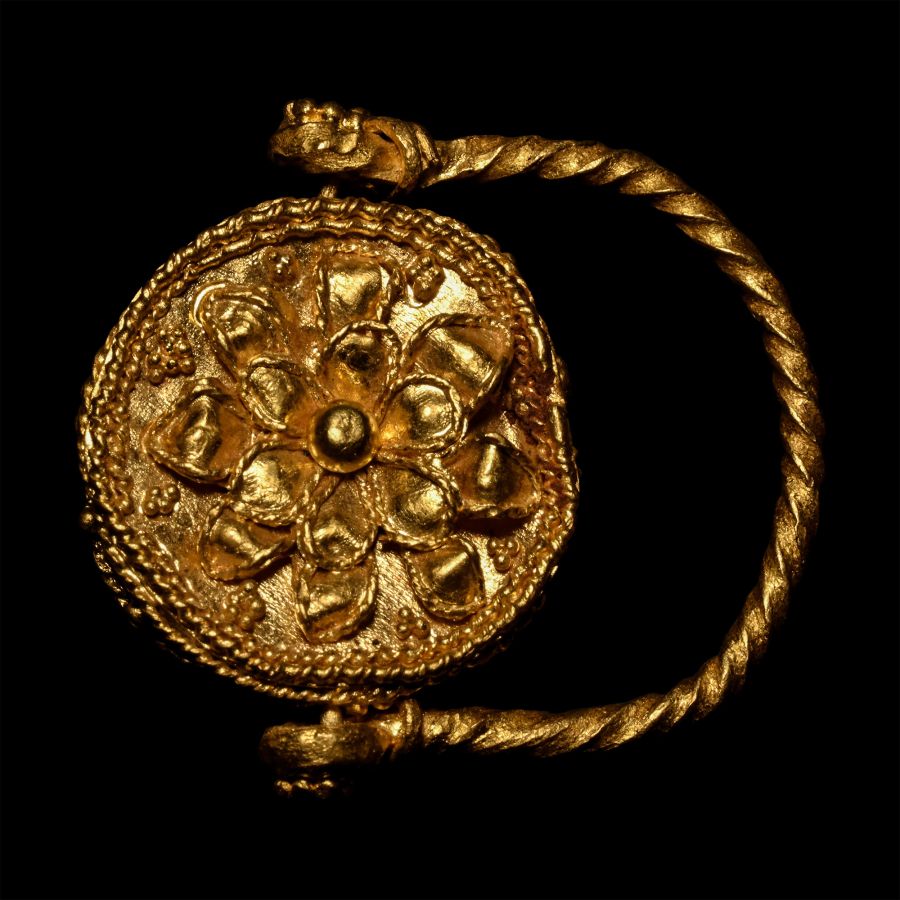
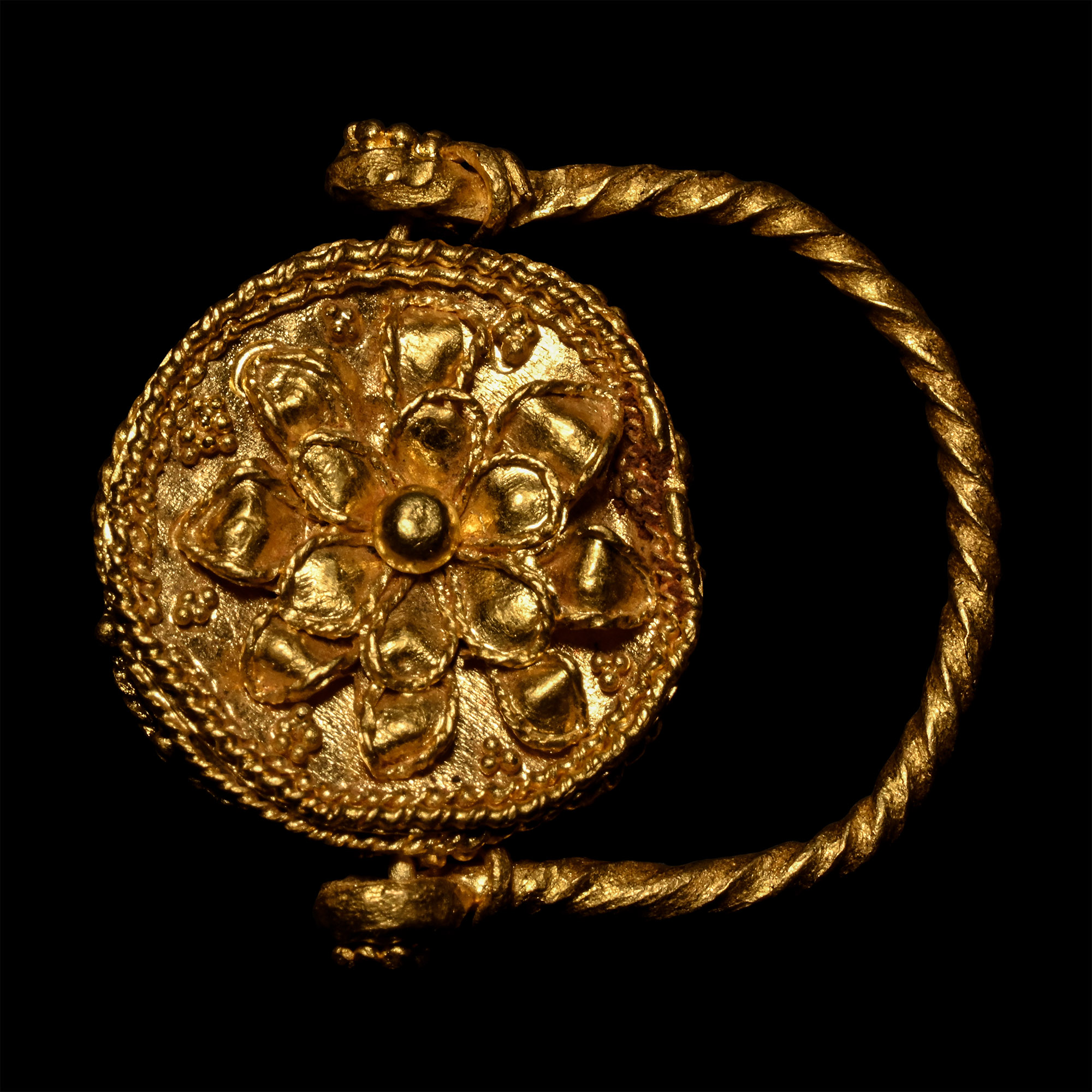
Greek Gold Ring with Rosettes
5TH CENTURY B.C. OR LATER
7/8 in. (8.94 grams, 23.27 mm overall, 21.6x18.1 mm internal diameter (approximate size British P 1/2, USA 7 3/4, Europe 16.86, Japan 16)).
Twisted hoop with granulated mounting lobes, swivel-mounted hollow-formed disc bezel with granule clusters to the rim, filigree and granule clusters to the obverse.
ProvenanceAcquired on the UK art market 1971-1974.
Private collection, London, UK.
This lot has been checked against the Interpol Database of stolen works of art and is accompanied by search certificate number no.13163-248089.
TimeLine Auctions follows a vetting process to ensure the authenticity and legality of all items, reinforcing our commitment to integrity and responsible trading. Each antiquity, antique, and coin lot undergoes thorough examination by a vetting committee of at least ten external specialists, professional trade association members, scientists, and archaeologists: Our Vetting Process
AUCTIONS:
TimeLine is a leading auction house specialising in antiquities, ancient art, collectables, natural history, coins, medals, and books. Our auctions offer museums, collectors, historians, and enthusiasts the opportunity to acquire unique and historically significant pieces.
LOT 0558
Greek Gold Ring with Rosettes
Estimate £1,800 - 2,400€2,090 - 2,780 (for guidance only)$2,430 - 3,240 (for guidance only)
-
.jpg)
Italic Banded Agate Scarab with Kneeling Warrior in Gold Mount
3rd century B.C.Sold for (Inc. bp): £11,700
Scarab bezel with carapace detailing and intaglio of a kneeling male nude wearing a helmet, holding a shield, sword and a spear; set into a later gold swivel ring; supplied with a museum-quality impression. 5.24 grams, 25 mm
English private collection. Acquired on the English art market. This lot has been checked against the Interpol Database of stolen works of art and is accompanied by search certificate number no.13110-248399.
The intaglio can depict Capaneus, a legendary, strong, skilled, but arrogant warrior. He was one of the Seven Against Thebes, who boasted that not even Zeus could stop him from scaling the city walls. However, as he climbed them, Zeus struck him down with a bolt of lightning, illustrating divine punishment for his hubris. Evadne, his wife, then threw herself onto the funerary pyre in her grief. The story of strength but excessive pride was reflected in Dante's Inferno, where Capaneus is in the seventh circle as a condemned blasphemer. -
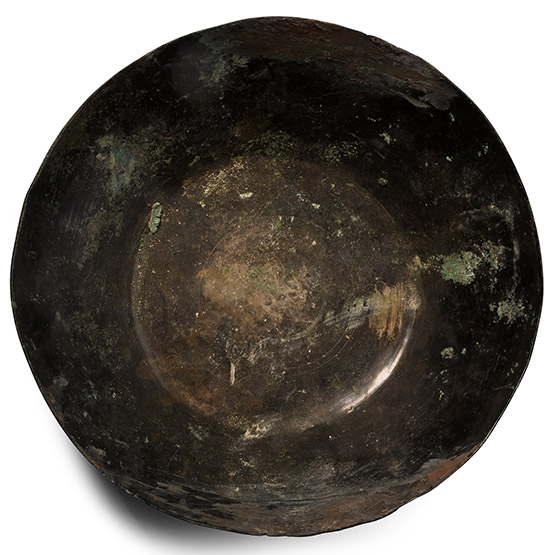
Parthian Bronze Bowl
2nd century B.C.-1st century A.D.Sold for (Inc. bp): £78
Broad and squat with flared sidewall. 153 grams, 17.5 cm
Ex 1990s collection and with a central London gallery. -
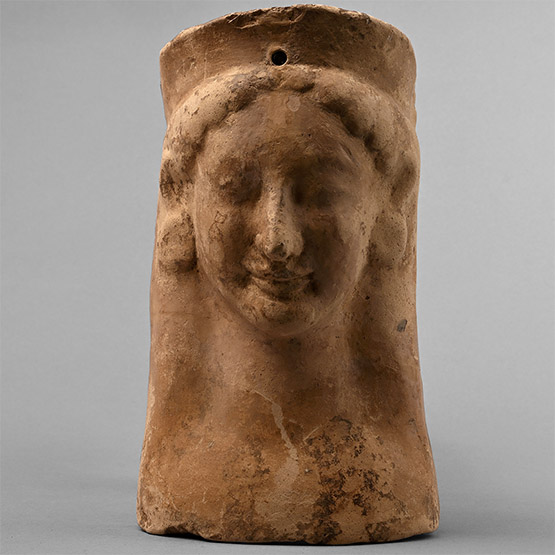
Greek Terracotta Female Protome
Early 5th century B.C.Estimate: £1,500 - 2,000 (‡+bp*)
Opening Bid: £750
Mould-made female protome with oval face, graceful nose and typical "archaic" smile; forehead framed by snail-shell curls descending to shoulder-height; with a low polos with a central perforation and large disc earrings. 606 grams, 19.5 cm
Ex Herbert A. Cahn, Kunst der Antike, Basel, 1997. with Paul and Vreny Vosseler-Studer, Riehen. Accompanied by a copy of an Art Loss Register certificate no.S00057826. This lot has been checked against the Interpol Database of stolen works of art and is accompanied by search certificate number no.12474-228714.
