
Loading, please wait...
_900x900.jpg "Greek Gold Ring with Artemis Gemstone")
_200x200.jpg "Greek Gold Ring with Artemis Gemstone")
_900x900.jpg "Greek Gold Ring with Artemis Gemstone")
_200x200.jpg "Greek Gold Ring with Artemis Gemstone")
.jpg "Greek Gold Ring with Artemis Gemstone")
.jpg "Greek Gold Ring with Artemis Gemstone")
LOT 0097
Greek Gold Ring with Artemis Gemstone
HELLENISTIC, 2ND CENTURY B.C.
1 in. (11.27 grams, 26.91 mm overall, 17.95 x 20.72 mm internal diameter (approximate size British R, USA 8 1/2, Europe 18 3/4, Japan 18)).
Hollow-formed shank with broad plaque and inset garnet cabochon intaglio profile bust of Artemis in high-relief; supplied with a museum-quality impression.
ProvenanceEuropean art market.
This lot has been checked against the Interpol Database of stolen works of art and is accompanied by search certificate number no.12219-222340.
Cf. Ruseva-Slokoska, L., Roman Jewellery, Sofia, 1991, item 202, for type.
CONDITIONTimeLine Auctions follows a vetting process to ensure the authenticity and legality of all items, reinforcing our commitment to integrity and responsible trading. Each antiquity, antique, and coin lot undergoes thorough examination by a vetting committee of at least ten external specialists, professional trade association members, scientists, and archaeologists: Our Vetting Process
AUCTIONS:
TimeLine is a leading auction house specialising in antiquities, ancient art, collectables, natural history, coins, medals, and books. Our auctions offer museums, collectors, historians, and enthusiasts the opportunity to acquire unique and historically significant pieces.
LOT 0097
Greek Gold Ring with Artemis Gemstone
Estimate £3,000 - 4,000€3,480 - 4,640 (for guidance only)$4,050 - 5,400 (for guidance only)
-
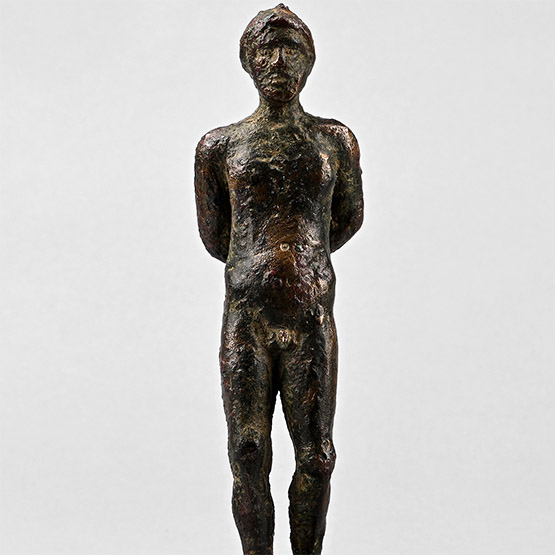
Greek Bronze Figure of a Bound Captive
Hellenistic, 2nd century B.C.Estimate: £3,000 - 4,000 (‡+bp*)
Opening Bid: £1,667
Modelled in the round nude male standing with hands bound behind his back; with short cropped hair and slender figure; left foot absent; mounted on a custom-made stand. 491 grams, 17 cm including stand
Ex S.K. collection. Acquired on the German art market, July 1995. Accompanied by an academic report by Dr Raffaele D'Amato. This lot has been checked against the Interpol Database of stolen works of art and is accompanied by a search certificate number no.12518-232076.
The character's hairstyle of the statuette is simple, and his hair is short, not treated with chalk like that of the famous ‘dying Galatian’ from Pergamon. The gaze is fixed in the distance, while the bony, beardless and long-limbed figure expresses the prisoner's energy. The nose here takes on a strong characteristic together with the broad jaw, which is also recognizable in later statuettes of Roman age. These characteristics, combined with those of nudity, allow us to recognize the figure of the prisoner as a Celtic warrior. warrior. -
.jpg)
Very Large Greek Brindisi Type Terracotta Amphora
3rd-1st century B.C.Estimate: £1,000 - 1,400 (+bp*)
Opening Bid: £500
Comprising an ovoid bulbous body with knop finial, narrow tubular neck with lateral strap handles and a folded rim to the mouth. 12.5 kg, 75.5 cm high
Ex. H.P. Payot, Clarens (VD, Switzerland) collection, by inheritance. Private collection, UK. -
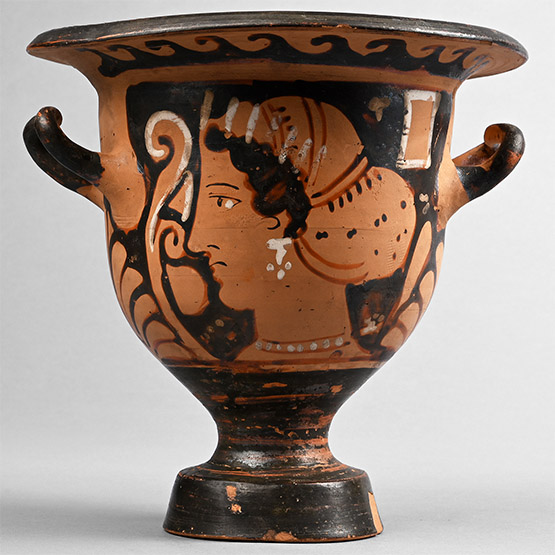
Greek Red-Figure Bell Krater
Campanian, 340-325 B.C.Estimate: £3,000 - 4,000 (+bp*)
Opening Bid: £1,500
With notable added white details; Side A: woman moving to her right while holding a cista, dressed in a chiton clinched at the waist, with a himation draped over her left arm, her hair adorned with a sakkos; Side B: profile head of a woman wearing a patterned sakkos and radiated stephane, intricate earrings and necklace of beads, objects in the field; beneath the handles, palmettes with floral elements. 585 grams, 18 cm high
Ex Rev. & Mrs T.S. Hichens, Cornwall with Charles Ede, 1981 (Stock No.8370). Ex Mrs B. Shankes, November 1986. This lot has been checked against the Interpol Database of stolen works of art and is accompanied by search certificate no.13068-248976.
Bell kraters were commonly used in regions of ancient Italy for mixing and serving wine during communal gatherings, thanks to their wide shape and flared mouth. These vessels also served as artistic expressions, reflecting the cultural tastes of the time. The Chevron Group is the conventional name for a group of ancient Apulian red-figure vase painters who were active in Southern Italy between approximately 335-310 BC. They are named for their distinctive use of a band of chevron patterns to encircle the rims of the small kraters (mixing vessels) they decorated.
