
Loading, please wait...
LOT 0080
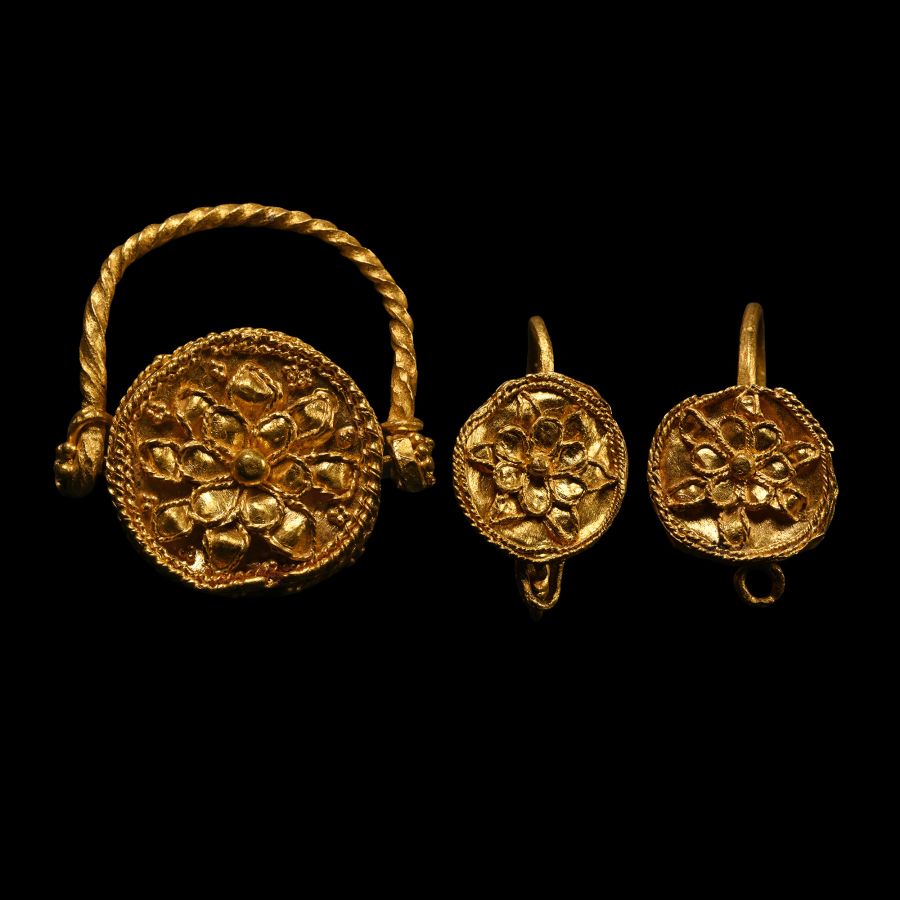
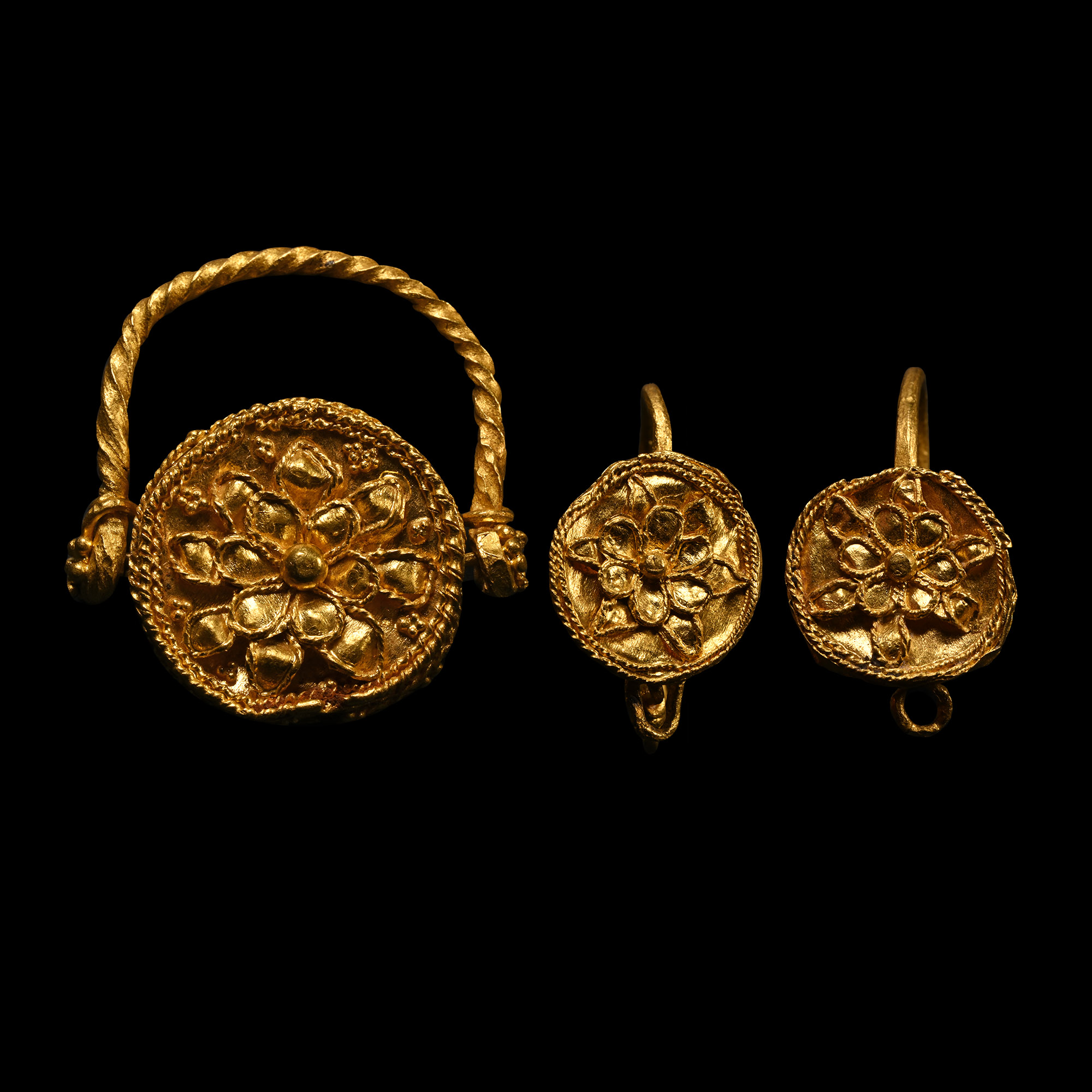
Greek Gold Ring and Earring Set with Rosettes
4TH CENTURY B.C.
7/8 in. (14.6 grams total, earrings: 23-24 mm, ring: 23.59 mm overall, 21.52 x 17.44 internal diameter (approximate size British P 1/2, USA 7 3/4, Europe 16.86, Japan 16)).
Comprising: finger ring with twisted-rod hoop ending in loops with granule ornament, swivelling hollow-formed drum-shaped plaque with applied filigree and granule clusters in a rosette motif; two earrings, each with a smaller version of the ring's plaque mounted on a hooked wire with fastener. [3]
ProvenanceAcquired on the UK art market 1971-1974.
Private collection, London.
Accompanied by an academic report by Dr Raffaele D'Amato.
This lot has been checked against the Interpol Database of stolen works of art and is accompanied by search certificate no.12493-230329.
This lot has been cleared against the Art Loss Register database, and is accompanied by an illustrated lot declaration signed by the Head of the Antiquities Department, Dr Raffaele D’Amato.
Cf. Chadour, A.B., Rings: The Alice and Louis Koch Collection, volume I, Leeds, 1994, item 41, for type; Ogden, J. & Williams, D., Greek Gold Jewelry of The Classical World, New York, 1994, p.67, no.20, for similar earrings with Nike; Despini, A., Ancient Gold Jewellery, Athens, 1996, no.104, for earrings with similar rosettes and dove pendants.
CONDITIONTimeLine Auctions follows a vetting process to ensure the authenticity and legality of all items, reinforcing our commitment to integrity and responsible trading. Each antiquity, antique, and coin lot undergoes thorough examination by a vetting committee of at least ten external specialists, professional trade association members, scientists, and archaeologists: Our Vetting Process
AUCTIONS:
TimeLine is a leading auction house specialising in antiquities, ancient art, collectables, natural history, coins, medals, and books. Our auctions offer museums, collectors, historians, and enthusiasts the opportunity to acquire unique and historically significant pieces.
LOT 0080
Greek Gold Ring and Earring Set with Rosettes
Estimate £3,000 - 4,000€3,480 - 4,640 (for guidance only)$4,050 - 5,400 (for guidance only)
-
Daunian Terracotta Olla
Subgeometric, 6th-5th century B.C.Estimate: £600 - 800 (‡+bp*)
Opening Bid: £270
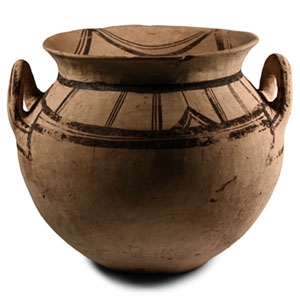
With a deep body on round base, flaring mouth, short loop handles to the shoulders; pendant circle segments on interior of mouth; Metope-like frieze on shoulder with triglyphs and suspended triangles, U-shaped motif at the root of the handle, horizontal bands; monochrome ware. 2.33 kg, 25.5 cm wide
The estate of Hans-Ulrich Rutschmann, Switzerland, circa 1950s-1970s. Accompanied by a copy of an Art Loss Register certificate no.S00097644. This lot is accompanied by an illustrated lot declaration signed by the Head of the Antiquities Department, Dr Raffaele D’Amato. -
.jpg)
Graeco-Parthian Bronze Mirror with Animals
2nd-1st century B.C.Estimate: £500 - 700 (+bp*)
Opening Bid: £250
Discoid flat mirror with piriform attachment bracket developing to an addorsed pair of animal heads, equine but with a single curved plume or horn between the ears; mounted on a custom-made stand. 516 grams total, 16.6 cm
UK private collection before 2000. UK art market. Ex property of a London gentleman. This lot is accompanied by an illustrated lot declaration signed by the Head of the Antiquities Department, Dr Raffaele D’Amato. -
.jpg)
Hellenistic Silver Child's Bracelet
1st century B.C.-1st century A.D.Sold for (Inc. bp): £286
Decorated on the central round bezel with the head of a youth surrounded by a laurel wreath; external face decorated with pattern of alternating lozenges, lines and S-shaped motifs; twisted closure at the back. 4.80 grams, 8 mm
Ex property of a London lady; from her family collection formed in the 1970s. Property of a Bedfordshire, UK, private collector. Accompanied by an illustrated collector's identification tag. This lot is accompanied by an illustrated lot declaration signed by the Head of the Antiquities Department, Dr Raffaele D’Amato.
