
Loading, please wait...
_900x900.jpg "Greek Gold Ring and Carnelian Gemstone with Asclepius and Hygeia")
_200x200.jpg "Greek Gold Ring and Carnelian Gemstone with Asclepius and Hygeia")
.jpg "Greek Gold Ring and Carnelian Gemstone with Asclepius and Hygeia")
LOT 0067
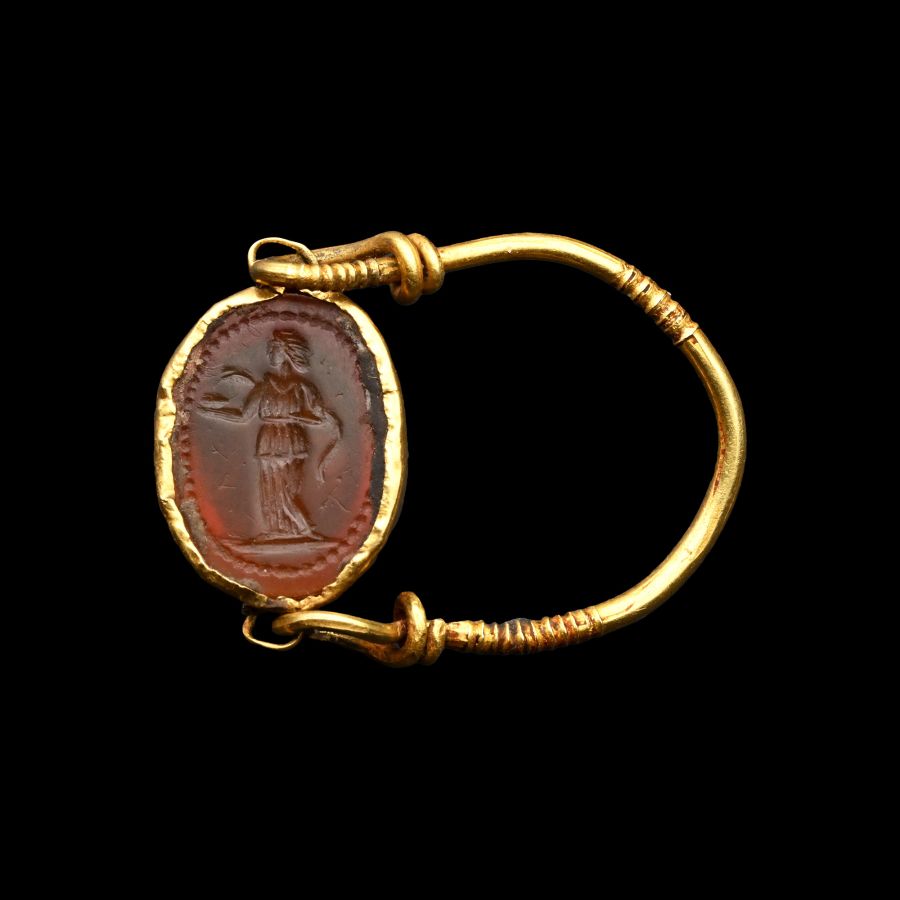
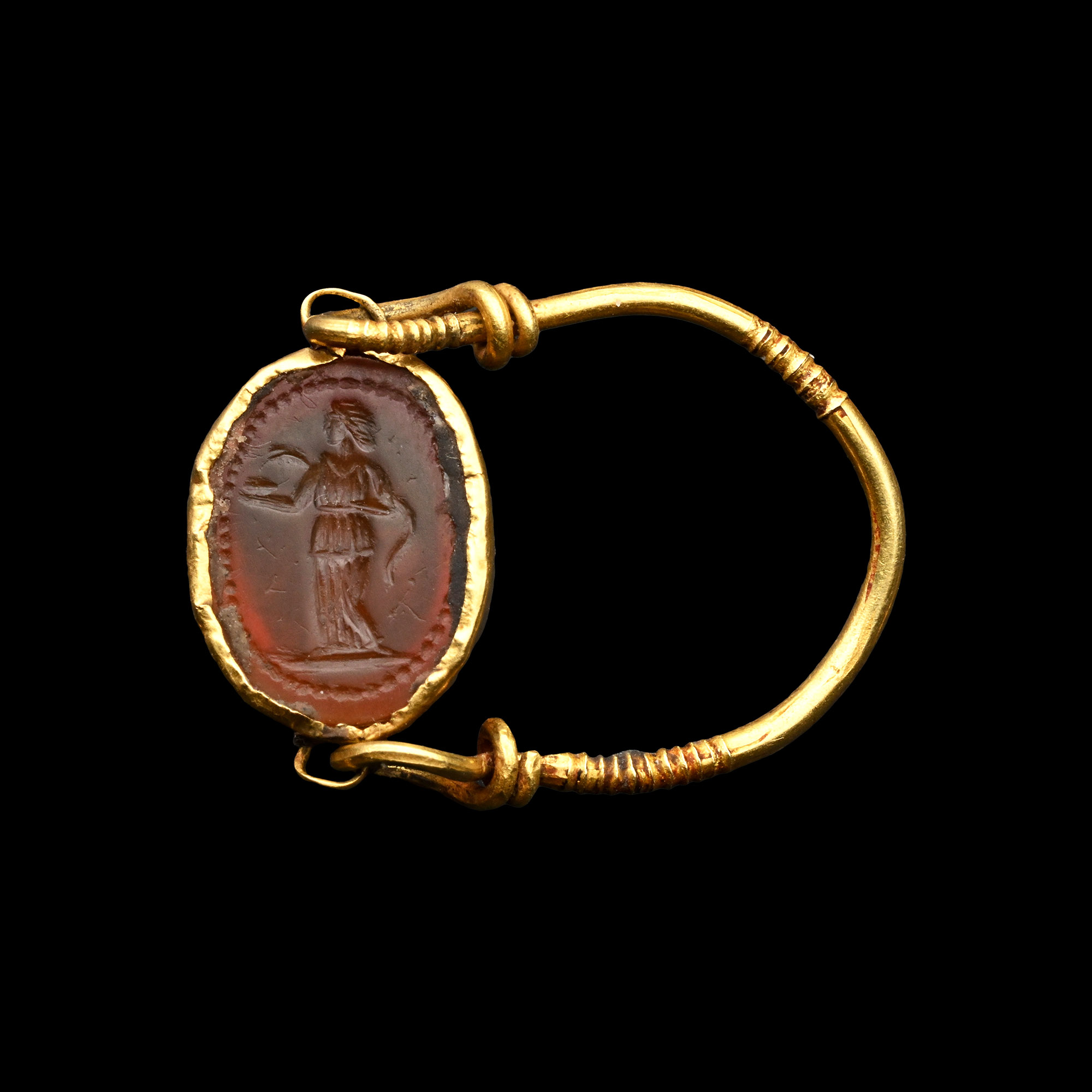
Greek Gold Ring and Carnelian Gemstone with Asclepius and Hygeia
HELLENISTIC, 1ST CENTURY B.C.-1ST CENTURY A.D.
1 in. (2.12 grams, 22.48 mm overall, 14.21 x 16.13 mm internal diameter (approximate size British F 1/2, USA 3, Europe 4.3, Japan 4)).
Comprising a gold wire hoop with panels of baluster detailing, scrolled and securing a gold cell with an inset cabochon gemstone; to the domed face, the god Asclepius with caduceus symbol; to the flat face, goddess Hygeia standing holding a serpent; some usage wear.
ProvenancePrivate collection, UK.
This lot has been checked against the Interpol Database of stolen works of art and is accompanied by search certificate number no.13357- 259200.
Cf. a similar ring with Asclepius and Hygeia in the Princeton University Art Museum, inv. no. Y1952-141; cf. Henig, M. & MacGregor, A., Catalogue of the Engraved Gems and Finger Rings in the Ashmolean Museum, no. 1.27, for a parallel.
FootnotesAsclepius, son of Apollo and Coronis, was the Graeco-Roman god of medicine, healing and prophecy. He had two daughters with Epione, the goddess of soothing - Hygeia (goddess of health) and Panacea (goddess of healing).
CONDITIONTimeLine Auctions follows a vetting process to ensure the authenticity and legality of all items, reinforcing our commitment to integrity and responsible trading. Each antiquity, antique, and coin lot undergoes thorough examination by a vetting committee of at least ten external specialists, professional trade association members, scientists, and archaeologists: Our Vetting Process
AUCTIONS:
TimeLine is a leading auction house specialising in antiquities, ancient art, collectables, natural history, coins, medals, and books. Our auctions offer museums, collectors, historians, and enthusiasts the opportunity to acquire unique and historically significant pieces.
LOT 0067
Greek Gold Ring and Carnelian Gemstone with Asclepius and Hygeia
Sold for (Inc. bp): £2,340
-
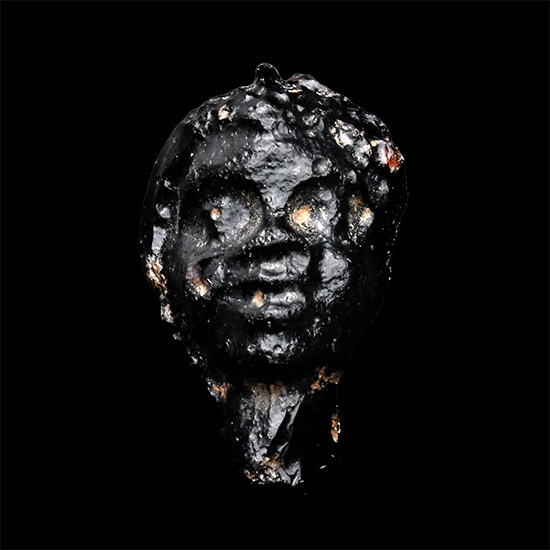
Greek Glass Head of an African Male
Carthaginian, 2nd century B.C.Sold for (Inc. bp): £117
Moulded in the round in black glass with short hair, casting seam around the edges. 1.57 grams, 17 mm
Ex private collection of the late Mr S.M., London, UK, acquired 1979-1999, thence by descent. Accompanied by a previously illustrated catalogue card with provenance. -
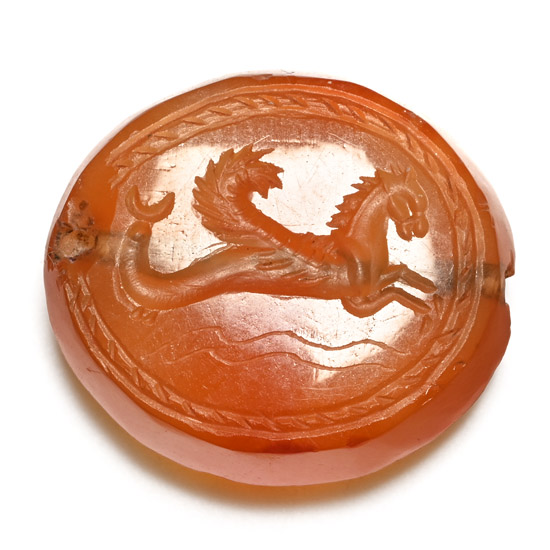
Greek Carnelian Gemstone with Hippocamp
4th century B.C.Sold for (Inc. bp): £650
Scaraboid type with incuse design to the underside of a winged hippocamp inside a ropework border, possibly later engraved water waves; supplied with a museum-quality impression. 2.29 grams 16 mm
From the private collection of a European gentleman (1942-2024), formed since the 1970s. -
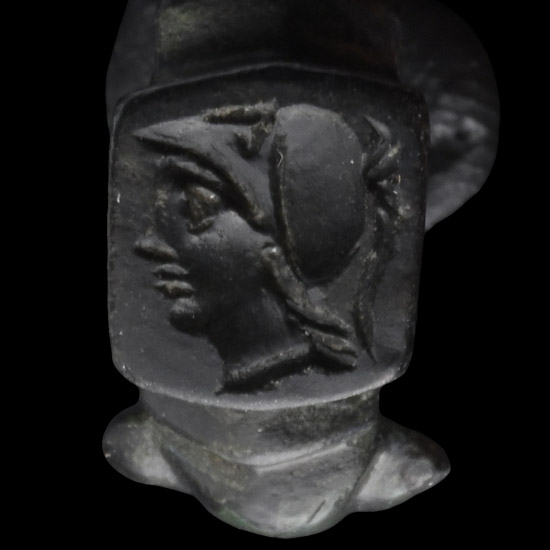
Graeco-Roman Bronze Ring with Bust of Athena
Circa 1st century B.C.Sold for (Inc. bp): £234
D-section hoop with stepped rims and trefoil shoulders, cuboid bezel with incuse profile bust of Athena to the upper face. 10.19 grams, 27.01 mm overall, 17.71 mm internal diameter (approximate size British O 1/2, USA 7 1/4, Europe 15.61, Japan 15)
Ex German art market, 2000s. Acquired from an EU collector living in London. From the collection of a Surrey, UK, gentleman.
