
Loading, please wait...
LOT 0053
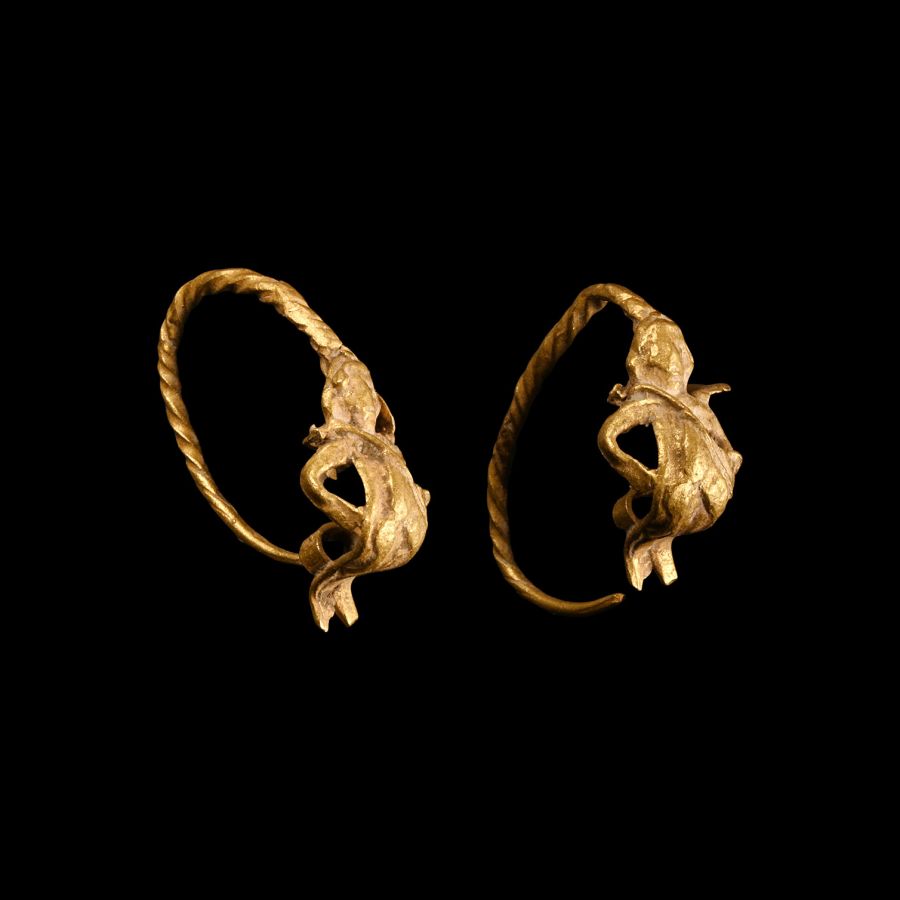
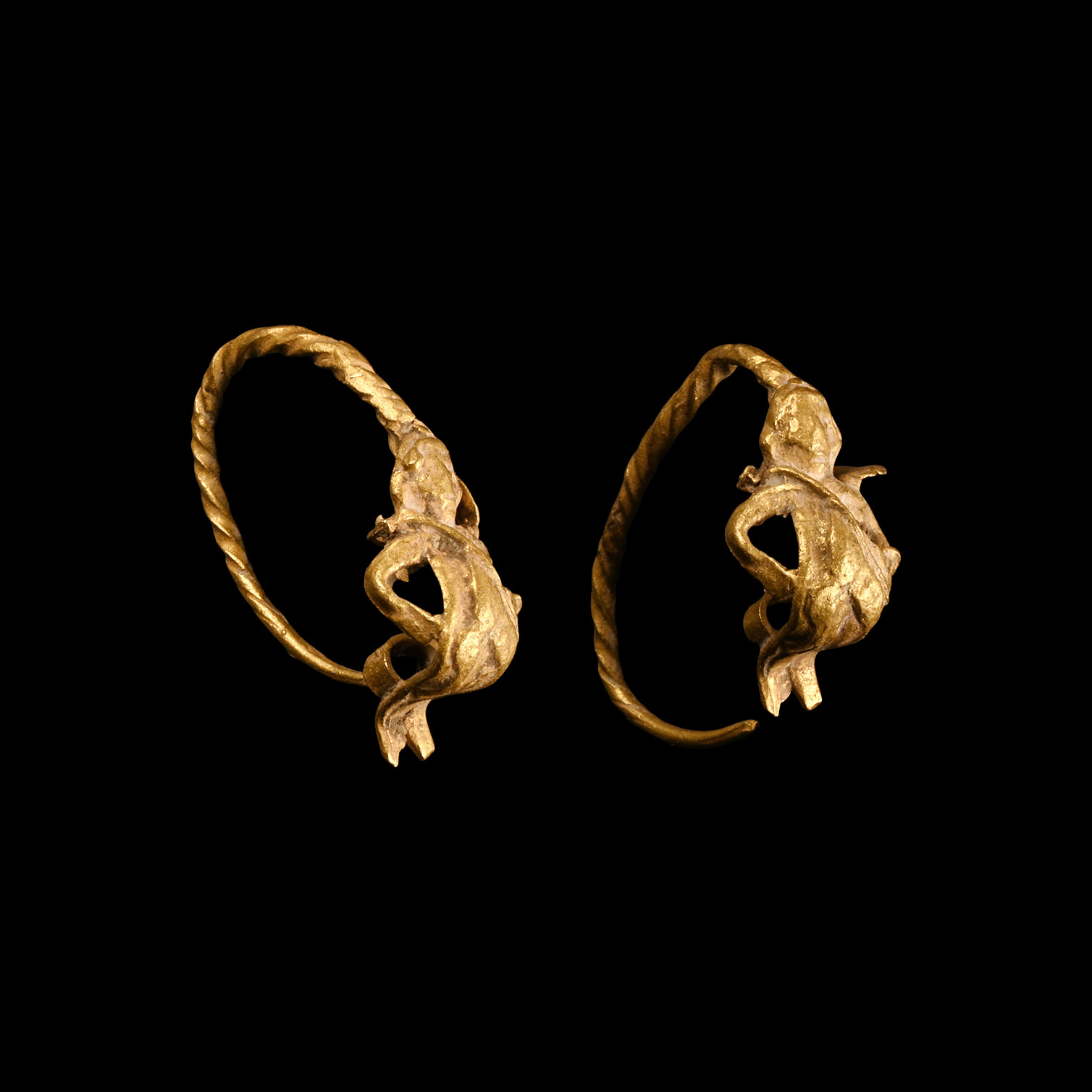
Greek Gold Eros Earrings
3RD-2ND CENTURY B.C.
5/8 in. (2.55 grams total, 17 mm each).
A pair of gold Eros earrings, each composed of a decoratively twisted tapering wire hoop and a winged Eros plaque with detailing to the body, face and hair; closure loop to reverse. [2]
ProvenanceAcquired 1980-2015.
Ex Abelita family collection.
Cf. The Metropolitan Museum, accession number 74.51.3506, for similar.
CONDITIONTimeLine Auctions follows a vetting process to ensure the authenticity and legality of all items, reinforcing our commitment to integrity and responsible trading. Each antiquity, antique, and coin lot undergoes thorough examination by a vetting committee of at least ten external specialists, professional trade association members, scientists, and archaeologists: Our Vetting Process
AUCTIONS:
TimeLine is a leading auction house specialising in antiquities, ancient art, collectables, natural history, coins, medals, and books. Our auctions offer museums, collectors, historians, and enthusiasts the opportunity to acquire unique and historically significant pieces.
-
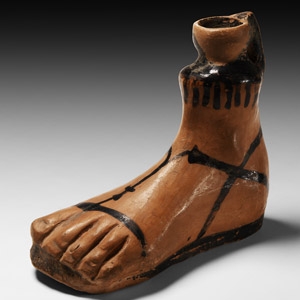
Greek Terracotta Foot-Shaped Aryballos
6th century B.C.Sold for (Inc. bp): £2,210
A ceramic vessel shaped as a human foot with sandal; cup-shaped mouth above the ankle with strap to the rear, painted strap detailing; restored. 118 grams, 10.8 cm
Ex Léon Rodrigues-Ely (1924-1973), Marseille, France. with Christie's, Paris, Collection of Léon Rodrigues-Ely-Joseph Soustiel et à Divers, 6 May 2015, lot 32. Accompanied by a copy of a French cultural passport no.163295. -
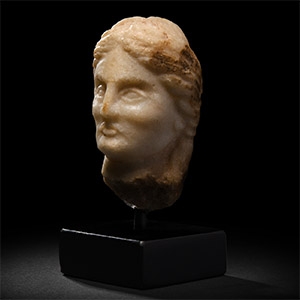
Greek Marble Head of a Woman
2nd century B.C.Estimate: £1,200 - 1,700 (+bp*)
Opening Bid: £667
A marble head of lady carved in the round with semi-naturalistic, masculine facial features, severe facial expression, hair dressed with a central parting and tied in a chignon at the nape of the neck; mounted on a custom-made display stand. 386 grams total, 11 cm high
Acquired in the 1980s. Ex private German collection.
Probably a votive statuette, of which only the head remains; it may also have been part of a high-relief made in the style of Asia Minor sculptures. The soft treatment of the hair, and the deep-set eyes in the narrow face, creating a soft effect, are among the characteristics known from the late Classical period. The arrangement of the hair in soft curls encircling the face, in a manner which provides a triangular form to the forehead, and then hanging downwards after being collected at the back of the neck, resembles the Kore types known from the early Hellenistic period. -
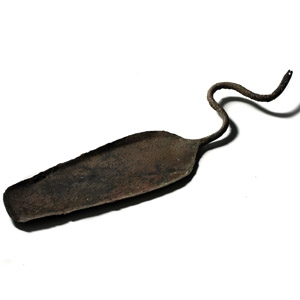
Greek Silver Medical Implement with Snake Handle
4th-3rd century B.C.Estimate: £450 - 650 (+bp*)
Opening Bid: £250
A silver and copper-alloy medical instrument, oval in shape, the handle formed as a snake with shallow hatched pattern on the body representing scales, stylised rendering of the snake's head. 68 grams, 25 cm long
Fair condition.
Acquired mid 1980s to early 1990s. Private family collection formed in London, UK. Accompanied by a metal test assessment number 182971/HM1456 from an Oxford specialist.
The use of this spatula (probe) for medical assessment can be confirmed by its snake-shaped handle, evidently a reference to the god Asklepios, whose symbol was a staff with a serpent wrapped around it. Such implements, called 'ἀπυρομήλη', were used in the Graeco-Persian world. The survival of the handle in this example makes it a rare find.
