Loading, please wait...

Greek Gold Earring Fragment Greek Gold Earring Fragment Greek Gold Earring Fragment
Use mousewheel to zoom in and out, click to enlarge
Details

LOT 0556

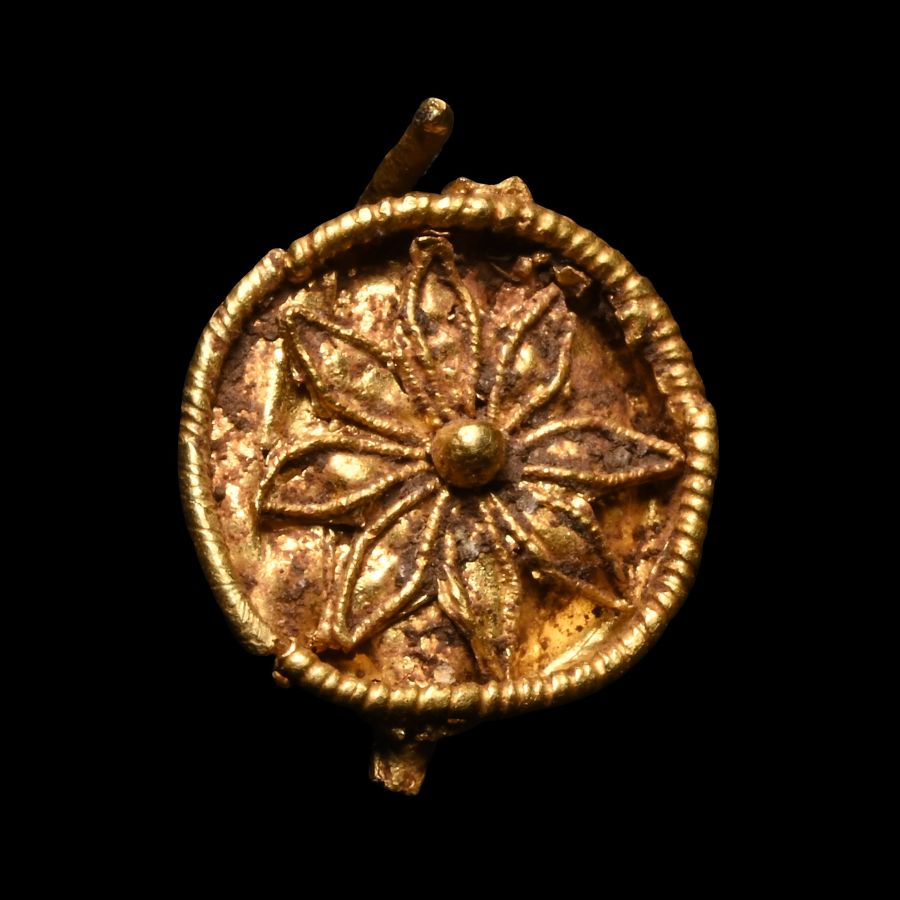
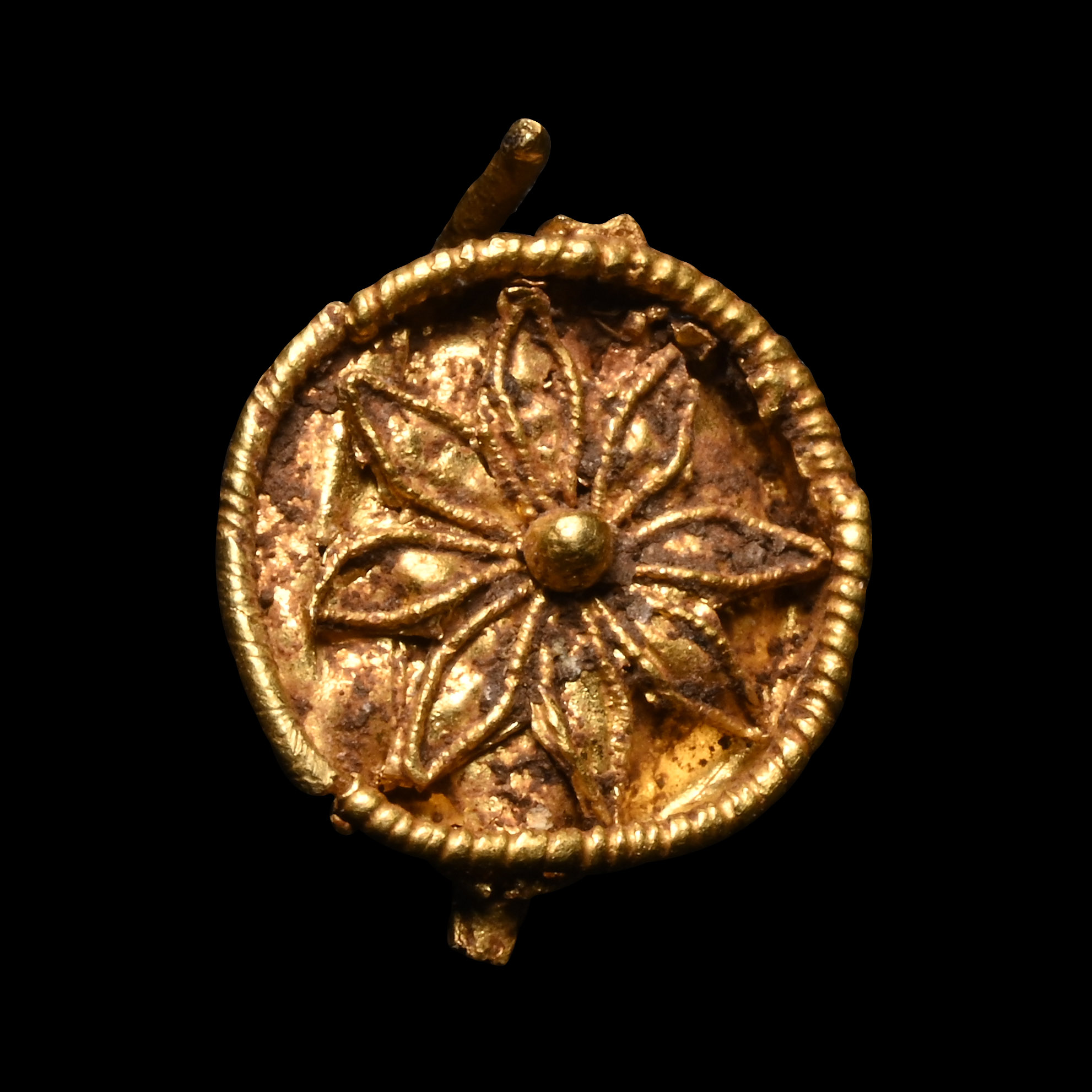
Greek Gold Earring Fragment

4TH-3RD CENTURY B.C.

1/2 in. (0.69 grams, 12 mm).

Disc with beaded wire rim and applied filigree rosette, loop to reverse. [No Reserve]

Provenance

From the collection of a London antiquarian, formed since the 1980s.
This lot is accompanied by an illustrated lot declaration signed by the Head of the Antiquities Department, Dr Raffaele D’Amato.

CONDITION
VETTING:

TimeLine Auctions follows a vetting process to ensure the authenticity and legality of all items, reinforcing our commitment to integrity and responsible trading. Each antiquity, antique, and coin lot undergoes thorough examination by a vetting committee of at least ten external specialists, professional trade association members, scientists, and archaeologists: Our Vetting Process


AUCTIONS:

TimeLine is a leading auction house specialising in antiquities, ancient art, collectables, natural history, coins, medals, and books. Our auctions offer museums, collectors, historians, and enthusiasts the opportunity to acquire unique and historically significant pieces.

LOT 0556

Greek Gold Earring Fragment

Sold for (Inc. bp): £104

Print page

RELATED LOTS
  • Greek Archaic Terracotta Skyphos with Concentric Circles
    Greek Archaic Terracotta Skyphos with Concentric Circles
    7th-early 6th century B.C.

    Sold for (Inc. bp): £468

    Conical in form with rounded shoulder, everted rim and two round-section handles; painted with concentric bands around the interior and exterior. 243 grams, 15.5 cm wide


    Acquired in Europe before 1992. European collection. This lot is accompanied by an illustrated lot declaration signed by the Head of the Antiquities Department, Dr Raffaele D’Amato.

    The skyphos was already well known in Greece since the age of the Achaeans. In Homer, Eumaeus, the swineherd, prepares for his guest Ulysses a cyssibium filled with wine which the hero drinks during the meal and, when he is full, Eumaeus makes him drink from the cup in which he himself was using, a skyphos. Ulysses also offers Polyphemus a drink in a skyphos.

    Lot Details

  • Greek Terracotta Female Protome
    Greek Terracotta Female Protome
    6th-5th century B.C.

    Estimate: £400 - 600 (‡+bp*)

    Opening Bid: £180

    Head of a girl with long hair and curls framing the forehead; elongated, oval face with almond-shaped eyes, slender nose and round chin; the lips forming an Archaic smile; mounted on a custom-made display stand. 33 grams total, 79 mm including stand


    with Herbert A. Cahn, Basle, 1990s. Accompanied by a copy of an Art Loss Register certificate no.S00075470. This lot is accompanied by an illustrated lot declaration signed by the Head of the Antiquities Department, Dr Raffaele D’Amato.

    Small mould-made heads were used for female divinities, sphinxes and sirens, or attached to pottery as plastic ornaments. The figure was wearing a polos, a small, drum-shaped headdress designating in this period a divinity.

    Lot Details

  • Greek Gilt Bronze Wine Strainer with Swan-Head Handles
    Greek Gilt Bronze Wine Strainer with Swan-Head Handles
    4th-3rd century B.C.

    Estimate: £8,000 - 10,000 (‡+bp*)

    Opening Bid: £4,000

    Comprising a shallow bowl and broad flange rim, two integral scalloped handles with lateral scrolled flourishes, each tapering to a S-curved handle with swan-head terminals with incised eye and beak detailing; perforated whirl within roundel to interior base; accompanied by a custom-made display stand with mirror. 402 grams total, 19.7 cm including stand


    with Hôtel des ventes de Belfort Sarl, October 2011, no.16. Acquired by the present owner at the above sale. Accompanied by an academic report by Dr Raffaele D'Amato. This lot has been checked against the Interpol Database of stolen works of art and is accompanied by search certificate number no.12209-222140. This lot has been cleared against the Art Loss Register database, and is accompanied by an illustrated lot declaration signed by the Head of the Antiquities Department, Dr Raffaele D’Amato.

    Elaborate gilded strainers, such as this present example, were used at symposia and festive occasions for the purpose of preventing the dregs of wine from entering the wine cup. This and other related silver utensils became popular in the later 4th and 3rd century B.C. These highly decorated wine strainers were fitted with dual handles forming loops in the shape of twisting animals, here a swan. Usually they took the form of a shallow dish complete with four rings of perforations in the centre in order to drain the wine. Strainers of this type were used to separate out sediments which could be found in the thick Greek wine. Examples similar to this one have been found in royal tombs in northern Greece, as well as the tomb of a monarch in Sudan.

    Lot Details

Stay up-to-date with the latest from TimeLine Auctions by joining our mailing list