
Loading, please wait...
LOT 0560
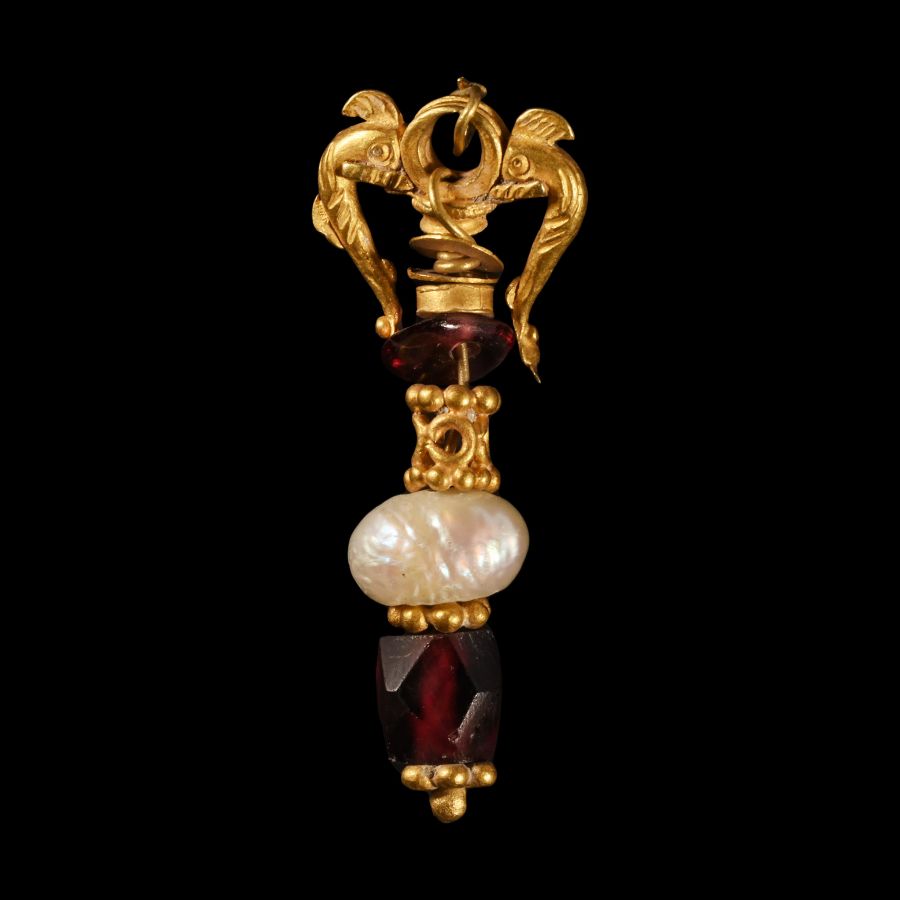
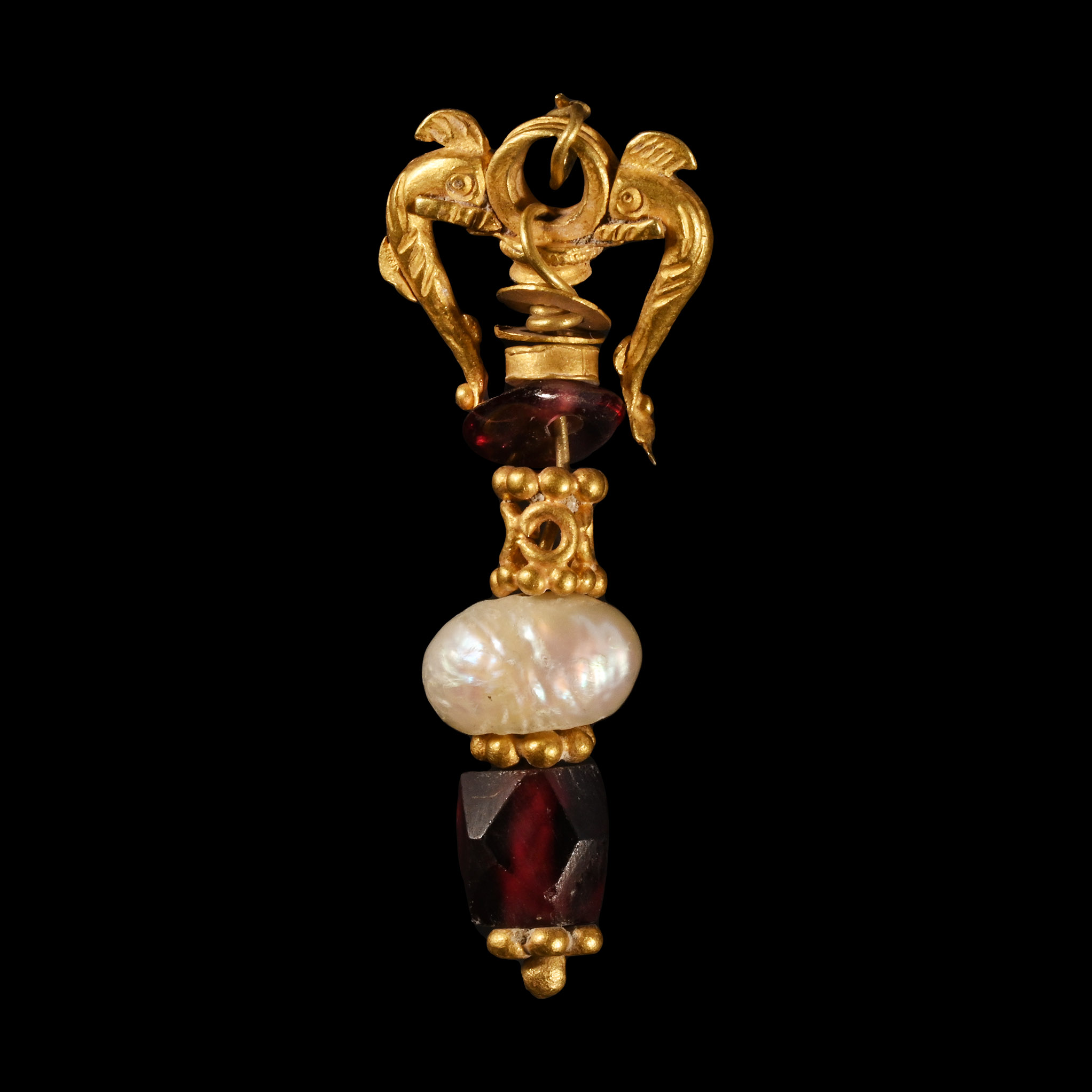
Greek Gold Dolphin Pendant
5TH-3RD CENTURY B.C. AND LATER
1 1/4 in. (2.76 grams, 31 mm).
A gold amphora style pendant composed of granulated beads alternating with facetted garnet, pearl and lentoid garnet beads, openwork granulated bead, gold suspension loop with leaping dolphin 'handles' engraved with anatomical and eye detailing; a marriage.
ProvenanceAcquired 1970-2010.
Collection of a late Japanese gentleman.
TimeLine Auctions follows a vetting process to ensure the authenticity and legality of all items, reinforcing our commitment to integrity and responsible trading. Each antiquity, antique, and coin lot undergoes thorough examination by a vetting committee of at least ten external specialists, professional trade association members, scientists, and archaeologists: Our Vetting Process
AUCTIONS:
TimeLine is a leading auction house specialising in antiquities, ancient art, collectables, natural history, coins, medals, and books. Our auctions offer museums, collectors, historians, and enthusiasts the opportunity to acquire unique and historically significant pieces.
-
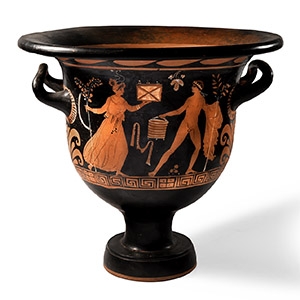
Large Greek Apulian Red-Figure Bell-Krater
4th century B.C.Sold for (Inc. bp): £28,600
A red-figure terracotta bell-krater displaying polychrome figural panels between a laurel wreath and a band of Greek key motifs; side a) two robed male figures holding staffs, wearing a taenia or a band around the head, standing facing a central altar; side b) a woman wearing a chiton and holding a casket and olive sprig in her outstretched hands, advancing right towards a nude man standing right, his head turned towards her, holding a bucket and olive sprig, a cloak draped over his arm, elaborate volute palmettes beneath both handles; restored. 4 kg, 41 cm wide
Private collection, Neuchâtel, Switzerland. Ex collection H.& P. Payot, Clarens, by descent. Accompanied by an original thermoluminescence analysis report no.QED2237/SG-0201 from QED Laboratoire. Accompanied by an academic report by Dr Raffaele D’Amato. This lot has been checked against the Interpol Database of stolen works of art and is accompanied by search certificate number no.11580-199029.
Wide-mouthed bell kraters like this one were specifically designed for holding large quantities of liquid and to work as mixing bowls, as it was considered barbaric for wine to be drunk neat (a privilege only enjoyed by Dionysus and his entourage who could handle such a level of intoxication). Wine would be mixed with water, usually one part to three, or even more, as described by Homer regarding the wine offered to the giant Polyphemus (Odyssey, IX, 206-211). As such, kraters provided an ideal large surface area for decoration, and as wine was of utmost importance at the symposium, kraters would usually take centre place, and the decoration of such vessels were geared towards such gatherings attempting to provide subject matter for philosophical debate, like the ones described in Athenaeus’ Deipnosophistae. -
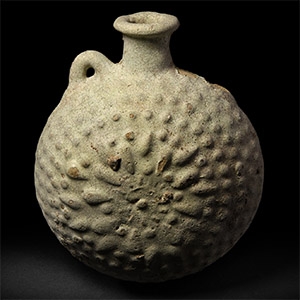
Parthian Faience Pilgrim's Flask
2nd-3rd century A.D.Estimate: £1,000 - 1,400 (‡+bp*)
Opening Bid: £500
A faience pilgrim’s flask with slender neck and loop handle, raised geometric or floral pattern to both faces; remains of glaze; second loop handle now absent. 812 grams, 19 cm high
Acquired in 1998. Ex private American collection; thence by descent. Private Swiss collection since 1998. -
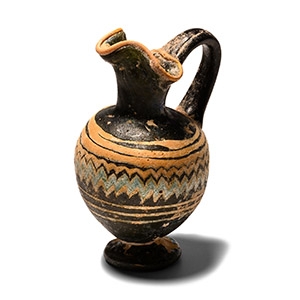
Greek Glass Trefoil Oinochoe
6th-3rd century B.C.Sold for (Inc. bp): £1,560
An opaque blue glass oinochoe with trefoil mouth, handle and discoid foot, polychrome bands and chevrons around the body and plain yellow band to lip; iridescent surfaces. 45 grams, 75 mm high
French collection, 1960s-early 2000s. From an important Paris gallery, France.
