
Loading, please wait...
LOT 0552
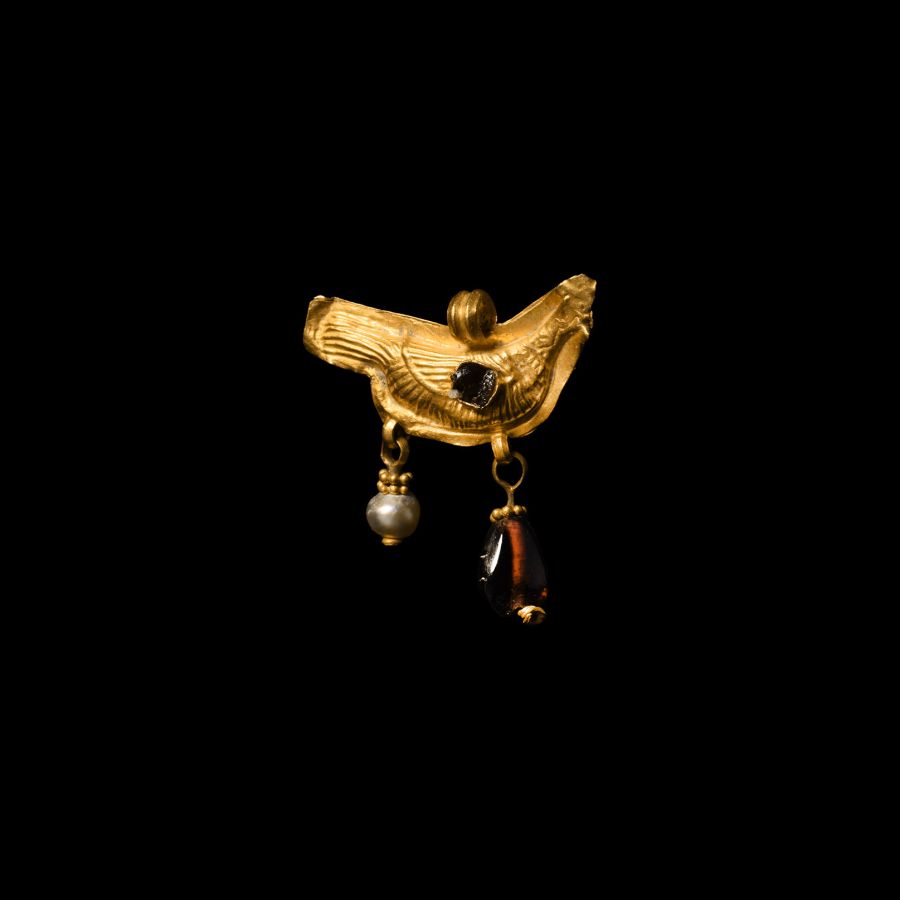
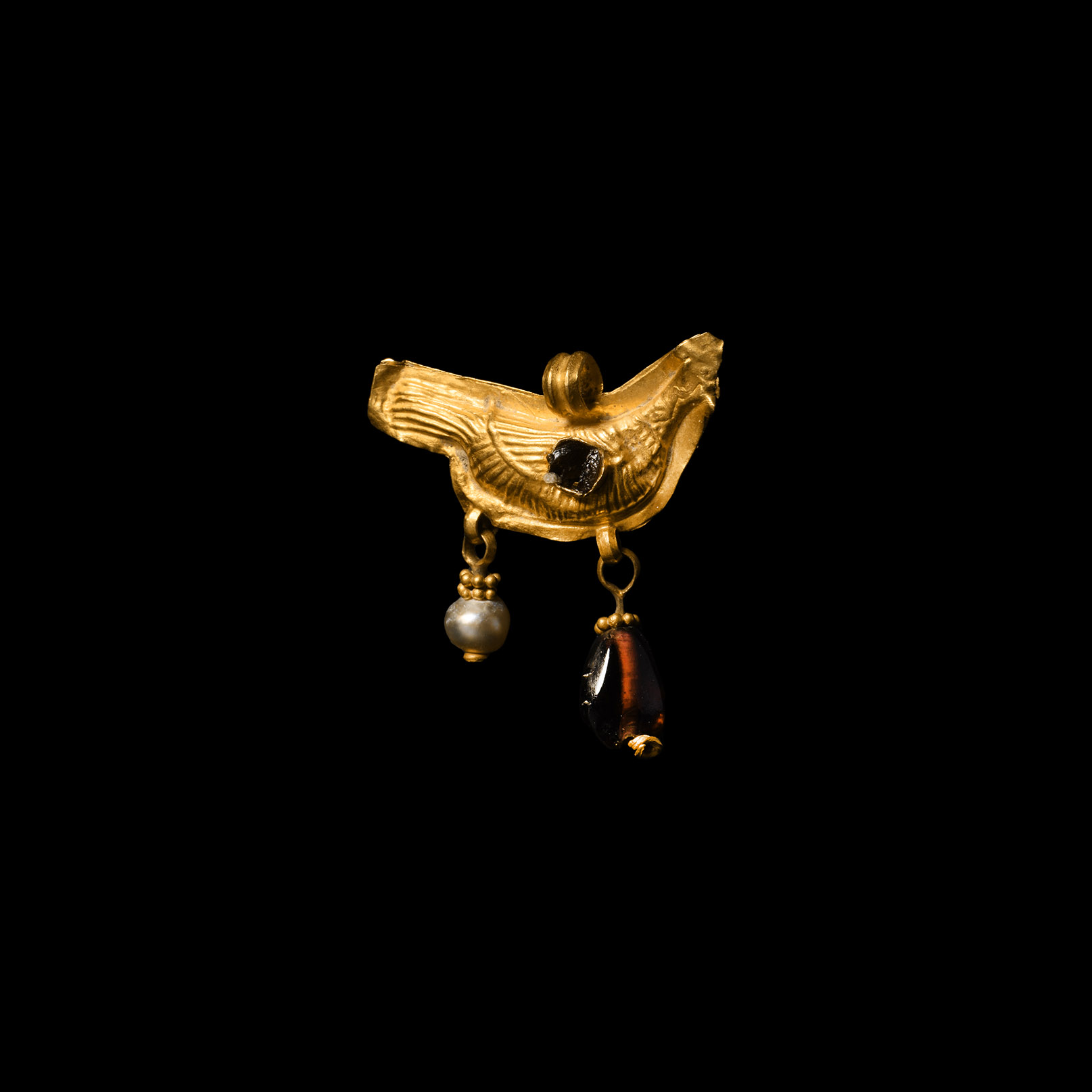
Greek Gold Bird Pendant with Garnet and Pearl Drop
5TH-3RD CENTURY B.C.
1 in. (2.29 grams, 26 mm).
A gold pendant composed of a bifacial zoomorphic body in the form of a bird, with detailing to the head and feathers; circular cell to one face containing possible remains of black glass; two dangles below, one featuring a granulated gold bead above a pearl bead, the other a granulated gold bead and a polished garnet stone; ribbed suspension loop above; a marriage.
ProvenanceAcquired 1970-2010.
Collection of a late Japanese gentleman.
Cf. Ogden, J. and Williams, D., Greek Gold: Jewelry Of The Classical World, New York, 1994, p.79, for a similar animal form produced as an appliqué and dated 5th century B.C.
CONDITIONTimeLine Auctions follows a vetting process to ensure the authenticity and legality of all items, reinforcing our commitment to integrity and responsible trading. Each antiquity, antique, and coin lot undergoes thorough examination by a vetting committee of at least ten external specialists, professional trade association members, scientists, and archaeologists: Our Vetting Process
AUCTIONS:
TimeLine is a leading auction house specialising in antiquities, ancient art, collectables, natural history, coins, medals, and books. Our auctions offer museums, collectors, historians, and enthusiasts the opportunity to acquire unique and historically significant pieces.
LOT 0552
Greek Gold Bird Pendant with Garnet and Pearl Drop
Estimate £450 - 650€520 - 750 (for guidance only)$610 - 880 (for guidance only)
-
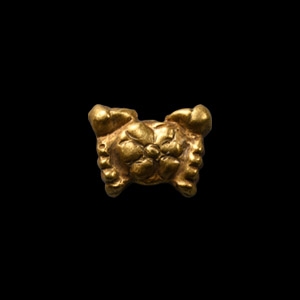
Graeco-Roman Gold Crab Amulet
2nd century B.C-1st century A.D.Sold for (Inc. bp): £191
A hollow-formed gold amulet of a crab with socketted claws above, pierced for attachment. 0.85 grams, 11.5 mm
Fine condition.
Acquired 1970s-1980s. Ex UK collection. Property of a Portsmouth, UK gentleman. -
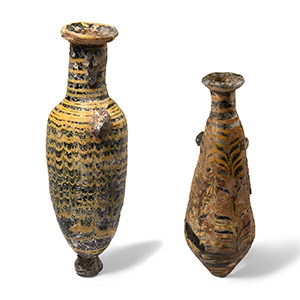
Greek Trailed Glass Vessel Group
2nd-1st century B.C.Estimate: £500 - 700 (‡+bp*)
Opening Bid: £250
A pair of glass vessels with polychrome decoration and iridescent surfaces: an alabastron with fusiform body, conical foot and ledge handles, decorated with yellow feathering and trails; a blue amphoriskos with yellow festooning and trails, knop foot and everted rim; fragmentary. 197 grams total, 11.3-15 cm high
Acquired early 1990s. Ex private American collection; thence by descent. Private collection since 1998. -
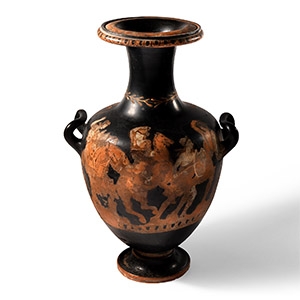
Greek Red-Figure Hydria with Fighting Between Amazons and Greek or Trojan Heroes
4th century B.C.Estimate: £8,000 - 10,000 (‡+bp*)
Opening Bid: £4,000
A red-figure terracotta hydria with mythological scene, the vessel with integral round-section upward facing handles, a third, round-section handle placed vertically between shoulder and upper neck to rear; laurel sprigs to the neck with traces of gilding; combat scene with Amazons (and Trojans?) below, armed with short swords and crescent shields, most wearing an exomis leaving the shoulder and one breast uncovered; volute palmettes below both side handles, a panel of tiered and swirling volutes to the rear, all on a band of egg-moulding, repeated around the rim; possibly Apulian or Campanian; restored. 3 kg, 46 cm high
Ex collection Woodyat, Rome, Italy, 1912. with Vente Genève, 24 & 25 June 1960. Private European collection. Accompanied by an academic report by Dr Raffaele D’Amato. This lot has been checked against the Interpol Database of stolen works of art and is accompanied by search certificate number no.11581-199028.
The mythological topic of this hydria is fascinating, representing the fight between Amazons and Greek or Trojan heroes (suggested by the central cavalryman wearing a Phrygian cap). During this period, Amazons were no longer represented as Persian or Scythian warriors, as in Attic red-figure ceramics, but depicted as athletic parthenoi and wearing chitons. Rather than the oriental costume and armour, the Amazons wear a short exomis with a bare shoulder and breast (Patten, 2013, PI.VI, I, VI,2, 2 and 3).
