
Loading, please wait...
LOT 0072
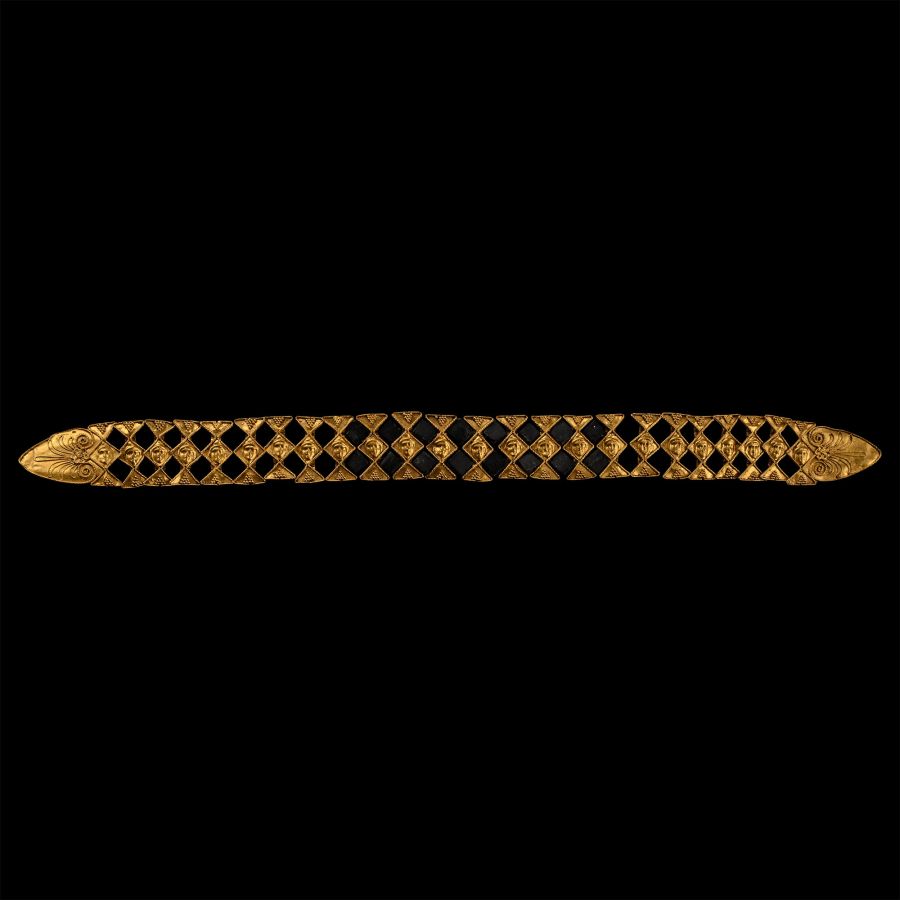
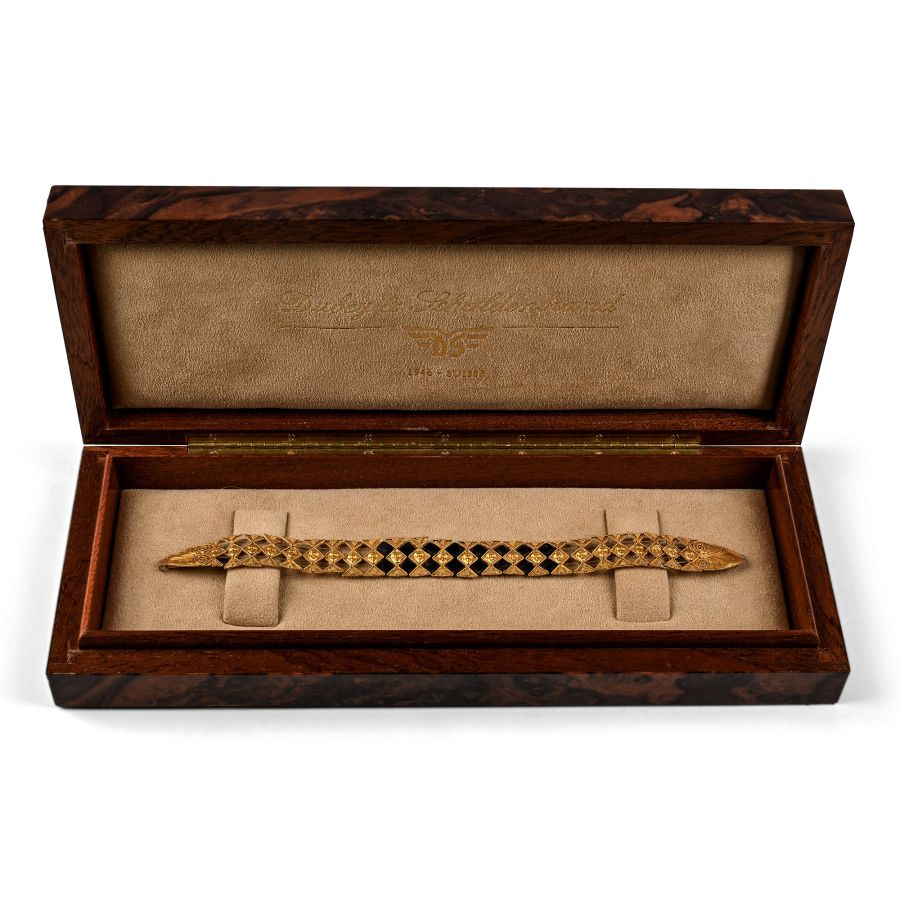
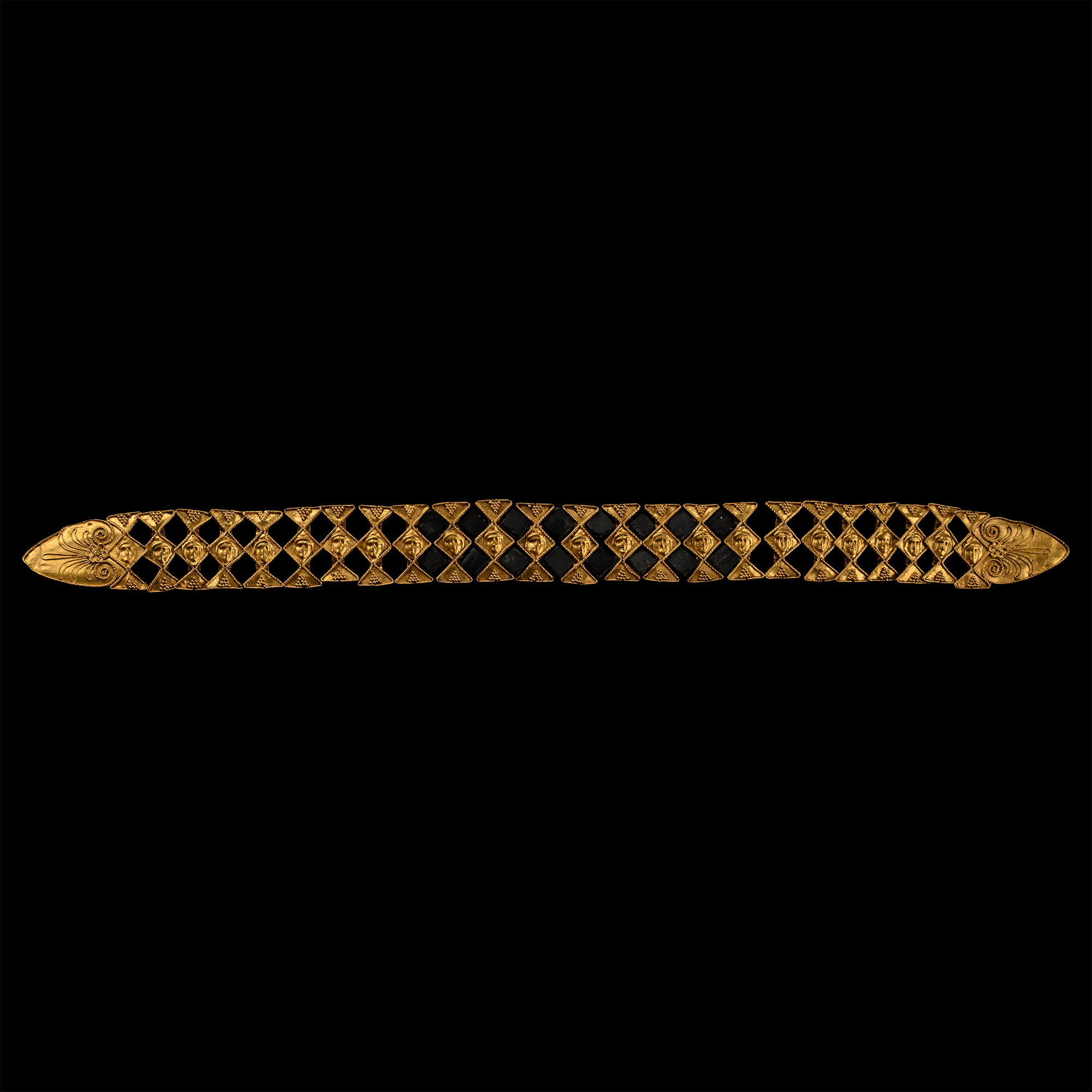
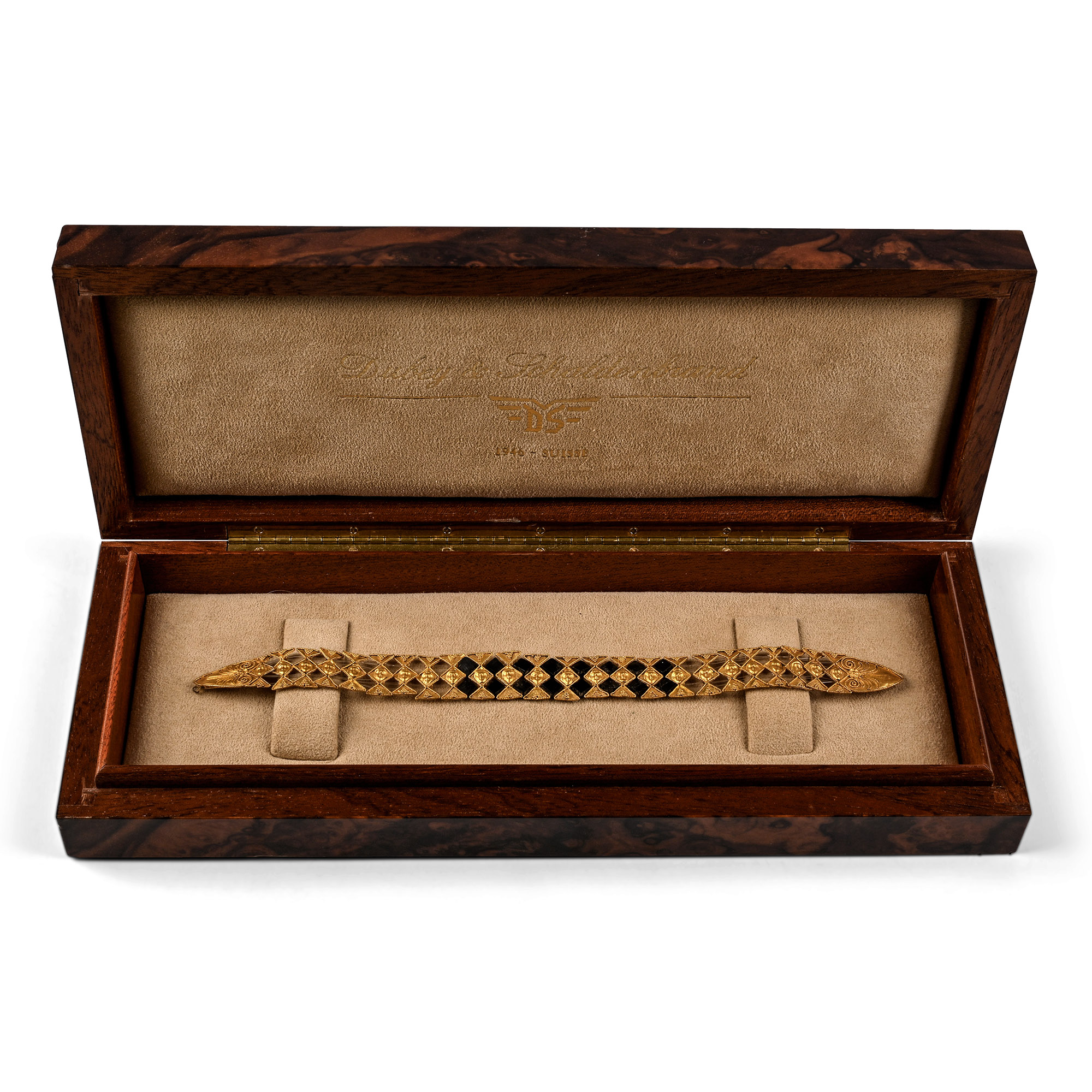
Greek Gold and Jet Diadem with Masks
HELLENISTIC, 3RD-2ND CENTURY B.C.
8 1/2 in. (22.5 grams, 21.6 cm).
A gold necklace or diadem composed of twenty-two articulated units each in the form of a complex shields terminating in finials decorated with palmettes executed in filigree; body consists of shield-shaped jet(?) elements with a central rhomboid panel, joined above and below by triangular sections decorated with granulated triangles; the perimeter of each shield framed by a soldered beaded wire; at the centre of each rhomboid panel, an embossed appliqué mask in low relief; to the reverse of each element, two vertically aligned loops formed from narrow gold strips and intended for articulation; offered in a lined wooden display case.
ProvenanceEx M. Velensky collection, London, UK, 1990s.
Accompanied by a copy of a four page examination report number 90/2015 by Dr habil Mikhail Treister.
This lot has been checked against the Interpol Database of stolen works of art and is accompanied by search certificate number no.13104-248043.
See The Metropolitan Museum of Art, object number 13.234.1, for clasps.
FootnotesThe terminals are comparatively rare survivals, decorated with palmettes in filigree, a feature only occasionally attested among comparable assemblages from Bosporan contexts. The overall typology, decorative programme, and construction techniques closely parallel examples recovered from well-documented burials at Phanagoria, Pantikapaion, Tanais, and Tsukur-Liman. Comparable necklaces combining shield elements with embossed human heads are particularly characteristic of the 3rd-2nd centuries BC. According to the examination conducted by Dr habil. Mikhail Treister, there is nothing to challenge the authenticity of the object. The specific form, restricted geographic distribution, and close parallels suggest manufacture within a workshop of the Bosporan Kingdom, most plausibly in Phanagoria, one of its principal production centres during the Hellenistic period.
CONDITIONTimeLine Auctions follows a vetting process to ensure the authenticity and legality of all items, reinforcing our commitment to integrity and responsible trading. Each antiquity, antique, and coin lot undergoes thorough examination by a vetting committee of at least ten external specialists, professional trade association members, scientists, and archaeologists: Our Vetting Process
AUCTIONS:
TimeLine is a leading auction house specialising in antiquities, ancient art, collectables, natural history, coins, medals, and books. Our auctions offer museums, collectors, historians, and enthusiasts the opportunity to acquire unique and historically significant pieces.
-
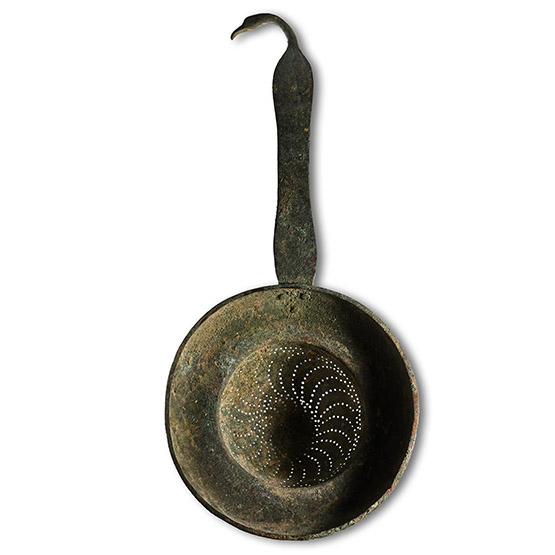
Greek Bronze Swan-Headed Wine Strainer
5th century B.C.Estimate: £2,500 - 3,500 (‡+bp*)
Opening Bid: £1,250
Cup-shaped body with flared and curved rim, flat-section handle with swan-head finial; the body with pierced rosette pattern. 159 grams, 27.4 cm
Acquired in the mid 1980s-1990s. Private collection, Switzerland, thence by descent. Private collection, since the late 1990s. This lot has been checked against the Interpol Database of stolen works of art and is accompanied by search certificate number no.12233-222331.
The Agora excavations in Athens have yielded a large number of funnels, Hellenistic and Roman, which tend to be of a basically similar type, though of course with variations. Perhaps the most important feature of all these funnels is that they were made for use and not for show. The bronze specimen found in Galaxidi is very similar to our strainer. -
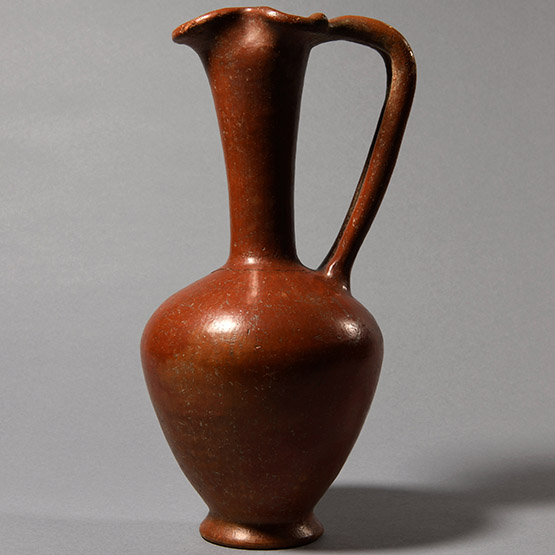
Large Phoenician Ceramic Piriform Jug
Levantine, 8th century B.C.Sold for (Inc. bp): £3,380
With trefoil mouth and integral ribbed handle, covered in a red slip with burnished surface; held in an antique wooden box crate. 1.72 kg, 28 cm
Collected by Miss Patience Townend, in the late 1950s. Thence by descent to the owner’s godmother. By gift to Mrs Lucy Manningham-Buller, circa 2002. Private collection, UK. Accompanied by a copy of a letter from Rupert Chapman, Curator of Levantine Antiquities, in the Middle Eastern Department at the British Museum, dated 4th March 2013, discussing the piece: ‘…there is no doubt in our minds that the piece is genuine, and that it dates to the eighth century B.C....the piece you have is a very fine one… any museum would be very happy to have such a fine example in its collection’. This lot has been checked against the Interpol Database of stolen works of art and is accompanied by search certificate number no.13090-248974.
This object exemplifies the high-quality tableware produced during its historical period, intended for use in the wealthiest homes. -
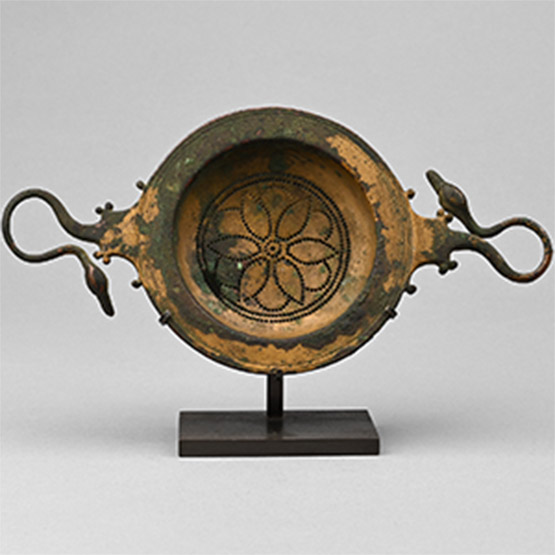
Greek Bronze Wine Strainer with Swan-Head Handles
4th-3rd century B.C.Estimate: £10,000 - 14,000 (‡+bp*)
Opening Bid: £5,000
Comprising a shallow bowl and broad flange rim, two integral scalloped handles with lateral scrolled flourishes, each tapering to a S-curved handle with swan-head terminals with incised eye and beak detailing; perforated whirl within roundel to interior base; accompanied by a custom-made display stand with mirror. 402 grams total, 19.7 cm including stand
with Hôtel des ventes de Belfort Sarl, October 2011, no.16. Acquired by the present owner at the above sale. Accompanied by an academic report by Dr Raffaele D'Amato. This lot has been checked against the Interpol Database of stolen works of art and is accompanied by search certificate number no.12209-222140.
Elaborate gilded strainers, such as this present example, were used at symposia and festive occasions for the purpose of preventing the dregs of wine from entering the wine cup. This and other related silver utensils became popular in the late 4th and 3rd century B.C. These highly decorated wine strainers were fitted with dual handles forming loops in the shape of twisting animals, here a swan. Usually, they took the form of a shallow dish complete with four rings of perforations in the centre in order to drain the wine. Strainers of this type were used to separate out sediments found in the thick Greek wine. Examples similar to this one have been found in royal tombs in northern Greece, as well as the tomb of a monarch in Sudan.
