
Loading, please wait...
LOT 0106
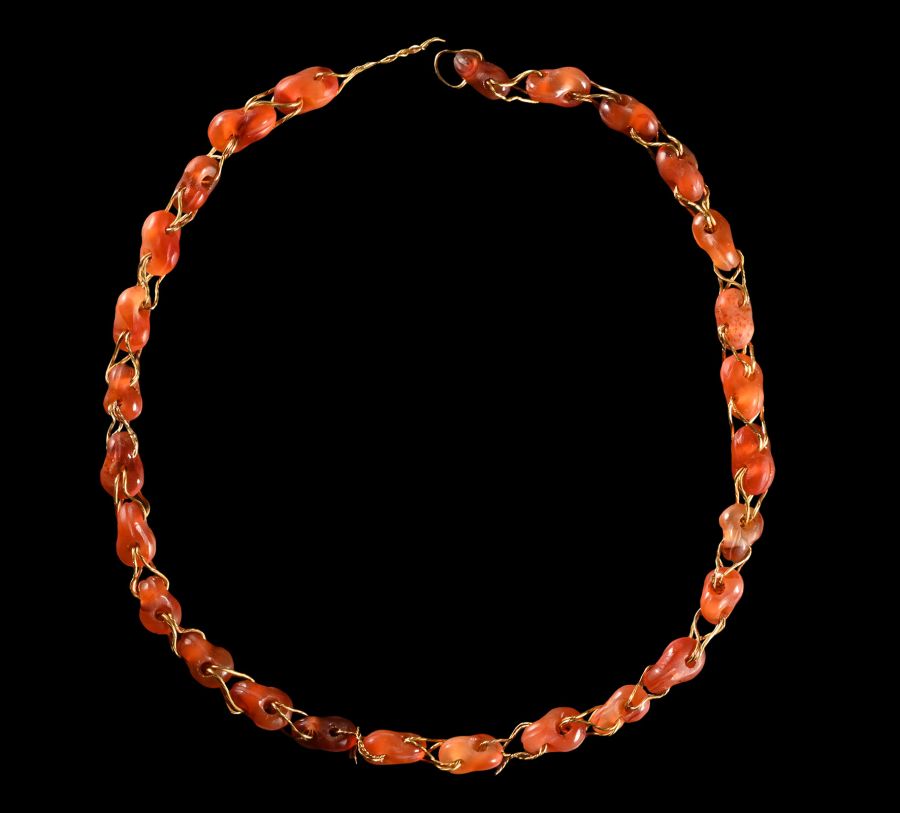
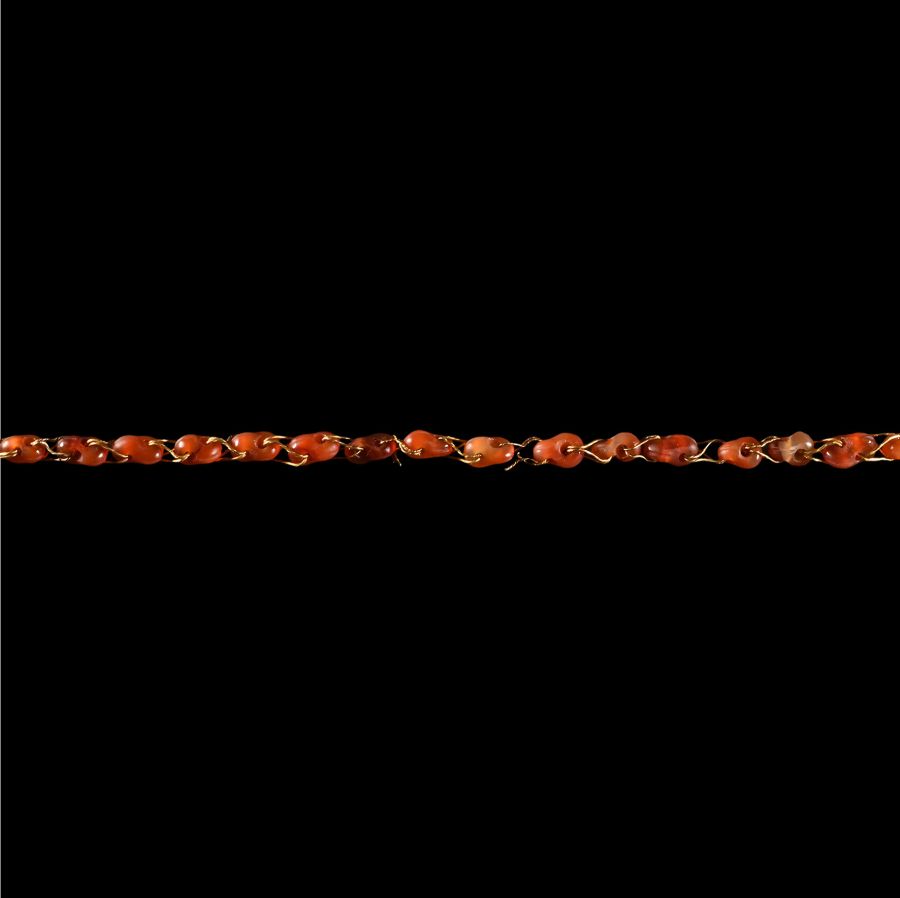
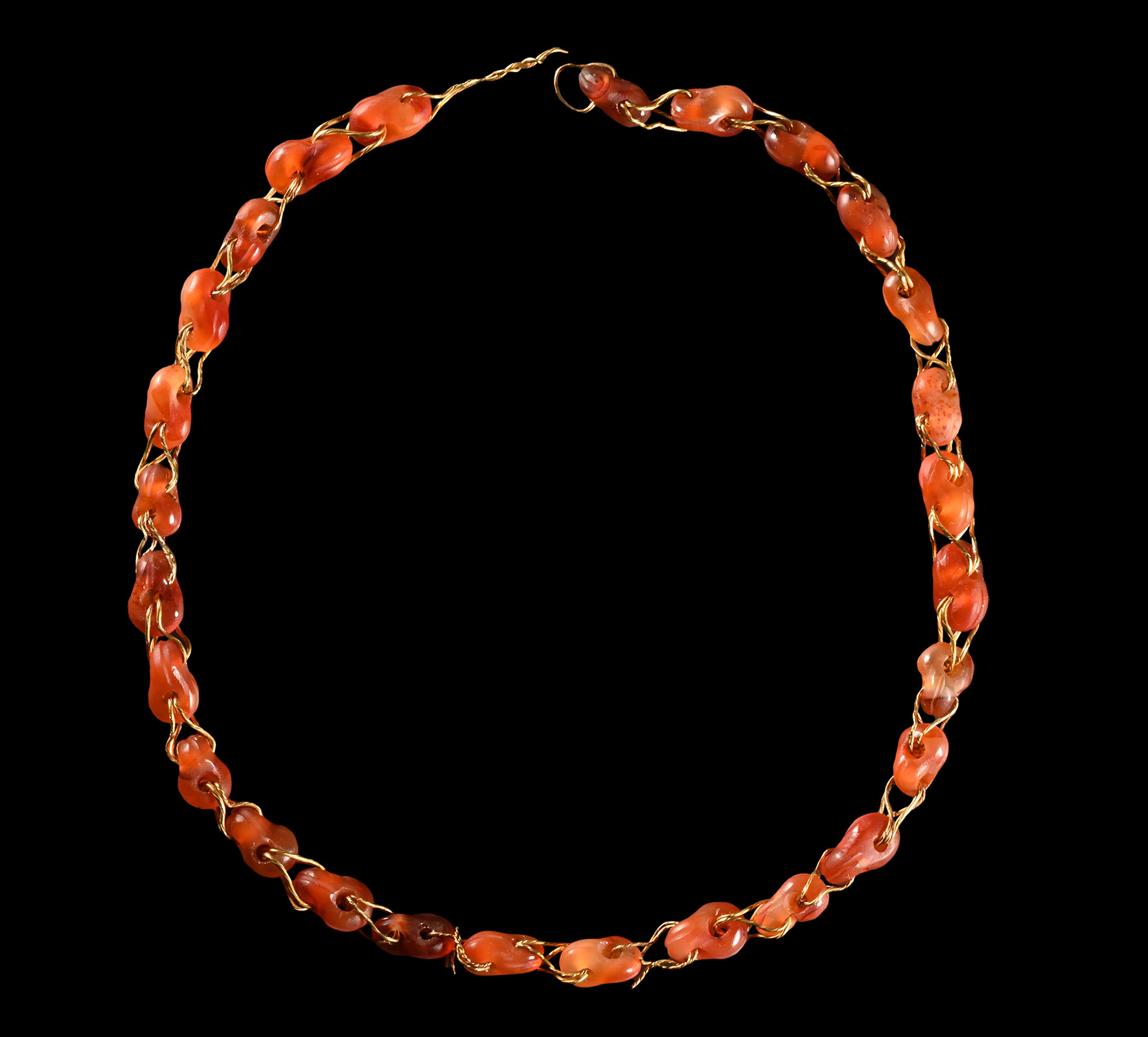
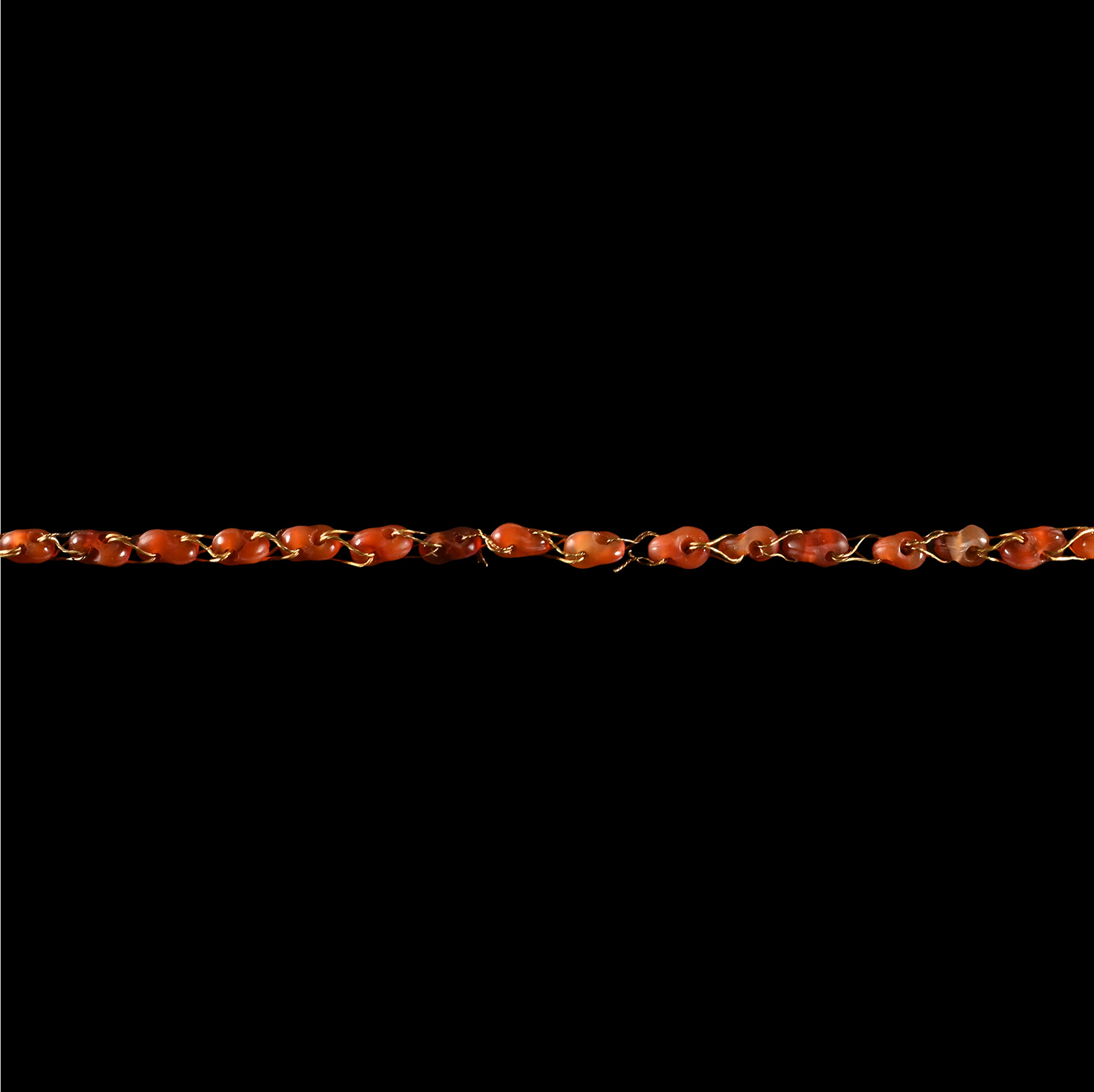
Greek Gold and Carnelian Necklace
1ST CENTURY B.C.-1ST CENTURY A.D.
10 1/4 in. (8.16 grams, 26 cm long).
A section of a necklace of carnelian drop-shaped beads, each pierced in two planes and linked loop-in-loop with thin twisted gold wires, possibly later.
ProvenanceThe Gans collection, Hebling Dec, Berlin, 1929.
with Christie's, New York, 8 December 1999, lot 51.
Accompanied by a copy of the relevant Christie's catalogue pages.
This lot has been checked against the Interpol Database of stolen works of art and is accompanied by search certificate no.11608-198969.
Cf. Jaeger, R., Die Sammlung Eduard Gans, Berlin, 1928, no. 97.
CONDITIONTimeLine Auctions follows a vetting process to ensure the authenticity and legality of all items, reinforcing our commitment to integrity and responsible trading. Each antiquity, antique, and coin lot undergoes thorough examination by a vetting committee of at least ten external specialists, professional trade association members, scientists, and archaeologists: Our Vetting Process
AUCTIONS:
TimeLine is a leading auction house specialising in antiquities, ancient art, collectables, natural history, coins, medals, and books. Our auctions offer museums, collectors, historians, and enthusiasts the opportunity to acquire unique and historically significant pieces.
LOT 0106
Greek Gold and Carnelian Necklace
Estimate £2,000 - 3,000€2,320 - 3,480 (for guidance only)$2,700 - 4,050 (for guidance only)
-
Greek Chevron Group Apulian Bell Krater
Circa 330 B.C.Sold for (Inc. bp): £910
With bell-shaped body and narrow chamfered foot, two lateral looped and folded handles, broad everted rim with chamfered edge; remains of black painted design with palmettes. 1.7 kg, 26.5 cm high
with Galerie vom Parkberg, Hamburg, Germany, 1997. Acquired Gerhard Hirsch, Munich, Germany, 24-28 September 2018, lot 677. Accompanied by an original thermoluminescence report from Ralf Kotalla, no.190131, dated 10 March 1997. Accompanied by a copy of the Gerhard Hirsch invoice and export licence. -
Cypriot Terracotta Female Figurine Holding a Child
650-600 B.C.Sold for (Inc. bp): £468
With flared base, press-moulded facial detail, irregular arms encircling a naïve figure of a swaddled baby; old inked collector's number '113' to reverse and label with same; later drilled hole to underside. 87 grams, 82 mm
Collection of Louis-Gabriel Bellon (1819-1899), Saint-Nicolas-lez-Arras and Rouen, thence by descent. with Millon & Associes Auctions, Paris, 6th December 2021, lot 41 [Part]. -
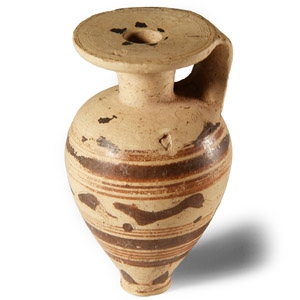
Etruscan Buffware Aryballos
8th-7th century B.C.Sold for (Inc. bp): £169
With a piriform body and narrow foot, deep shoulder and flange rim, strap handle to the rear; the rim and shoulder with radiating strokes, concentric bands to the body and foot, frieze of stylised running hounds below the shoulder. 34 grams, 63 mm high
Acquired 1980-1990s. From the private collection of H.N., Milton Keynes, Bedfordshire, UK.
Proto-Corinthian aryballoi of the same type, probably of Etruscan manufacture, in buff-ware decorated with dark metallic, purple-maroon and red-brown bands have been found in the Veii excavations. John Boardman noted that the shape in Corinth barely survives the 7th century, but these small pots are still found in Etruscan graves of the first half, or at least the first quarter, of the 6th century B.C.
