
Loading, please wait...
LOT 0051
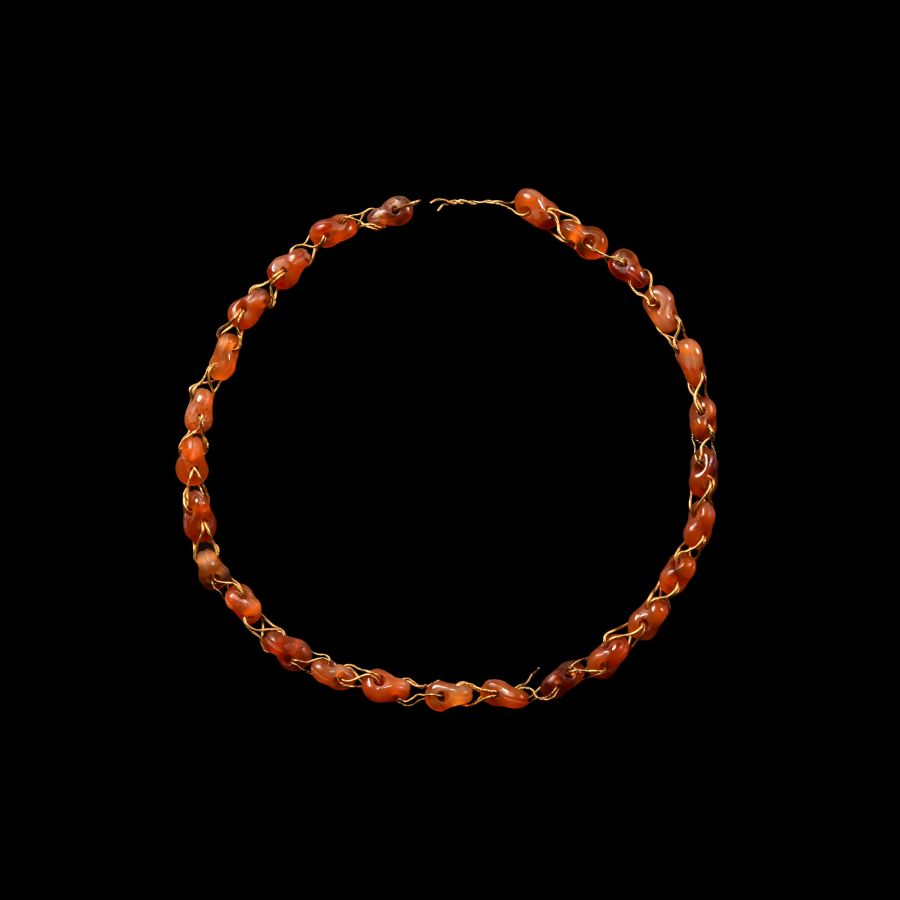
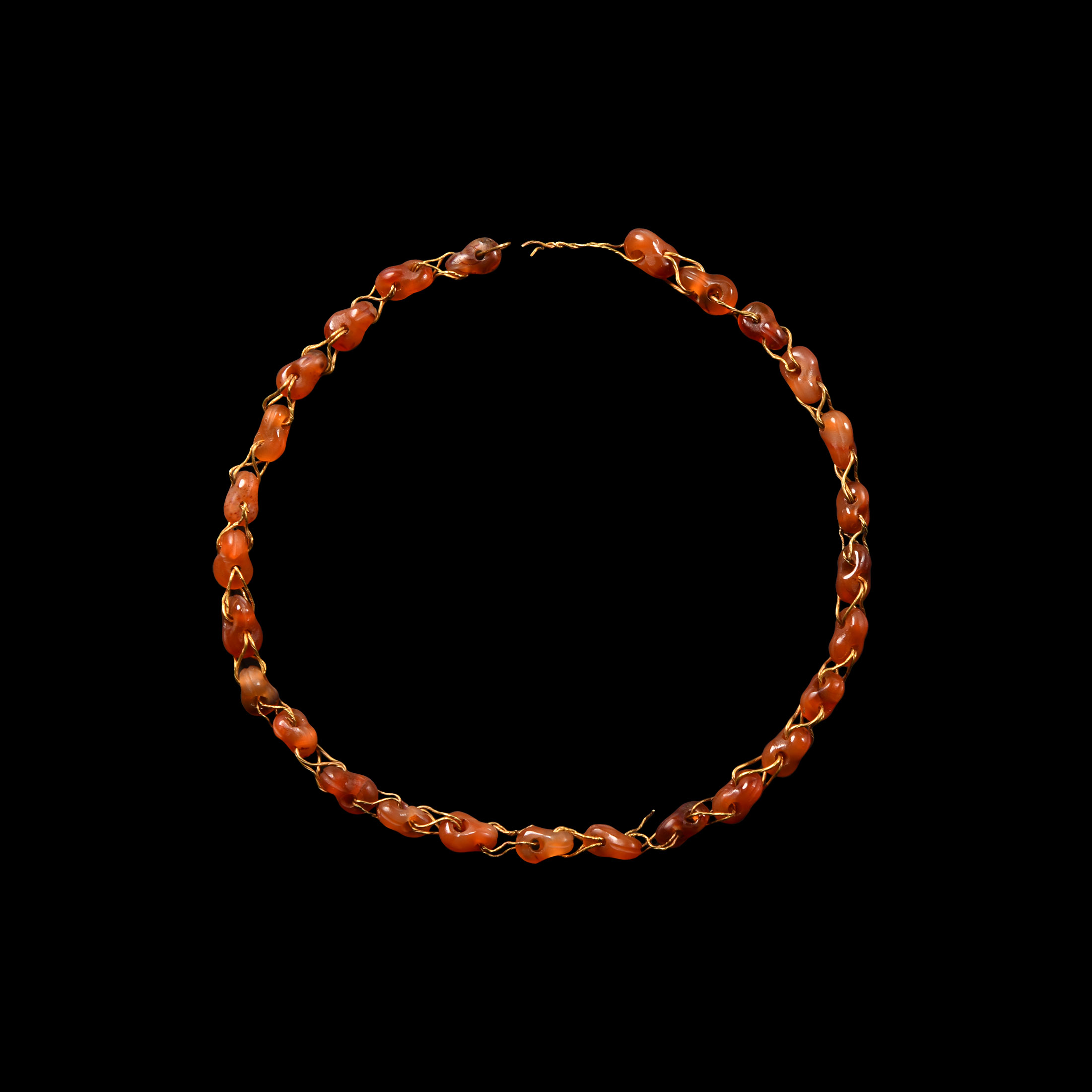
Greek Gold and Carnelian Necklace
1ST CENTURY B.C.-1ST CENTURY A.D.
10 1/4 in. (8.16 grams, 26 cm long).
A section of a necklace of carnelian drop-shaped beads, each pierced in two planes and linked loop-in-loop with thin twisted gold wires, possibly later.
ProvenanceThe Gans collection, Hebling Dec, Berlin, 1929.
with Christie's, New York, 8 December 1999, lot 51.
Accompanied by a copy of the relevant Christie's catalogue pages.
This lot has been checked against the Interpol Database of stolen works of art and is accompanied by search certificate no.11608-198969.
Cf. Jaeger, R., Die Sammlung Eduard Gans, Berlin, 1928, no. 97.
CONDITIONTimeLine Auctions follows a vetting process to ensure the authenticity and legality of all items, reinforcing our commitment to integrity and responsible trading. Each antiquity, antique, and coin lot undergoes thorough examination by a vetting committee of at least ten external specialists, professional trade association members, scientists, and archaeologists: Our Vetting Process
AUCTIONS:
TimeLine is a leading auction house specialising in antiquities, ancient art, collectables, natural history, coins, medals, and books. Our auctions offer museums, collectors, historians, and enthusiasts the opportunity to acquire unique and historically significant pieces.
LOT 0051
Greek Gold and Carnelian Necklace
Estimate £3,000 - 4,000€3,480 - 4,640 (for guidance only)$4,050 - 5,400 (for guidance only)
-
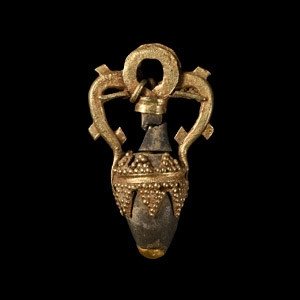
Greek Gold Dolphin Amphora Pendant
5th-3rd century B.C.Sold for (Inc. bp): £338
A gold amphora pendant composed of a piriform stone body with gold cap to foot and granulated triangles around the shoulder, stone beads forming the neck, gold rim and hoop above, gold dolphin handles. 2.19 grams, 23 mm
Acquired 1970-2010. Collection of a late Japanese gentleman. -
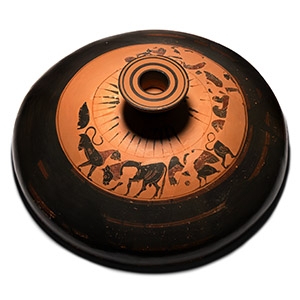
Huge Corinthian Black-Figure Lekanis Lid
6th century B.C.Estimate: £10,000 - 14,000 (‡+bp*)
Opening Bid: £5,000
An extremely large Corinthian or Attic black-figure ceramic lekanis lid with concentric bands to the rim and handle; to the tondo, a frieze of painted figures comprising a swan, a regardant lion, two opposed sphinxes, another regardant lion, another swan, a bull, a lioness and part of another bull(?); restored. 3.7 kg, 49.5 cm wide
Acquired early 1990s. Ex private American collection; thence by descent. Private Swiss collection since 1998. This lot has been checked against the Interpol Database of stolen works of art and is accompanied by search certificate no.11614-199000. -
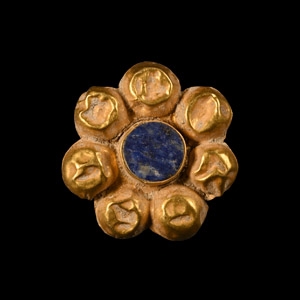
Greek Gold Rosette with Blue Stone
6th-4th century B.C.Sold for (Inc. bp): £130
A gold rosette jewellery element or appliqué formed from seven (squashed) bulbs arranged around a central circular cell set with a blue veined stone, likely lapis lazuli or sodalite. 0.48 grams, 14 mm
Acquired 1970-2010. Collection of a late Japanese gentleman.
