
Loading, please wait...
LOT 0124
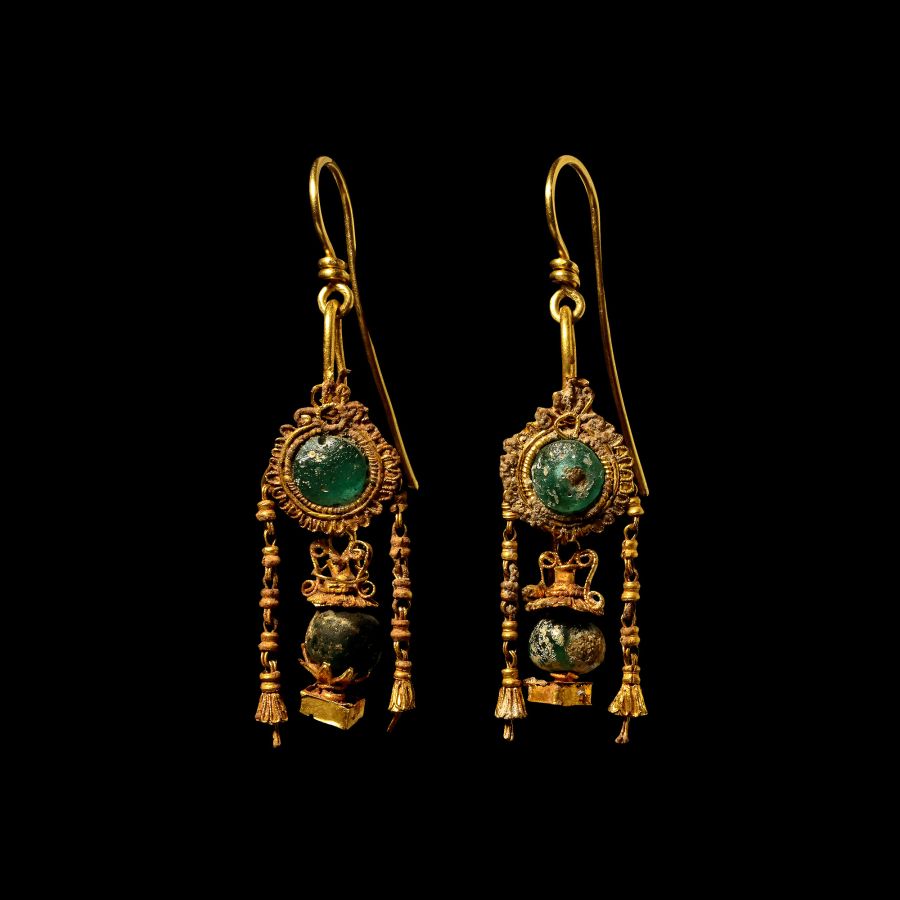
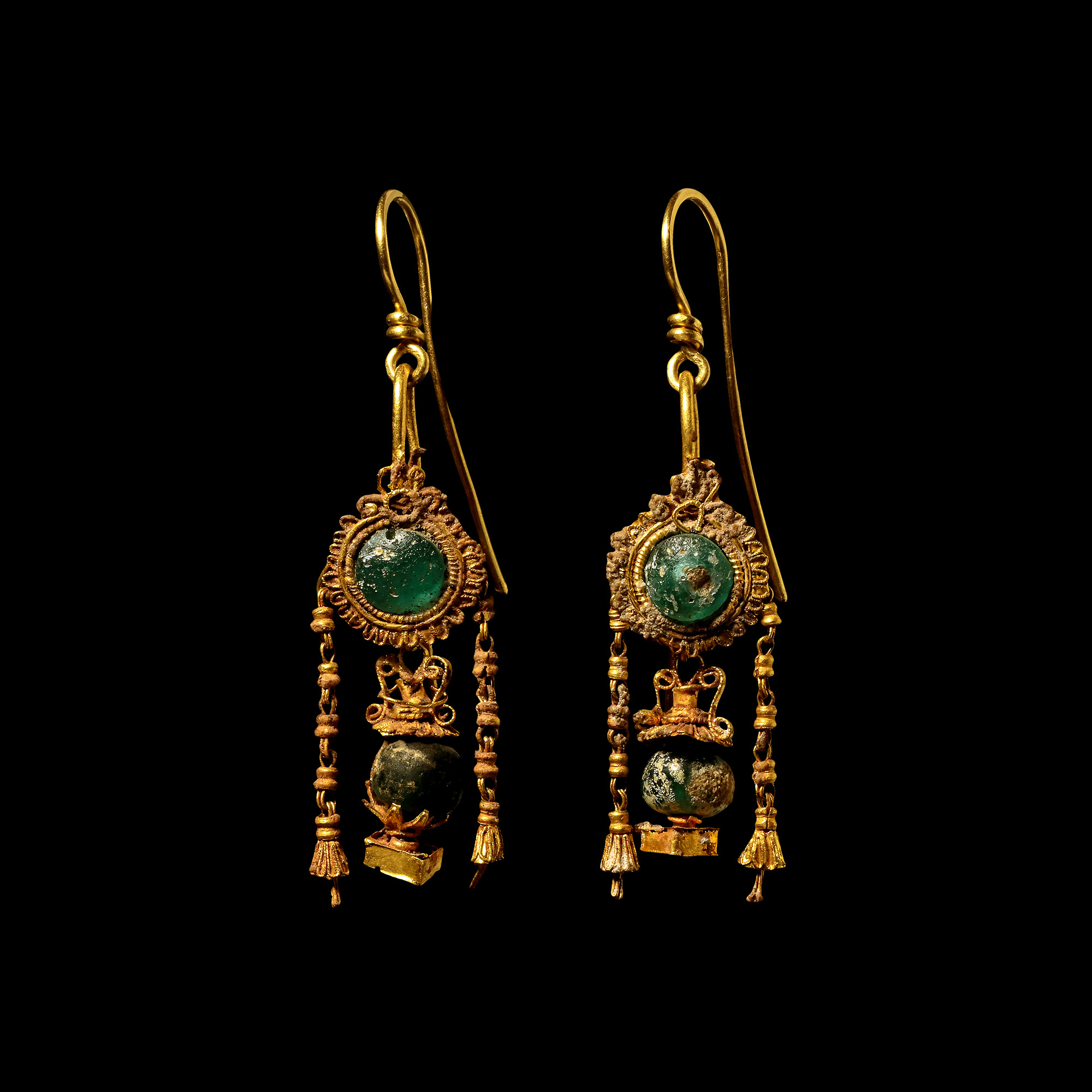
Greek Gold and Bead Drop Earrings
HELLENISTIC, 2ND-1ST CENTURY B.C.
1 3/4 in. (5.15 grams total, 46 mm each).
Matched pair of hooked wire earrings, each with an inset cabochon, articulated dangles and other ornaments. [2]
ProvenancePrivate American collection, 1970s-1980s.
with Robert Haber, New York, USA, circa 1990s.
Private collection, Europe.
Accompanied by a copy of an Art Loss Register certificate, 8 September 2004.
This lot has been checked against the Interpol Database of stolen works of art and is accompanied by search certificate number no.13187-249264.
See Ogden, J.M., Gold Jewellery in Ptolemaic, Roman and Byzantine Egypt, 2 vols., PhD thesis, Durham, 1990, V.2, fig.69, for a similar Hellenistic pair.
FootnotesThis pair belongs to the Hellenistic group of earrings with pendants, a broad group including pendants shaped as amphorae, birds, erotes and other exotic elements. Most of them come from sites around the Aegean or the Eastern Mediterranean and were probably produced in workshops in these regions. They usually date from the 2nd to the 1st centuries B.C.
CONDITIONTimeLine Auctions follows a vetting process to ensure the authenticity and legality of all items, reinforcing our commitment to integrity and responsible trading. Each antiquity, antique, and coin lot undergoes thorough examination by a vetting committee of at least ten external specialists, professional trade association members, scientists, and archaeologists: Our Vetting Process
AUCTIONS:
TimeLine is a leading auction house specialising in antiquities, ancient art, collectables, natural history, coins, medals, and books. Our auctions offer museums, collectors, historians, and enthusiasts the opportunity to acquire unique and historically significant pieces.
LOT 0124
Greek Gold and Bead Drop Earrings
Estimate £8,000 - 10,000€9,280 - 11,600 (for guidance only)$10,800 - 13,500 (for guidance only)
-
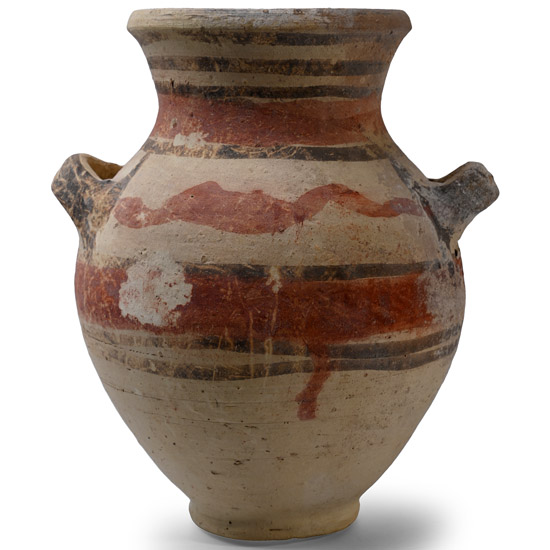
Eastern Mediterranean Two-Handled Vase
Iron Age, circa 6th century B.C. or laterSold for (Inc. bp): £221
With piriform body, broad neck and flared mouth with rolled rim, two lateral loop handles to the shoulder; painted circumferential bands. 593 grams, 19.3 cm
Property of a Northamptonshire collector. Acquired on the UK art market at auction in 2012. Property of a West Northamptonshire, UK, gentleman. -

Parthian Bronze Satyr Oil Lamp Section
1st century B.C.-1st century A.D.Estimate: £600 - 800 (+bp*)
Opening Bid: £300
Fragment comprising: tubular body with raised neck to the filler hole, everted rim and spur to reverse; raised tubular neck and head with pelletted collar, hair and bead, pinched nose, pellet eyes, crescent brow, goat's horn extending above in an arch to meet lateral extension from the brow and remains of similar to the other side; goat's legs below the body with hooves, pelletted bracket at the thigh and part of an arched extension connecting to the brow; nozzle to the forward edge and ovoid everted rim. 799 grams, 21 cm
Acquired before 1983. Ex London gallery, 1990s. Private collection, London, UK.
The theme of the item is similar to the classical satyr, part human and part goat. -
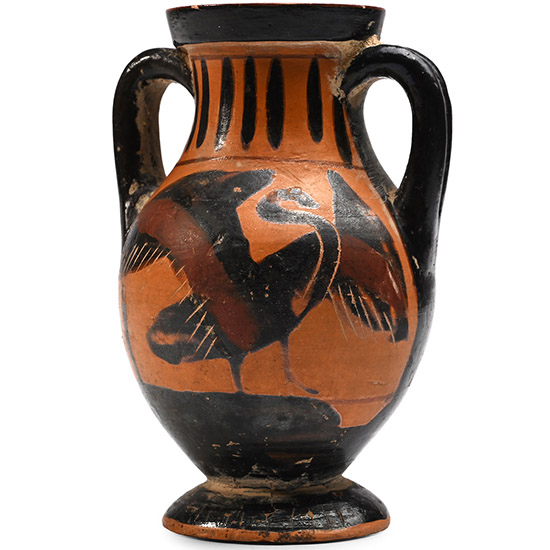
Greek Black-Figure Miniature Amphora with Swan
Attic, 6th-5th century B.C.Estimate: £4,000 - 6,000 (‡+bp*)
Opening Bid: £2,000
With two handles and an everted rim; parallel, vertical strokes on the neck and below a swan with its wings open and neck elegantly curved, a staff on the background. 57.1 grams, 76 mm
Swiss private collection, assembled in the 1960s and 1970s. Acquired by the present owner in 2004. Accompanied by an academic report by Dr Raffaele D’Amato. This lot has been checked against the Interpol Database of stolen works of art and is accompanied by a search certificate number no.13019-246754.
The swan was a favoured motif in Greek art, admired for its elegance and associations with divinity and beauty. In mythology, the bird was sacred to Apollo, god of music and light, whose chariot was said to be drawn by swans on his annual journey to the land of the Hyperboreans. It was likewise linked to Aphrodite, symbolising love and sensuality, and appears in scenes celebrating harmony and the ideal of beauty. The swan also featured prominently in the myth of Leda and the Swan, in which Zeus, transformed into the bird, inspired numerous representations across Greek art.
