
Loading, please wait...


LOT 0487
Greek Glass Head of an African Male
CARTHAGINIAN, 2ND CENTURY B.C.
5/8 in. (1.57 grams, 17 mm).
Moulded in the round in black glass with short hair, casting seam around the edges.
ProvenanceEx private collection of the late Mr S.M., London, UK, acquired 1979-1999, thence by descent.
Accompanied by a previously illustrated catalogue card with provenance.
Cf. Andrews, C., Amulets of Ancient Egypt, London, 1994, fig.15.
CONDITIONTimeLine Auctions follows a vetting process to ensure the authenticity and legality of all items, reinforcing our commitment to integrity and responsible trading. Each antiquity, antique, and coin lot undergoes thorough examination by a vetting committee of at least ten external specialists, professional trade association members, scientists, and archaeologists: Our Vetting Process
AUCTIONS:
TimeLine is a leading auction house specialising in antiquities, ancient art, collectables, natural history, coins, medals, and books. Our auctions offer museums, collectors, historians, and enthusiasts the opportunity to acquire unique and historically significant pieces.
-
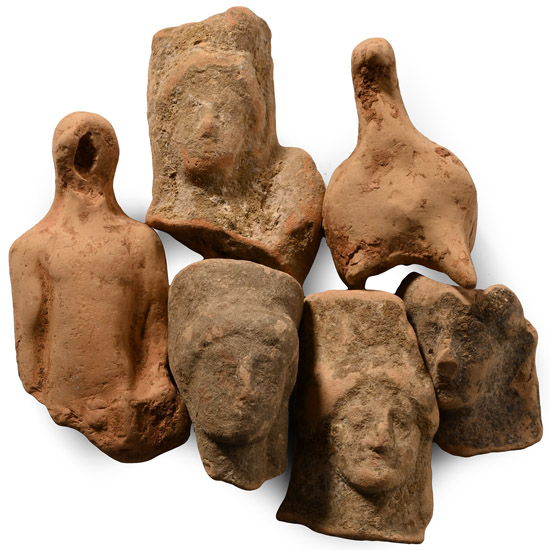
Greek Terracotta Head Collection
Circa 4th-2nd century B.C.Sold for (Inc. bp): £221
Comprising four head fragments, one fragment of the upper torso of a male, and a bird fragment. 116 grams total, 37-72 mm
From the collection of a Cambridge, UK, gentleman, by direct descent from his father, who acquired the items in London in circa 1960. -
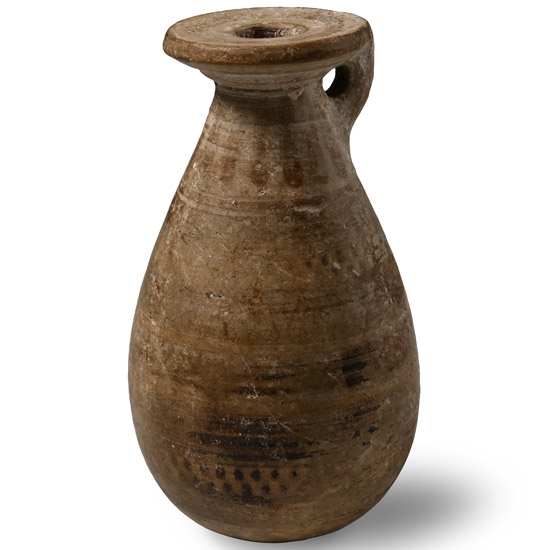
Greek Corinthian Terracotta Alabastron
Archaic Period, circa 600-575 B.B.Sold for (Inc. bp): £130
Ovoid body, short neck, disc-shaped rim, a vestigial handle with suspension hole, decorated with linear motifs such as tongues, lines and dots, all organised in zones. 48.3 grams, 74 mm
From the private collection of a Sussex, UK, gentleman. -

Parthian Carnelian Gemstone of a Goat-Headed Rhyton in Gold Ring
4th century B.C.-220 A.D.Estimate: £2,000 - 3,000 (+bp*)
Opening Bid: £1,000
Achaemenid or Parthian oval intaglio engraved with a style standing at the threshold between natural and stiff rigid linear style, depicting a goat-headed rhyton, the vessel terminating in the forepart of a wild goat with the front leg tucked under the body, the head rendered in profile with elegantly arched horns, pronounced muzzle, and carefully incised eye; the neck of the conical rhyton decorated with diagonal and cross-hatched incisions suggesting ribbing or chased metalwork; set in a modern gold ring with a small triangular area at the top left of the stone filled in with gold; supplied with a museum-quality impression. 8.51 grams, 24.02 mm overall, 21.18 mm internal diameter (approximate size British P, USA 7 1/2, Europe 16.23, Japan 15)
Acquired on the European art market. This lot has been checked against the Interpol Database of stolen works of art and is accompanied by search certificate number no.13356-257945.
The subject, a rhyton terminating in an animal protome, belongs to a well-established tradition in Eastern Greek and Achaemenid art of the late Archaic and Classical periods, in which zoomorphic libation vessels were used in ritual and ceremonial contexts. Goat-headed rhyta, though less commonly preserved in glyptic media, are attested in silver and ceramic examples, notably from Asia Minor and Thrace. The stylised horned animal, here likely a wild goat or ibex, is associated with vitality and mountain symbolism, while the rhyton itself signals elite drinking culture and votive use. The use of carnelian is typical of high-quality glyptic production in the 6th to 4th century BC, valued for its durability and ability to take a fine polish. The style and iconography suggest an Eastern Mediterranean origin, most probably Ionian or Anatolian.
