
Loading, please wait...

LOT 0059
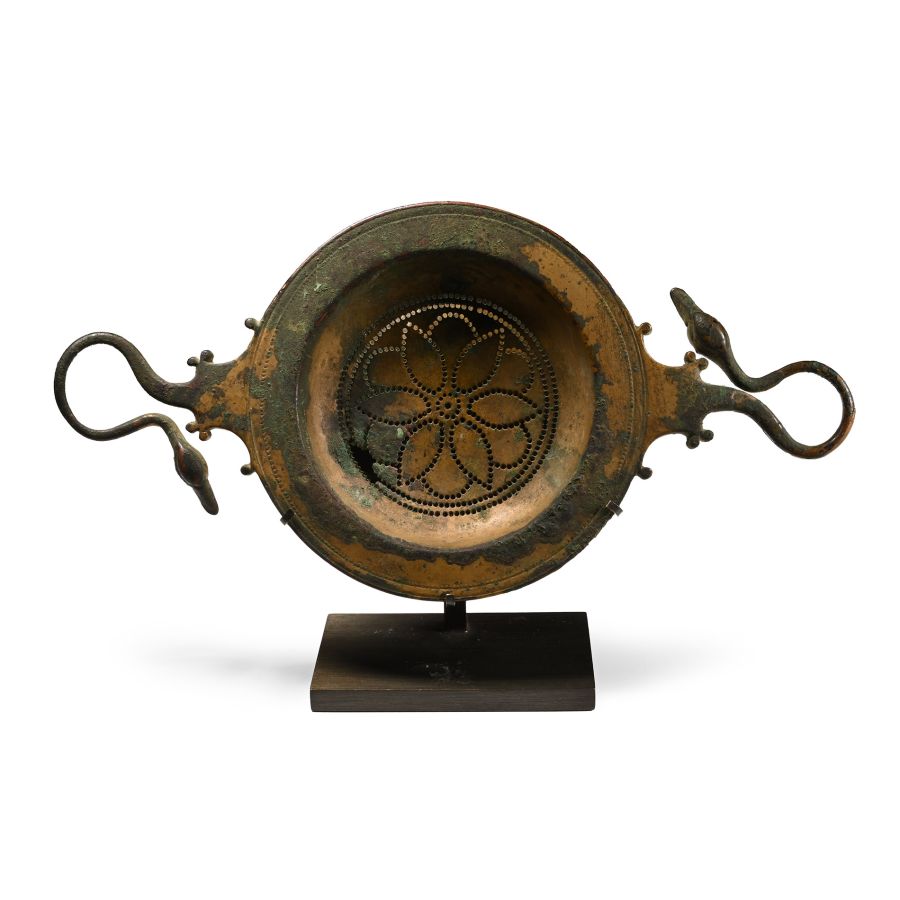
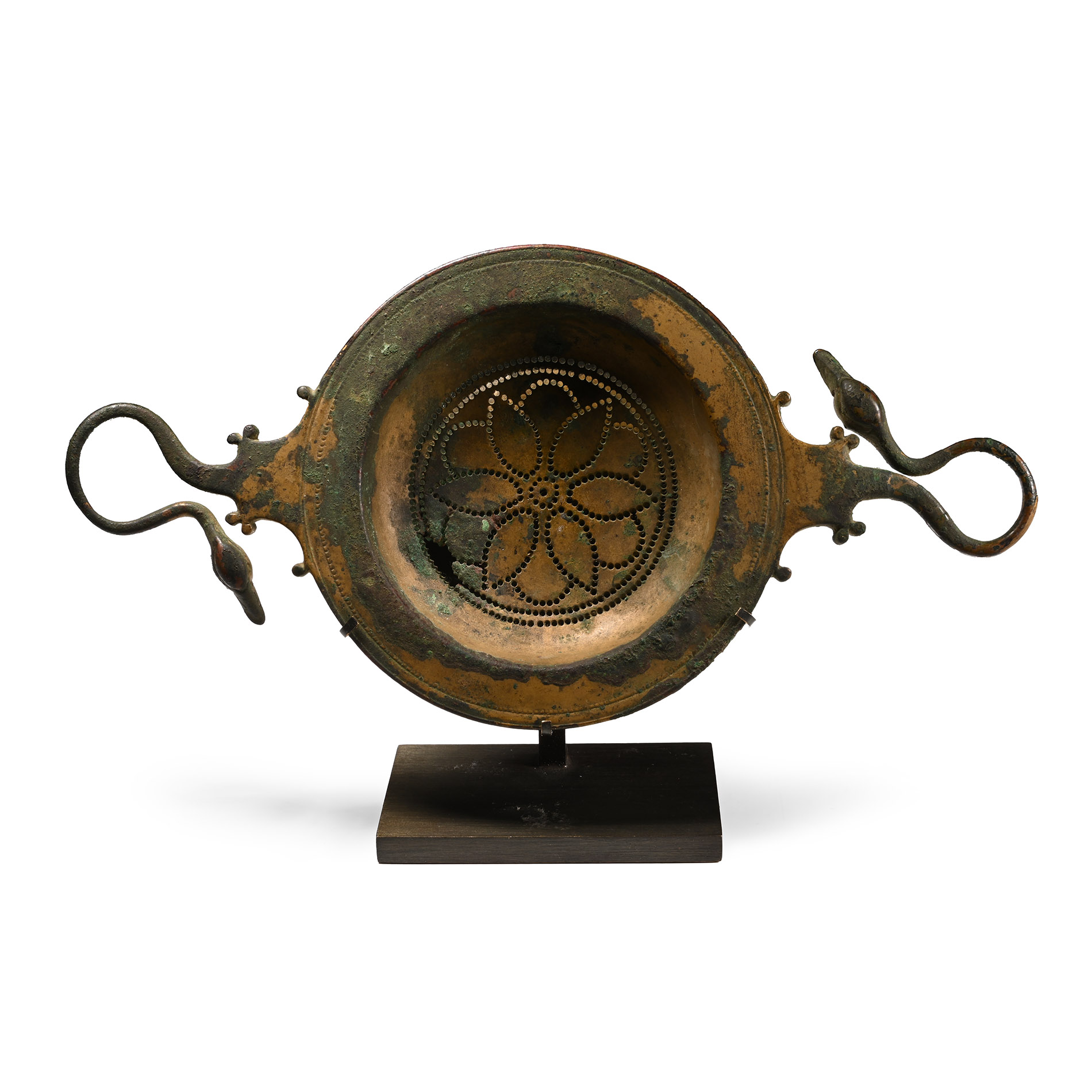
Greek Gilt Bronze Wine Strainer with Swan-Head Handles
4TH-3RD CENTURY B.C.
7 3/4 in. (402 grams total, 19.7 cm including stand).
Comprising a shallow bowl and broad flange rim, two integral scalloped handles with lateral scrolled flourishes, each tapering to a S-curved handle with swan-head terminals with incised eye and beak detailing; perforated whirl within roundel to interior base; accompanied by a custom-made display stand with mirror.
Provenancewith Hôtel des ventes de Belfort Sarl, October 2011, no.16.
Acquired by the present owner at the above sale.
Accompanied by an academic report by Dr Raffaele D'Amato.
This lot has been checked against the Interpol Database of stolen works of art and is accompanied by search certificate number no.12209-222140.
This lot has been cleared against the Art Loss Register database, and is accompanied by an illustrated lot declaration signed by the Head of the Antiquities Department, Dr Raffaele D’Amato.
Cf. Reeder, Ellen D., Hellenistic Art in the Walters Art Gallery, Baltimore, 1988, p.125, no.130, for similar examples and a general discussion of type; A Passion for Antiquities, Ancient Art from the collection of Barbera and Lawrence Fleischman, The J. Paul Getty Museum, Malibu, 1994, pp.77-78, no.31D; and The Search for Alexander, exhibition catalogue, 1980, p.167, no.130; the Metropolitan Museum of Art, accession number 1972.118.88, for a group containing a strainer with similar looped handle and bird head terminal; a similar specimen in the Walters Art Museum, accession number 57.910; a similar example in shape and quality can be seen in the ‘Tomb of the Prince’, in Pella, cf. Touratsoglou, I., Macedonia, History, Monuments, Museums, Athens, 1996, p.240, fig.312.
FootnotesElaborate gilded strainers, such as this present example, were used at symposia and festive occasions for the purpose of preventing the dregs of wine from entering the wine cup. This and other related silver utensils became popular in the later 4th and 3rd century B.C. These highly decorated wine strainers were fitted with dual handles forming loops in the shape of twisting animals, here a swan. Usually they took the form of a shallow dish complete with four rings of perforations in the centre in order to drain the wine. Strainers of this type were used to separate out sediments which could be found in the thick Greek wine. Examples similar to this one have been found in royal tombs in northern Greece, as well as the tomb of a monarch in Sudan.
CONDITIONTimeLine Auctions follows a vetting process to ensure the authenticity and legality of all items, reinforcing our commitment to integrity and responsible trading. Each antiquity, antique, and coin lot undergoes thorough examination by a vetting committee of at least ten external specialists, professional trade association members, scientists, and archaeologists: Our Vetting Process
AUCTIONS:
TimeLine is a leading auction house specialising in antiquities, ancient art, collectables, natural history, coins, medals, and books. Our auctions offer museums, collectors, historians, and enthusiasts the opportunity to acquire unique and historically significant pieces.
LOT 0059
Greek Gilt Bronze Wine Strainer with Swan-Head Handles
Estimate £8,000 - 10,000€9,280 - 11,600 (for guidance only)$10,800 - 13,500 (for guidance only)
-
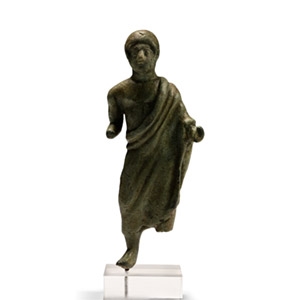
Etruscan Youth Presenting an Offering
Late 5th century B.C.Sold for (Inc. bp): £416
Bronze figure of a youth in contrapposto stance, wrapped in a long mantle revealing his right shoulder and muscular upper body; end of the mantle, with broad hem, draped over the left shoulder, angled right arm supporting an offering or patera (absent); left hand perhaps holding a lance or staff originally; hair worn short with ears exposed but covering the temples; facing straight ahead with wide-open eyes framed by finely drawn eyelids; right hand, left lower leg and foot absent, minor retouching to tip of the nose. 125 grams total, 10.4 cm including stand
Wladimir Rosenbaum, Ascona, before 1984. Accompanied by a copy of an Art Loss Register certificate no.S00092263. This lot is accompanied by an illustrated lot declaration signed by the Head of the Antiquities Department, Dr Raffaele D’Amato.
Wladimir Rosenbaum (1894-1984) was a prominent Swiss lawyer, art dealer, and collector based in Ascona, Switzerland. Renowned for his eclectic taste and intellectual pursuits, Rosenbaum assembled a distinguished collection of antiquities and modern art during his lifetime. His circle included influential artists, intellectuals, and dealers of the 20th century, and his legacy remains significant in the art world. This piece, part of his collection prior to 1984, reflects Rosenbaum's keen eye for rare and historically important objects, embodying his deep appreciation for the cultural and artistic achievements of the past. -
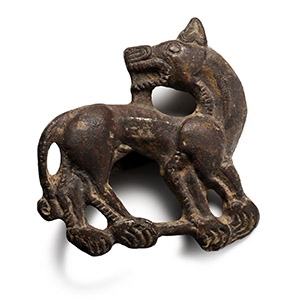
Scythian Silver Panther Looking Back Belt Mount
5th-3rd century B.C.Sold for (Inc. bp): £1,105
In regardant pose standing on a baseline, substantial slider-loop to reverse. 43.3 grams, 53 mm
Ex German art market, 2000s. Acquired from an EU collector living in London. From the collection of Surrey, UK, gentleman. This lot is accompanied by an illustrated lot declaration signed by the Head of the Antiquities Department, Dr Raffaele D’Amato. -
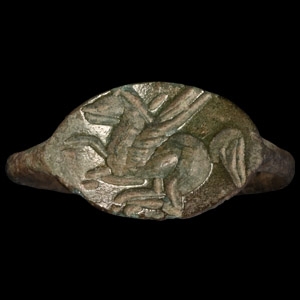
Greek Bronze Ring with Pegasus
5th-3rd century B.C.Sold for (Inc. bp): £286
Lentoid bezel with incuse winged horse motif. 1.33 grams, 19.42 mm overall, 16.97 mm internal diameter (approximate size British L, USA 5 3/4, Europe 11.24, Japan 10)
Ex German art market, 2000s. Acquired from an EU collector living in London. From the collection of Surrey, UK, gentleman. This lot is accompanied by an illustrated lot declaration signed by the Head of the Antiquities Department, Dr Raffaele D’Amato.
