
Loading, please wait...


LOT 0629
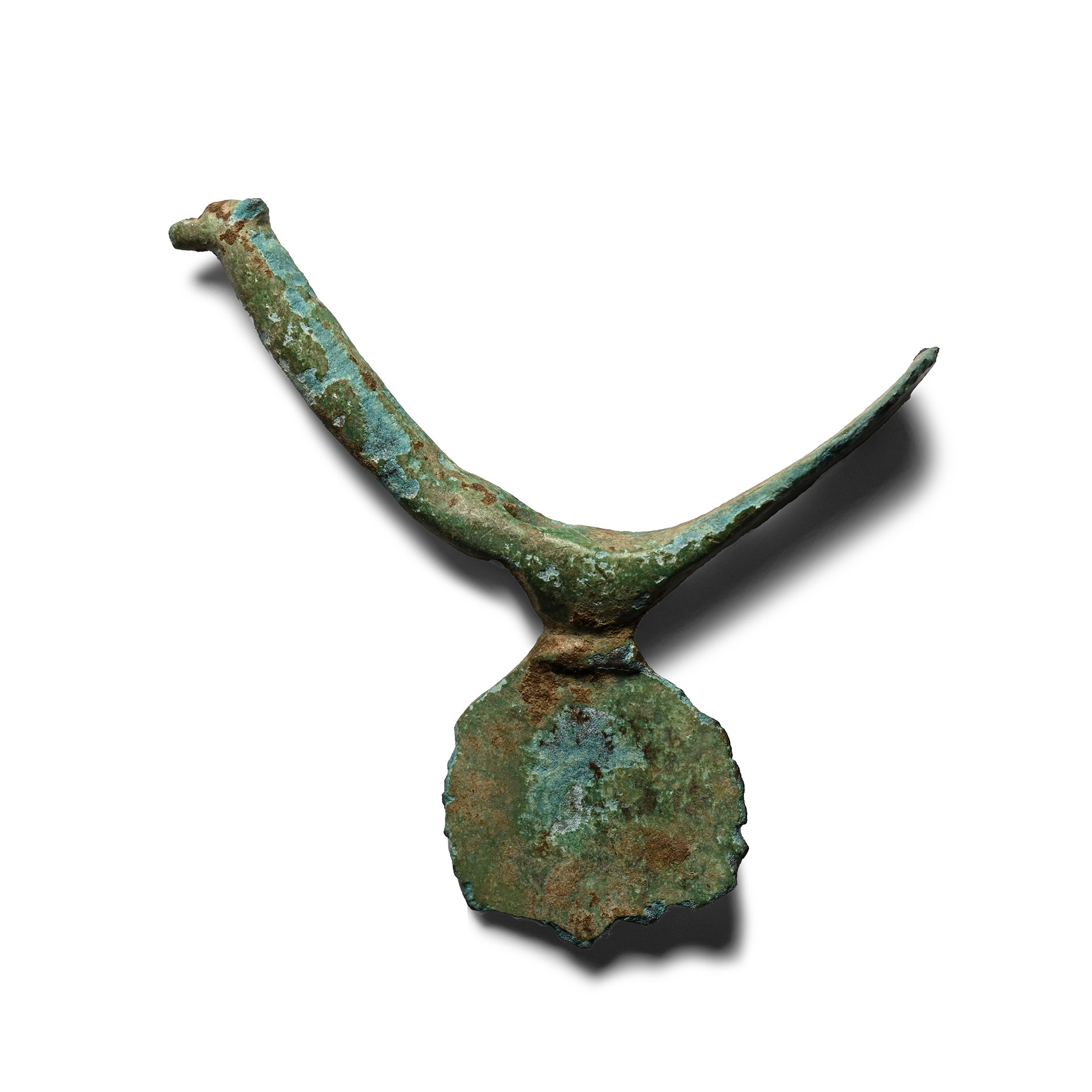
Greek Geometric Votive Gift in the Form of a Bird
8TH CENTURY B.C.
1 3/4 in. (8.47 grams, 46 mm).
Comprising a columnar neck with pinched detailing to the head and spatulate tail, discoid plate below.
Provenancewith Christie's, London, 25 January 2001, no.263 [Part].
Accompanied by a copy of an Art Loss Register certificate no.S00034403.
TimeLine Auctions follows a vetting process to ensure the authenticity and legality of all items, reinforcing our commitment to integrity and responsible trading. Each antiquity, antique, and coin lot undergoes thorough examination by a vetting committee of at least ten external specialists, professional trade association members, scientists, and archaeologists: Our Vetting Process
AUCTIONS:
TimeLine is a leading auction house specialising in antiquities, ancient art, collectables, natural history, coins, medals, and books. Our auctions offer museums, collectors, historians, and enthusiasts the opportunity to acquire unique and historically significant pieces.
LOT 0629
Greek Geometric Votive Gift in the Form of a Bird
Estimate £100 - 140€120 - 160 (for guidance only)$140 - 190 (for guidance only)
-
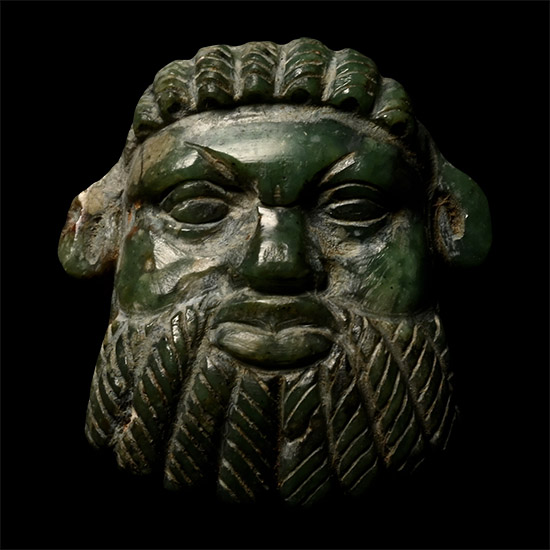
Greek Green Stone Bearded Face Amulet
400-300 B.C.Sold for (Inc. bp): £338
Finely carved head, featuring narrow eyes, a snub nose, full lips, a broad, stranded beard, and tightly curled hair rows; with a suspension loop behind the head. 4.16 grams, 20 mm
Private collection, England.
The facial features closely resemble those of Bes; the absence of Bes's characteristic plumed headdress is also evident in other amulets (Cf. Reisner, G.A., Catalogue général des antiquités égyptiennes du Musée du Caire, Nos.12528-13595, Vol. II, Amulets, Cairo, 1958, p. 16 (CG12649), pl. IV). -
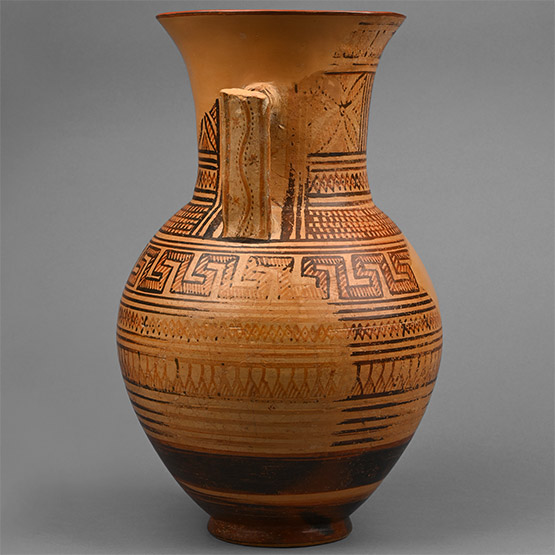
Large Greek Terracotta Oinochoe with Swastikas
Geometric, 8th century B.C.Estimate: £3,500 - 5,500 (‡+bp*)
Opening Bid: £1,800
With flared mouth, wide neck, bulbous body and ring foot, painted in brown and red matte glaze; geometric pattern spread over several registers separated by bundles of encircling stripes, triangles with hatching inside them, neck with metopes containing swastikas, rosettes and rhombuses with a band of rhombuses beneath; the shoulder with five line friezes arranged one above the other; the body decorated with meander and a band of rhombuses and triangles with hatching below, a broad black stripe (in places reddish as a result of misfiring) to the lower part; transition to the ring foot and ring foot painted black; wide strap handle attached to the shoulder and painted on the outside with a wavy line framed by dots, edge stripes and three small stars, the connecting bar patterned with stripes; museum-quality restoration. 2.04 kg, 35.5 cm
Ex Madame P., Paris. Accompanied by an academic report by Dr Raffaele D'Amato. This lot has been checked against the Interpol Database of stolen works of art and is accompanied by search certificate number no.12460-228686.
Vessels of the Geometric Period (900-700 BCE) are easily recognisable by their abstract decorative designs, which had their origin in woven textiles and baskets. While early period pottery typically has sparse geometric motifs on a black background, the amount of the decoration increased progressively to the point that objects from the late Geometric period are often entirely covered - in this example, even the strap handle. -
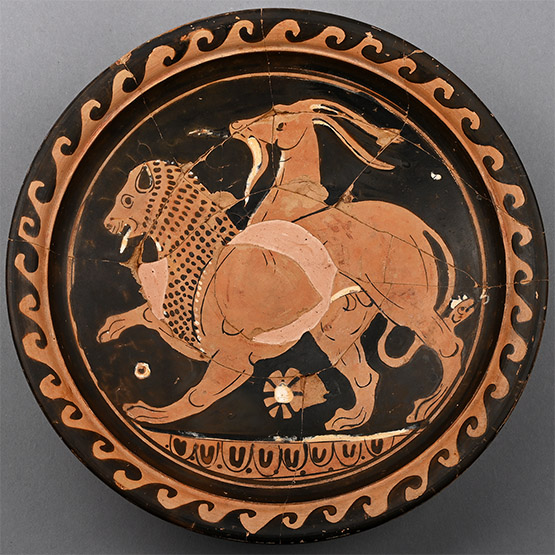
Greek Red-Figure Patera with Chimera
Apulian, 4th century B.C.Sold for (Inc. bp): £5,720
With curved rim, carinated profile and low foot; rim with reserved wave pattern, tondo with reserved ring enclosing a chimera in profile advancing on an egg-and-dart baseline; repaired and partly restored. 342 grams, 20.5 cm wide
Ex private North American collection. Acquired in the United States, 2010. Accompanied by an academic report by Dr Raffaele D'Amato. Accompanied by a thermoluminescence analysis report no.N126a12 from Oxford Authentication. This lot has been checked against the Interpol Database of stolen works of art and is accompanied by search certificate number no.13028-246781.
The legend of Bellerophon and the chimaera was a subject highly appreciated by the Greek ceramists. Red-figure Apulian plates depicting the chimaera were realised in South Italian workshops dating back to around 350-340 BC. The most famous example and possible prototype is the one held at the Musée du Louvre in Paris, created using the red-figure technique.
